 Add to Chrome
 Add to Firefox
 Add to Edge
ARC-TGI: Human-Validated Task Generators with Reasoning Chain Templates for ARC-AGI
Mar 05, 2026
The Abstraction and Reasoning Corpus (ARC-AGI) probes few-shot abstraction and rule induction on small visual grids, but progress is difficult to measure on static collections of hand-authored puzzles due to overfitting, dataset leakage, and memorisation. We introduce ARC-TGI (ARC Task Generators Inventory), an open-source framework for task-family generators: compact Python programs that sample diverse ARC-AGI tasks while preserving a latent rule. ARC-TGI is built around a solver-facing representation: each generated task is paired with natural-language input and transformation reasoning chains and partially evaluated Python code implementing sampling, transformation, and episode construction. Crucially, ARC-TGI supports task-level constraints so that training examples collectively expose the variations needed to infer the underlying rule, a requirement for human-solvable ARC tasks that independent per-example sampling often fails to guarantee. All generators undergo human refinement and local verification to keep both grids and reasoning traces natural and consistent under variation. We release 461 generators covering 180 ARC-Mini tasks, 215 ARC-AGI-1 tasks (200 train, 15 test), and 66 ARC-AGI-2 tasks (55 train, 11 test), enabling scalable dataset sampling and controlled benchmarking.

Integrating Single-Cell Foundation Models with Graph Neural Networks for Drug Response Prediction
Apr 19, 2025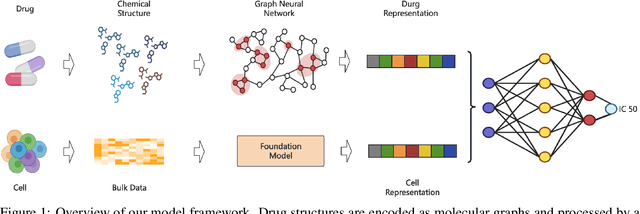
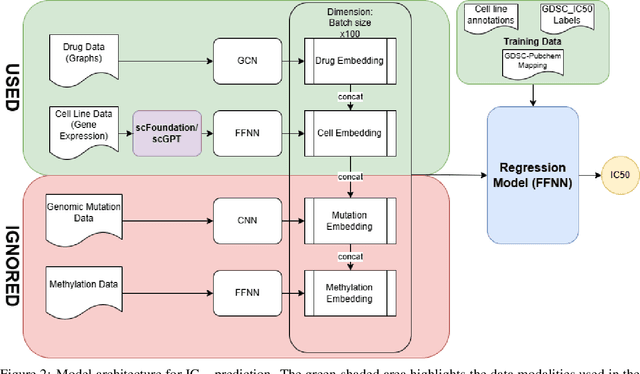
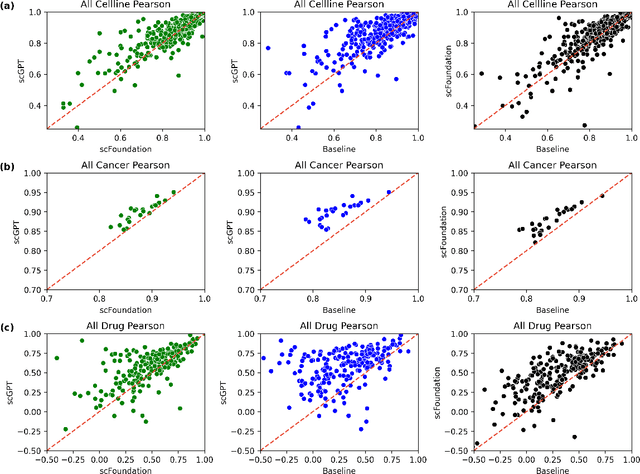
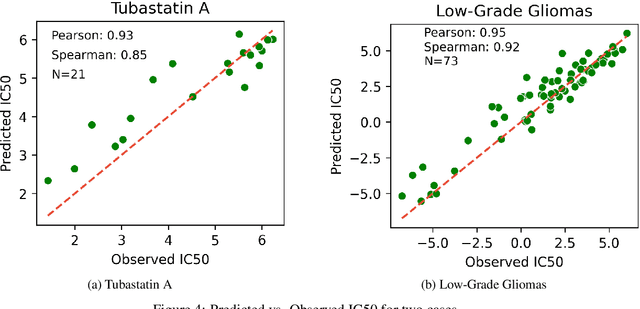
In this study, we propose an innovative methodology for predicting Cancer Drug Response (CDR) through the integration of the scGPT foundation model within the DeepCDR model. Our approach utilizes scGPT to generate embeddings from gene expression data, which are then used as gene expression input data for DeepCDR. The experimental findings demonstrate the efficacy of this scGPT-based method in outperforming previous related works, including the original DeepCDR model and the scFoundation-based model. This study highlights the potential of scGPT embeddings to enhance the accuracy of CDR predictions and offers a promising alternative to existing approaches.