 Add to Chrome
 Add to Firefox
 Add to Edge
Prompt Compression in the Wild: Measuring Latency, Rate Adherence, and Quality for Faster LLM Inference
Apr 03, 2026
With the wide adoption of language models for IR -- and specifically RAG systems -- the latency of the underlying LLM becomes a crucial bottleneck, since the long contexts of retrieved passages lead large prompts and therefore, compute increase. Prompt compression, which reduces the size of input prompts while aiming to preserve performance on downstream tasks, has established itself as a cost-effective and low-latency method for accelerating inference in large language models. However, its usefulness depends on whether the additional preprocessing time during generation is offset by faster decoding. We present the first systematic, large-scale study of this trade-off, with thousands of runs and 30,000 queries across several open-source LLMs and three GPU classes. Our evaluation separates compression overhead from decoding latency while tracking output quality and memory usage. LLMLingua achieves up to 18% end-to-end speed-ups, when prompt length, compression ratio, and hardware capacity are well matched, with response quality remaining statistically unchanged across summarization, code generation, and question answering tasks. Outside this operating window, however, the compression step dominates and cancels out the gains. We also show that effective compression can reduce memory usage enough to offload workloads from data center GPUs to commodity cards, with only a 0.3s increase in latency. Our open-source profiler predicts the latency break-even point for each model-hardware setup, providing practical guidance on when prompt compression delivers real-world benefits.

Tokenizer Choice For LLM Training: Negligible or Crucial?
Oct 18, 2023
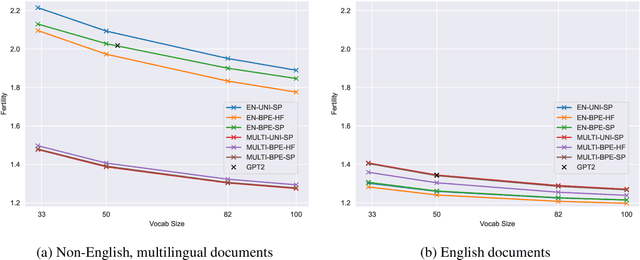


The recent success of LLMs has been predominantly driven by curating the training dataset composition, scaling of model architectures and dataset sizes and advancements in pretraining objectives, leaving tokenizer influence as a blind spot. Shedding light on this underexplored area, we conduct a comprehensive study on the influence of tokenizer choice on LLM downstream performance by training 24 mono- and multilingual LLMs at a 2.6B parameter scale, ablating different tokenizer algorithms and parameterizations. Our studies highlight that the tokenizer choice can significantly impact the model's downstream performance, training and inference costs. In particular, we find that the common tokenizer evaluation metrics fertility and parity are not always predictive of model downstream performance, rendering these metrics a questionable proxy for the model's downstream performance. Furthermore, we show that multilingual tokenizers trained on the five most frequent European languages require vocabulary size increases of factor three in comparison to English. While English-only tokenizers have been applied to the training of multi-lingual LLMs, we find that this approach results in a severe downstream performance degradation and additional training costs of up to 68%, due to an inefficient tokenization vocabulary.