 Add to Chrome
 Add to Firefox
 Add to Edge
Agentic Discovery of Non-Canonical Antimicrobial Peptides with AMPGAN v3
Jun 15, 2026
Antimicrobial resistance causes to over a million deaths annually. Antimicrobial peptides (AMPs) are a promising solution, but generative AMP models are not yet ready to design peptides with non-natural amino acids and/or chemical modifications, which are essential for real-world peptide drugs. We present AMPGAN v3, a multi-objective conditional GAN that expands the generative vocabulary to D-amino acids and N/C-terminus modifications such as amidation. By separating adversarial and activity-aware supervision across two specialized discriminators, AMPGAN v3 substantially improves training stability and outperforms prior generative AMP models on external classifiers. We validated five candidates spanning three structural classes in vitro; two showed activity against Gram-positive strains, with the best candidate reaching MIC 8 μg/mL against B. subtilis. To support downstream curation, we further present PepCraft, a multi-agent framework for end-to-end AMP discovery in which a Planning Agent orchestrates specialized executors for generation, filtering, and verification. Its prioritization recommendations align with our in vitro outcomes. Together, these contributions let us examine, on a small but real scale, how generative and agentic AI compose in therapeutic peptide discovery. Code: https://github.com/marszzibros/AMPGANv3

Autonomous Skeletal Landmark Localization towards Agentic C-Arm Control
Apr 20, 2026Purpose: Automated C-arm positioning ensures timely treatment in patients requiring emergent interventions. When a conventional Deep Learning (DL) approach for C-arm control fails, clinicians must revert to manual operation, resulting in additional delays. Consequently, an agentic C-arm control framework based on multimodal large language models (MLLMs) is highly desirable, as it can incorporate clinician feedback and use reasoning to make adjustments toward more accurate positioning. Skeletal landmark localization is essential for C-arm control, and we investigate adapting MLLMs for autonomous landmark localization. Methods: We used an annotated synthetic X-ray dataset and a real X-ray dataset. Each X-ray in both datasets is paired with several skeletal landmarks. We fine-tuned two MLLMs and tasked them with retrieving the closest landmarks from each X-ray. Quantitative evaluations of landmark localization were performed and compared against a leading DL approach. We further conducted qualitative experiments demonstrating: (1) how an MLLM can correct an initially incorrect prediction through reasoning, and (2) how the MLLM can sequentially navigate the C-arm toward a target location. Results: On both datasets, fine-tuned MLLMs demonstrate competitive performance across all localization tasks when compared with the DL approach. In the qualitative experiments, the MLLMs provide evidence of reasoning and spatial awareness. Conclusion: This study shows that fine-tuned MLLMs achieve accurate skeletal landmark localization and hold promise for agentic autonomous C-arm control. Our code is available athttps://github.com/marszzibros/C-arm-localization-LLMs.git
Turning Generators into Retrievers: Unlocking MLLMs for Natural Language-Guided Geo-Localization
Apr 12, 2026Natural-language Guided Cross-view Geo-localization (NGCG) aims to retrieve geo-tagged satellite imagery using textual descriptions of ground scenes. While recent NGCG methods commonly rely on CLIP-style dual-encoder architectures, they often suffer from weak cross-modal generalization and require complex architectural designs. In contrast, Multimodal Large Language Models (MLLMs) offer powerful semantic reasoning capabilities but are not directly optimized for retrieval tasks. In this work, we present a simple yet effective framework to adapt MLLMs for NGCG via parameter-efficient finetuning. Our approach optimizes latent representations within the MLLM while preserving its pretrained multimodal knowledge, enabling strong cross-modal alignment without redesigning model architectures. Through systematic analysis of diverse variables, from model backbone to feature aggregation, we provide practical and generalizable insights for leveraging MLLMs in NGCG. Our method achieves SOTA on GeoText-1652 with a 12.2% improvement in Text-to-Image Recall@1 and secures top performance in 5 out of 12 subtasks on CVG-Text, all while surpassing baselines with far fewer trainable parameters. These results position MLLMs as a robust foundation for semantic cross-view retrieval and pave the way for MLLM-based NGCG to be adopted as a scalable, powerful alternative to traditional dual-encoder designs. Project page and code are available at https://yuqichen888.github.io/NGCG-MLLMs-web/.
Geo$^\textbf{2}$: Geometry-Guided Cross-view Geo-Localization and Image Synthesis
Mar 26, 2026Cross-view geo-spatial learning consists of two important tasks: Cross-View Geo-Localization (CVGL) and Cross-View Image Synthesis (CVIS), both of which rely on establishing geometric correspondences between ground and aerial views. Recent Geometric Foundation Models (GFMs) have demonstrated strong capabilities in extracting generalizable 3D geometric features from images, but their potential in cross-view geo-spatial tasks remains underexplored. In this work, we present Geo^2, a unified framework that leverages Geometric priors from GFMs (e.g., VGGT) to jointly perform geo-spatial tasks, CVGL and bidirectional CVIS. Despite the 3D reconstruction ability of GFMs, directly applying them to CVGL and CVIS remains challenging due to the large viewpoint gap between ground and aerial imagery. We propose GeoMap, which embeds ground and aerial features into a shared 3D-aware latent space, effectively reducing cross-view discrepancies for localization. This shared latent space naturally bridges cross-view image synthesis in both directions. To exploit this, we propose GeoFlow, a flow-matching model conditioned on geometry-aware latent embeddings. We further introduce a consistency loss to enforce latent alignment between the two synthesis directions, ensuring bidirectional coherence. Extensive experiments on standard benchmarks, including CVUSA, CVACT, and VIGOR, demonstrate that Geo^2 achieves state-of-the-art performance in both localization and synthesis, highlighting the effectiveness of 3D geometric priors for cross-view geo-spatial learning.
GeoFlow: Real-Time Fine-Grained Cross-View Geolocalization via Iterative Flow Prediction
Mar 23, 2026Accurate and fast localization is vital for safe autonomous navigation in GPS-denied areas. Fine-Grained Cross-View Geolocalization (FG-CVG) aims to estimate the precise 2-Degree-of-Freedom (2-DoF) location of a ground image relative to a satellite image. However, current methods force a difficult trade-off, with high-accuracy models being slow for real-time use. In this paper, we introduce GeoFlow, a new approach that offers a lightweight and highly efficient framework that breaks this accuracy-speed trade-off. Our technique learns a direct probabilistic mapping, predicting the displacement (in distance and direction) required to correct any given location hypothesis. This is complemented by our novel inference algorithm, Iterative Refinement Sampling (IRS). Instead of trusting a single prediction, IRS refines a population of hypotheses, allowing them to iteratively 'flow' from random starting points to a robust, converged consensus. Even its iterative nature, this approach offers flexible inference-time scaling, allowing a direct trade-off between performance and computation without any re-training. Experiments on the KITTI and VIGOR datasets show that GeoFlow achieves state-of-the-art efficiency, running at real-time speeds of 29 FPS while maintaining competitive localization accuracy. This work opens a new path for the development of practical real-time geolocalization systems.
Spatially-Adaptive Conformal Graph Transformer for Indoor Localization in Wi-Fi Driven Networks
Jan 29, 2026Indoor localization is a critical enabler for a wide range of location-based services in smart environments, including navigation, asset tracking, and safety-critical applications. Recent graph-based models leverage spatial relationships between Wire-less Fidelity (Wi-Fi) Access Points (APs) and devices, offering finer localization granularity, but fall short in quantifying prediction uncertainty, a key requirement for real-world deployment. In this paper, we propose Spatially-Adaptive Conformal Graph Transformer (SAC-GT), a framework for accurate and reliable indoor localization. SAC-GT integrates a Graph Transformer (GT) model that captures network's spatial topology and signal strength dynamics, with a novel Spatially-Adaptive Conformal Prediction (SACP) method that provides region-specific uncertainty estimates. This allows SAC-GT to produce not only precise two-dimensional (2D) location predictions but also statistically valid confidence regions tailored to varying environmental conditions. Extensive evaluations on a large-scale real-world dataset demonstrate that the proposed SAC-GT solution achieves state-of-the-art localization accuracy while delivering robust and spatially adaptive reliability guarantees.
Cross-View Meets Diffusion: Aerial Image Synthesis with Geometry and Text Guidance
Aug 08, 2024Aerial imagery analysis is critical for many research fields. However, obtaining frequent high-quality aerial images is not always accessible due to its high effort and cost requirements. One solution is to use the Ground-to-Aerial (G2A) technique to synthesize aerial images from easily collectible ground images. However, G2A is rarely studied, because of its challenges, including but not limited to, the drastic view changes, occlusion, and range of visibility. In this paper, we present a novel Geometric Preserving Ground-to-Aerial (G2A) image synthesis (GPG2A) model that can generate realistic aerial images from ground images. GPG2A consists of two stages. The first stage predicts the Bird's Eye View (BEV) segmentation (referred to as the BEV layout map) from the ground image. The second stage synthesizes the aerial image from the predicted BEV layout map and text descriptions of the ground image. To train our model, we present a new multi-modal cross-view dataset, namely VIGORv2 which is built upon VIGOR with newly collected aerial images, maps, and text descriptions. Our extensive experiments illustrate that GPG2A synthesizes better geometry-preserved aerial images than existing models. We also present two applications, data augmentation for cross-view geo-localization and sketch-based region search, to further verify the effectiveness of our GPG2A. The code and data will be publicly available.
GeoDTR+: Toward generic cross-view geolocalization via geometric disentanglement
Aug 18, 2023Cross-View Geo-Localization (CVGL) estimates the location of a ground image by matching it to a geo-tagged aerial image in a database. Recent works achieve outstanding progress on CVGL benchmarks. However, existing methods still suffer from poor performance in cross-area evaluation, in which the training and testing data are captured from completely distinct areas. We attribute this deficiency to the lack of ability to extract the geometric layout of visual features and models' overfitting to low-level details. Our preliminary work introduced a Geometric Layout Extractor (GLE) to capture the geometric layout from input features. However, the previous GLE does not fully exploit information in the input feature. In this work, we propose GeoDTR+ with an enhanced GLE module that better models the correlations among visual features. To fully explore the LS techniques from our preliminary work, we further propose Contrastive Hard Samples Generation (CHSG) to facilitate model training. Extensive experiments show that GeoDTR+ achieves state-of-the-art (SOTA) results in cross-area evaluation on CVUSA, CVACT, and VIGOR by a large margin ($16.44\%$, $22.71\%$, and $17.02\%$ without polar transformation) while keeping the same-area performance comparable to existing SOTA. Moreover, we provide detailed analyses of GeoDTR+.
Cross-view Geo-localization via Learning Disentangled Geometric Layout Correspondence
Dec 20, 2022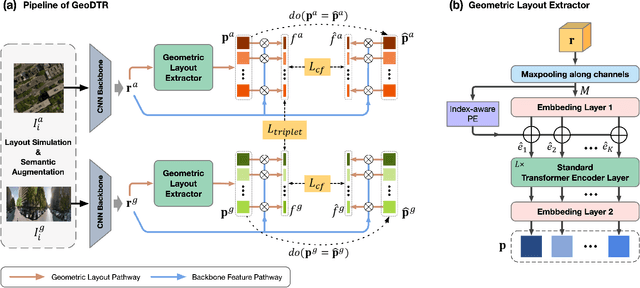
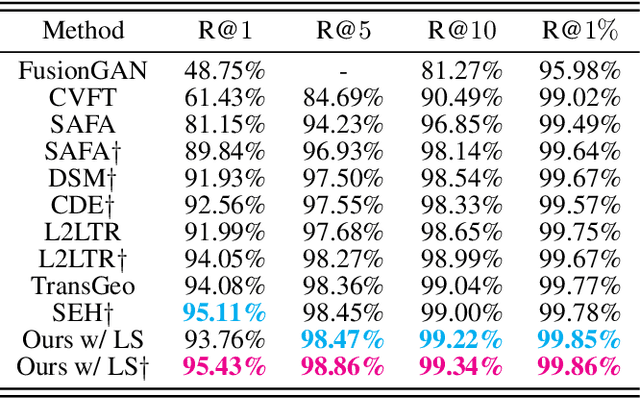
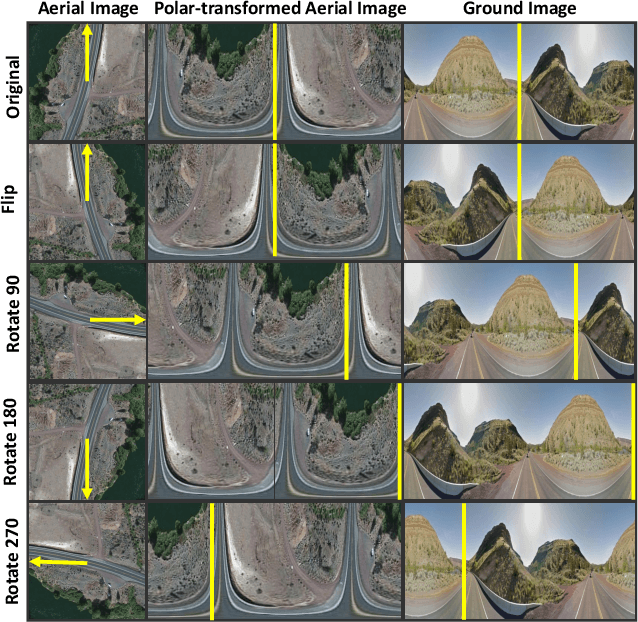
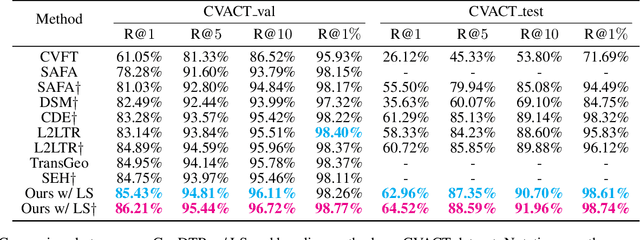
Cross-view geo-localization aims to estimate the location of a query ground image by matching it to a reference geo-tagged aerial images database. As an extremely challenging task, its difficulties root in the drastic view changes and different capturing time between two views. Despite these difficulties, recent works achieve outstanding progress on cross-view geo-localization benchmarks. However, existing methods still suffer from poor performance on the cross-area benchmarks, in which the training and testing data are captured from two different regions. We attribute this deficiency to the lack of ability to extract the spatial configuration of visual feature layouts and models' overfitting on low-level details from the training set. In this paper, we propose GeoDTR which explicitly disentangles geometric information from raw features and learns the spatial correlations among visual features from aerial and ground pairs with a novel geometric layout extractor module. This module generates a set of geometric layout descriptors, modulating the raw features and producing high-quality latent representations. In addition, we elaborate on two categories of data augmentations, (i) Layout simulation, which varies the spatial configuration while keeping the low-level details intact. (ii) Semantic augmentation, which alters the low-level details and encourages the model to capture spatial configurations. These augmentations help to improve the performance of the cross-view geo-localization models, especially on the cross-area benchmarks. Moreover, we propose a counterfactual-based learning process to benefit the geometric layout extractor in exploring spatial information. Extensive experiments show that GeoDTR not only achieves state-of-the-art results but also significantly boosts the performance on same-area and cross-area benchmarks.
Cross-View Image Sequence Geo-localization
Nov 02, 2022Cross-view geo-localization aims to estimate the GPS location of a query ground-view image by matching it to images from a reference database of geo-tagged aerial images. To address this challenging problem, recent approaches use panoramic ground-view images to increase the range of visibility. Although appealing, panoramic images are not readily available compared to the videos of limited Field-Of-View (FOV) images. In this paper, we present the first cross-view geo-localization method that works on a sequence of limited FOV images. Our model is trained end-to-end to capture the temporal structure that lies within the frames using the attention-based temporal feature aggregation module. To robustly tackle different sequences length and GPS noises during inference, we propose to use a sequential dropout scheme to simulate variant length sequences. To evaluate the proposed approach in realistic settings, we present a new large-scale dataset containing ground-view sequences along with the corresponding aerial-view images. Extensive experiments and comparisons demonstrate the superiority of the proposed approach compared to several competitive baselines.