 Add to Chrome
 Add to Firefox
 Add to Edge
A Role-Based LLM Framework for Structured Information Extraction from Healthy Food Policies
Apr 02, 2026
Current Large Language Model (LLM) approaches for information extraction (IE) in the healthy food policy domain are often hindered by various factors, including misinformation, specifically hallucinations, misclassifications, and omissions that result from the structural diversity and inconsistency of policy documents. To address these limitations, this study proposes a role-based LLM framework that automates the IE from unstructured policy data by assigning specialized roles: an LLM policy analyst for metadata and mechanism classification, an LLM legal strategy specialist for identifying complex legal approaches, and an LLM food system expert for categorizing food system stages. This framework mimics expert analysis workflows by incorporating structured domain knowledge, including explicit definitions of legal mechanisms and classification criteria, into role-specific prompts. We evaluate the framework using 608 healthy food policies from the Healthy Food Policy Project (HFPP) database, comparing its performance against zero-shot, few-shot, and chain-of-thought (CoT) baselines using Llama-3.3-70B. Our proposed framework demonstrates superior performance in complex reasoning tasks, offering a reliable and transparent methodology for automating IE from health policies.

Team, Then Trim: An Assembly-Line LLM Framework for High-Quality Tabular Data Generation
Feb 04, 2026While tabular data is fundamental to many real-world machine learning (ML) applications, acquiring high-quality tabular data is usually labor-intensive and expensive. Limited by the scarcity of observations, tabular datasets often exhibit critical deficiencies, such as class imbalance, selection bias, and low fidelity. To address these challenges, building on recent advances in Large Language Models (LLMs), this paper introduces Team-then-Trim (T$^2$), a framework that synthesizes high-quality tabular data through a collaborative team of LLMs, followed by a rigorous three-stage plug-in data quality control (QC) pipeline. In T$^2$, tabular data generation is conceptualized as a manufacturing process: specialized LLMs, guided by domain knowledge, are tasked with generating different data components sequentially, and the resulting products, i.e., the synthetic data, are systematically evaluated across multiple dimensions of QC. Empirical results on both simulated and real-world datasets demonstrate that T$^2$ outperforms state-of-the-art methods in producing high-quality tabular data, highlighting its potential to support downstream models when direct data collection is practically infeasible.
SmartHome-Bench: A Comprehensive Benchmark for Video Anomaly Detection in Smart Homes Using Multi-Modal Large Language Models
Jun 15, 2025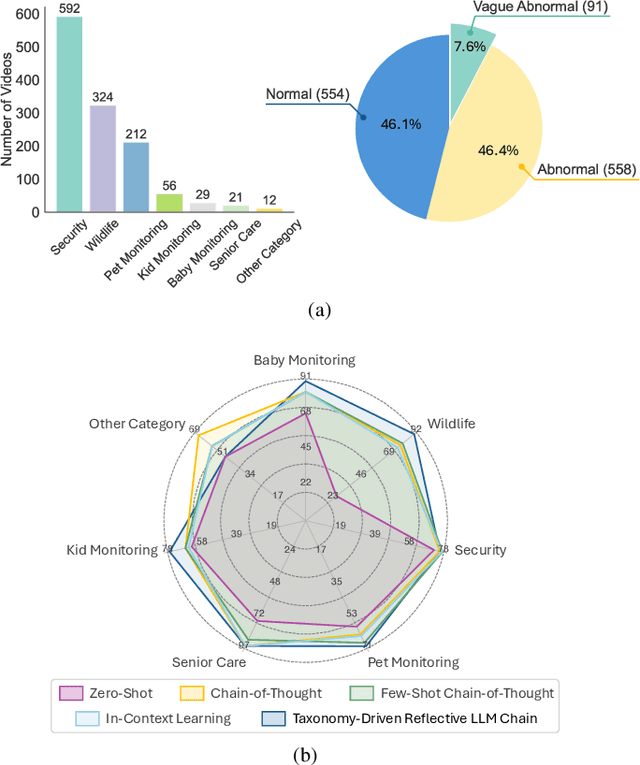
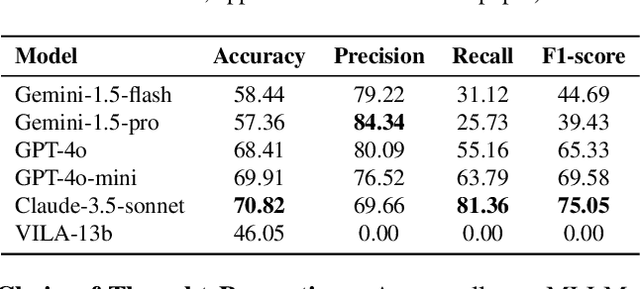
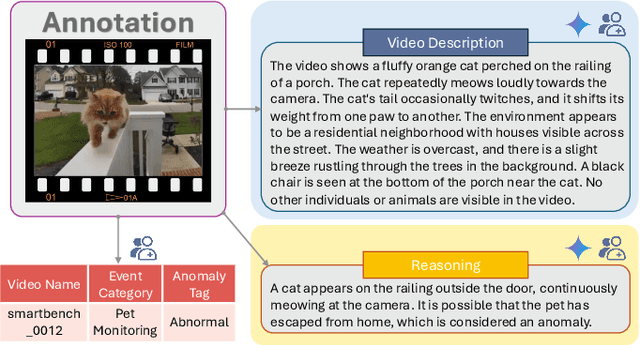
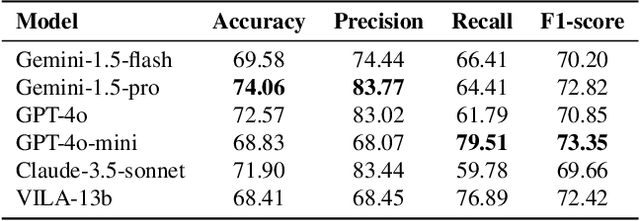
Video anomaly detection (VAD) is essential for enhancing safety and security by identifying unusual events across different environments. Existing VAD benchmarks, however, are primarily designed for general-purpose scenarios, neglecting the specific characteristics of smart home applications. To bridge this gap, we introduce SmartHome-Bench, the first comprehensive benchmark specially designed for evaluating VAD in smart home scenarios, focusing on the capabilities of multi-modal large language models (MLLMs). Our newly proposed benchmark consists of 1,203 videos recorded by smart home cameras, organized according to a novel anomaly taxonomy that includes seven categories, such as Wildlife, Senior Care, and Baby Monitoring. Each video is meticulously annotated with anomaly tags, detailed descriptions, and reasoning. We further investigate adaptation methods for MLLMs in VAD, assessing state-of-the-art closed-source and open-source models with various prompting techniques. Results reveal significant limitations in the current models' ability to detect video anomalies accurately. To address these limitations, we introduce the Taxonomy-Driven Reflective LLM Chain (TRLC), a new LLM chaining framework that achieves a notable 11.62% improvement in detection accuracy. The benchmark dataset and code are publicly available at https://github.com/Xinyi-0724/SmartHome-Bench-LLM.