 Add to Chrome
 Add to Firefox
 Add to Edge
Beyond Absolute Scores: Relative Edit-induced Difference for Generalizable Image Aesthetic Assessment
Jun 04, 2026
Traditional Image Aesthetic Assessment (IAA) methods mainly rely on regressing absolute Mean Opinion Scores (MOS). However, such a paradigm overlooks the inherently dynamic nature of human aesthetic perception, which relies on subconscious comparison against implicit visual references. Consequently, the lack of causal reasoning regarding aesthetic differences prevents models from learning generalizable aesthetic principles, thus limiting their generalization across diverse scenarios. In this work, we rethink the IAA task and propose Relative Edit-induced Difference Aesthetic learning (RED-Aes), a novel framework that leverages controllable image editing models to simulate the human aesthetic reasoning process. Instead of fitting absolute score distributions, RED-Aes explicitly learns the visual factors that drive aesthetic changes. To support this paradigm, we construct the RED-20k dataset, which comprises editing-based image pairs, quantitative aesthetic differences, and Chain-of-Thought (CoT) reasoning. Furthermore, we introduce a three-stage training strategy guided by a relative ranking consistency reward, optimizing the model solely via relative supervision. Extensive experiments demonstrate that RED-Aes achieves state-of-the-art performance on multiple public benchmarks, exhibiting superior generalization capabilities.

SIGMA: Bridging Structural and Distributional Gaps for Vision Foundation Model Adaptation
May 27, 2026Vision Foundation Models (VFMs) have demonstrated impressive representational capabilities. However, adapting them to downstream tasks via full fine-tuning incurs prohibitive computational and storage overhead. Parameter-Efficient Fine-Tuning (PEFT) has emerged as a compelling alternative, aiming to achieve performance parity with full fine-tuning at minimal training costs. Nonetheless, applying PEFT to VFMs for dense prediction tasks remains challenging due to the structural and distributional gaps. To bridge these gaps, we propose \textbf{S}cale-\textbf{I}ntegrated \textbf{G}lobal \textbf{M}odulation \textbf{A}dapter (\textbf{SIGMA}), a novel lightweight PEFT method, which consists of two modules: scale-adaptive fusion and semantic modulation. Specifically, the scale-adaptive fusion module is utilized to bridge structural gaps by enhancing the extraction of multi-granularity visual information. Furthermore, SIGMA introduces semantic modulation on the fusion features to perform global feature alignment to further eliminate the distribution gap. This design facilitates unified spatial and distributional adaptation, requiring only 1.72\% trainable parameters relative to the VFM backbone. Comprehensive experiments across various downstream dense tasks and multiple VFM backbones demonstrate that SIGMA achieves consistent and superior performance over state-of-the-art PEFT methods.
Pareto-Enhanced Portrait Generation: Vision-Aligned Text Supervision for Alignment, Realism, and Aesthetics
May 20, 2026Text-to-image diffusion models often face a severe trilemma in human portrait generation: text-image alignment, photorealism, and human-perceived aesthetics inherently inhibit one another. Supervised Fine-Tuning (SFT) is an effective method for enhancing the photorealism of image generation. However, it often leads to overfitting to the training dataset, corrupts pre-trained image priors, and degrades alignment or aesthetics. To break this bottleneck, we propose a feature supervision paradigm for Multimodal Diffusion Transformers (MM-DiT). Specifically, we introduce a lightweight cross-modal alignment mechanism that implicitly extracts multi-granularity vision-aligned text representations from SigLIP 2 and applies supervision to the image branch of MM-DiT during the training stage, with zero extra inference overhead. Our method injects vision-aligned text guidance while preserving the base model's original generalization, avoiding degradation caused by SFT. Furthermore, our method directly mines implicit multi-granularity aesthetic signals from pre-trained vision foundation models to optimize human-perceived aesthetics. Extensive experiments on MM-DiTs show that our method pushes the Pareto frontier and achieves synergistic improvements across text-image alignment, photorealism, and human-perceived aesthetics.
ProUIE: A Macro-to-Micro Progressive Learning Method for LLM-based Universal Information Extraction
Apr 12, 2026LLM-based universal information extraction (UIE) methods often rely on additional information beyond the original training data, which increases training complexity yet often yields limited gains. To address this, we propose ProUIE, a Macro-to-Micro progressive learning approach that improves UIE without introducing any external information. ProUIE consists of three stages: (i) macro-level Complete Modeling (CM), which learns NER, RE, and EE along their intrinsic difficulty order on the full training data to build a unified extraction foundation, (ii) meso-level Streamlined Alignment (SA), which operates on sampled data with simplified target formats, streamlining and regularizing structured outputs to make them more concise and controllable, and (iii) micro-level Deep Exploration (DE), which applies GRPO with stepwise fine-grained rewards (SFR) over structural units to guide exploration and improve performance. Experiments on 36 public datasets show that ProUIE consistently improves unified extraction, outperforming strong instruction-tuned baselines on average for NER and RE while using a smaller backbone, and it further demonstrates clear gains in large-scale production-oriented information extraction.
GUI-CEval: A Hierarchical and Comprehensive Chinese Benchmark for Mobile GUI Agents
Mar 16, 2026Recent progress in Multimodal Large Language Models (MLLMs) has enabled mobile GUI agents capable of visual perception, cross-modal reasoning, and interactive control. However, existing benchmarks are largely English-centric and fail to capture the linguistic and interaction characteristics of the Chinese mobile ecosystem. They also focus on isolated skills such as GUI grounding or offline agent, lacking a unified and fine-grained framework to assess the full capability chain from perception to execution. To address this gap, we introduce GUI-CEval, the first comprehensive benchmark for Chinese mobile GUI agents, built entirely on physical device environments. GUI-CEval spans 201 mainstream apps across four device types and adopts a two-level structure that evaluates both atomic abilities and realistic application-level performance along five dimensions: perception, planning, reflection, execution, and evaluation. All data are collected and verified through multi-stage manual processes to ensure authenticity and reproducibility. Extensive experiments on 20 representative MLLMs and multi-agent systems show that while models such as Qwen2.5-VL and UI-TARS perform competitively, most MLLMs still exhibit clear weaknesses in reflective decision-making and post-action self-evaluation, limiting their reliability in real-world interactions. We hope GUI-CEval provides a comprehensive and interpretable benchmark to guide capability diagnosis and advance the development of Chinese mobile GUI agents.
ProactiveMobile: A Comprehensive Benchmark for Boosting Proactive Intelligence on Mobile Devices
Feb 26, 2026Multimodal large language models (MLLMs) have made significant progress in mobile agent development, yet their capabilities are predominantly confined to a reactive paradigm, where they merely execute explicit user commands. The emerging paradigm of proactive intelligence, where agents autonomously anticipate needs and initiate actions, represents the next frontier for mobile agents. However, its development is critically bottlenecked by the lack of benchmarks that can address real-world complexity and enable objective, executable evaluation. To overcome these challenges, we introduce ProactiveMobile, a comprehensive benchmark designed to systematically advance research in this domain. ProactiveMobile formalizes the proactive task as inferring latent user intent across four dimensions of on-device contextual signals and generating an executable function sequence from a comprehensive function pool of 63 APIs. The benchmark features over 3,660 instances of 14 scenarios that embrace real-world complexity through multi-answer annotations. To ensure quality, a team of 30 experts conducts a final audit of the benchmark, verifying factual accuracy, logical consistency, and action feasibility, and correcting any non-compliant entries. Extensive experiments demonstrate that our fine-tuned Qwen2.5-VL-7B-Instruct achieves a success rate of 19.15%, outperforming o1 (15.71%) and GPT-5 (7.39%). This result indicates that proactivity is a critical competency widely lacking in current MLLMs, yet it is learnable, emphasizing the importance of the proposed benchmark for proactivity evaluation.
Unified Multimodal and Multilingual Retrieval via Multi-Task Learning with NLU Integration
Jan 21, 2026Multimodal retrieval systems typically employ Vision Language Models (VLMs) that encode images and text independently into vectors within a shared embedding space. Despite incorporating text encoders, VLMs consistently underperform specialized text models on text-only retrieval tasks. Moreover, introducing additional text encoders increases storage, inference overhead, and exacerbates retrieval inefficiencies, especially in multilingual settings. To address these limitations, we propose a multi-task learning framework that unifies the feature representation across images, long and short texts, and intent-rich queries. To our knowledge, this is the first work to jointly optimize multilingual image retrieval, text retrieval, and natural language understanding (NLU) tasks within a single framework. Our approach integrates image and text retrieval with a shared text encoder that is enhanced by NLU features for intent understanding and retrieval accuracy.
HyperVL: An Efficient and Dynamic Multimodal Large Language Model for Edge Devices
Dec 16, 2025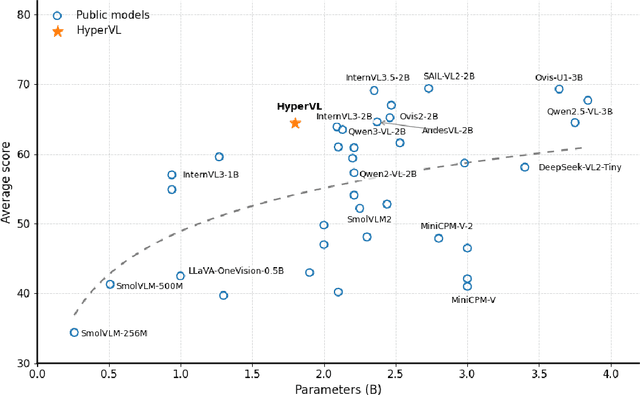

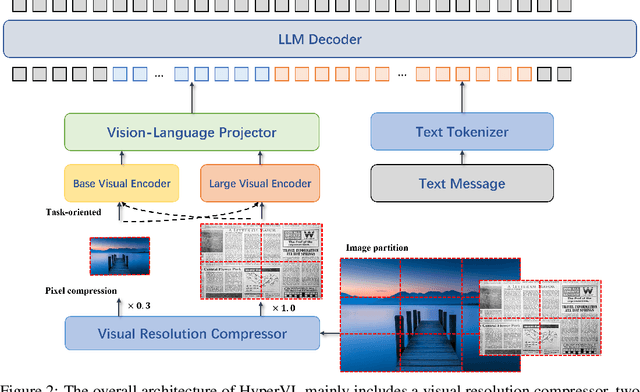
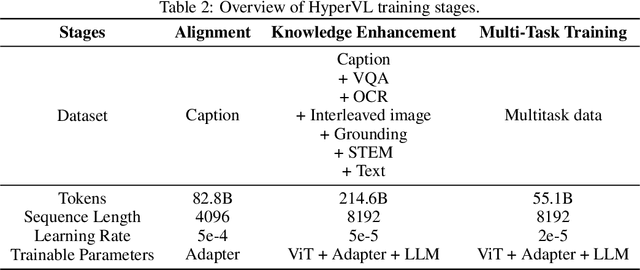
Current multimodal large lanauge models possess strong perceptual and reasoning capabilities, however high computational and memory requirements make them difficult to deploy directly on on-device environments. While small-parameter models are progressively endowed with strong general capabilities, standard Vision Transformer (ViT) encoders remain a critical bottleneck, suffering from excessive latency and memory consumption when processing high-resolution inputs.To address these challenges, we introduce HyperVL, an efficient multimodal large language model tailored for on-device inference. HyperVL adopts an image-tiling strategy to cap peak memory usage and incorporates two novel techniques: (1) a Visual Resolution Compressor (VRC) that adaptively predicts optimal encoding resolutions to eliminate redundant computation, and (2) Dual Consistency Learning (DCL), which aligns multi-scale ViT encoders within a unified framework, enabling dynamic switching between visual branches under a shared LLM. Extensive experiments demonstrate that HyperVL achieves state-of-the-art performance among models of comparable size across multiple benchmarks. Furthermore, it significantly significantly reduces latency and power consumption on real mobile devices, demonstrating its practicality for on-device multimodal inference.
Lego-Edit: A General Image Editing Framework with Model-Level Bricks and MLLM Builder
Sep 16, 2025Instruction-based image editing has garnered significant attention due to its direct interaction with users. However, real-world user instructions are immensely diverse, and existing methods often fail to generalize effectively to instructions outside their training domain, limiting their practical application. To address this, we propose Lego-Edit, which leverages the generalization capability of Multi-modal Large Language Model (MLLM) to organize a suite of model-level editing tools to tackle this challenge. Lego-Edit incorporates two key designs: (1) a model-level toolkit comprising diverse models efficiently trained on limited data and several image manipulation functions, enabling fine-grained composition of editing actions by the MLLM; and (2) a three-stage progressive reinforcement learning approach that uses feedback on unannotated, open-domain instructions to train the MLLM, equipping it with generalized reasoning capabilities for handling real-world instructions. Experiments demonstrate that Lego-Edit achieves state-of-the-art performance on GEdit-Bench and ImgBench. It exhibits robust reasoning capabilities for open-domain instructions and can utilize newly introduced editing tools without additional fine-tuning. Code is available: https://github.com/xiaomi-research/lego-edit.