 Add to Chrome
 Add to Firefox
 Add to Edge
Unified Agent: Managing Interactions across Devices
Aug 06, 2026
As capabilities rapidly increase, AI agents can move from running inside one app to acting across a user's devices over time. Yet existing agent systems still fall short in this scenario. This is because observations are scattered across devices and moments, but mainstream systems are not designed around this fact: a single agent that treats devices as tools lacks effective state management for all devices across time, and multi-agent systems coordinate across agents but do not maintain the compact carried state a cross-device, cross-time request needs. We argue that the agent should maintain an effectively designed state that organizes engagement evidence, stated facts, and the standing request in a compact, action-ready form for deciding its action given the current observation. To compare state designs, we construct a benchmark of user-agent interaction across devices and time. We instantiate this principle in Unified Agent, a stateful agent that carries interaction evidence across devices and moments and uses it with the current observation to act. In the default setting, it significantly outperforms our adaptations of four published designs. Across changes in multimodal large language model (MLLM) family, capability, and reasoning effort, it remains ahead of all compared systems, demonstrating that the state-design advantage is robust across MLLM settings. Our code and data will be publicly available on GitHub.

DexFuture: Hierarchical Future-State Visuomotor Targeting for Bimanual Dexterous Tool Use
Jun 04, 2026Bimanual dexterous tool use remains challenging for robots due to high-dimensional hand configurations and complex hand-tool-object dynamics and contact. Most existing control policies depend on future configuration references provided from demonstrations, while future action-conditioned world models require slow online planning over high-dimensional action sequences. A significant challenge is generating a dynamically consistent future reference trajectory without relying on privileged states from demonstrations or slow counterfactual planning. We propose DexFuture, a hierarchical system that couples a high-level Future-State Visuomotor Target Predictor with a low-level Target-Conditioned Structured Dexterous Policy. Conditioned on egocentric RGB, proprioceptive and geometric history, the high-level predictor constructs structured hand-tool-object visuomotor embeddings and uses a horizon-conditioned transformer to generate a multi-step future target trajectory. Then, the low-level policy tracks them with a target-conditioned per-link transformer. This hierarchy decouples coarse future reference generation from fine-grained action control, and slow long-horizon semantic prediction from high-frequency execution. On OakInk2 bimanual tool-use tasks, DexFuture achieves 90% of the privileged-oracle performance, compared to 7% for a no-reference policy. DexFuture operates at 60 Hz, approximately 250 times faster than DexWM-style Cross-Entropy Method (CEM) planning with a future action-conditioned world model.
PhysGraph: Physically-Grounded Graph-Transformer Policies for Bimanual Dexterous Hand-Tool-Object Manipulation
Mar 02, 2026Bimanual dexterous manipulation for tool use remains a formidable challenge in robotics due to the high-dimensional state space and complicated contact dynamics. Existing methods naively represent the entire system state as a single configuration vector, disregarding the rich structural and topological information inherent to articulated hands. We present PhysGraph, a physically-grounded graph transformer policy designed explicitly for challenging bimanual hand-tool-object manipulation. Unlike prior works, we represent the bimanual system as a kinematic graph and introduce per-link tokenization to preserve fine-grained local state information. We propose a physically-grounded bias generator that injects structural priors directly into the attention mechanism, including kinematic spatial distance, dynamic contact states, geometric proximity, and anatomical properties. This allows the policy to explicitly reason about physical interactions rather than learning them implicitly from sparse rewards. Extensive experiments show that PhysGraph significantly outperforms baseline - ManipTrans in manipulation precision and task success rates while using only 51% of the parameters of ManipTrans. Furthermore, the inherent topological flexibility of our architecture shows qualitative zero-shot transfer to unseen tool/object geometries, and is sufficiently general to be trained on three robotic hands (Shadow, Allegro, Inspire).
HumanOrbit: 3D Human Reconstruction as 360° Orbit Generation
Feb 27, 2026We present a method for generating a full 360° orbit video around a person from a single input image. Existing methods typically adapt image-based diffusion models for multi-view synthesis, but yield inconsistent results across views and with the original identity. In contrast, recent video diffusion models have demonstrated their ability in generating photorealistic results that align well with the given prompts. Inspired by these results, we propose HumanOrbit, a video diffusion model for multi-view human image generation. Our approach enables the model to synthesize continuous camera rotations around the subject, producing geometrically consistent novel views while preserving the appearance and identity of the person. Using the generated multi-view frames, we further propose a reconstruction pipeline that recovers a textured mesh of the subject. Experimental results validate the effectiveness of HumanOrbit for multi-view image generation and that the reconstructed 3D models exhibit superior completeness and fidelity compared to those from state-of-the-art baselines.
Consistency-Preserving Diverse Video Generation
Feb 17, 2026Text-to-video generation is expensive, so only a few samples are typically produced per prompt. In this low-sample regime, maximizing the value of each batch requires high cross-video diversity. Recent methods improve diversity for image generation, but for videos they often degrade within-video temporal consistency and require costly backpropagation through a video decoder. We propose a joint-sampling framework for flow-matching video generators that improves batch diversity while preserving temporal consistency. Our approach applies diversity-driven updates and then removes only the components that would decrease a temporal-consistency objective. To avoid image-space gradients, we compute both objectives with lightweight latent-space models, avoiding video decoding and decoder backpropagation. Experiments on a state-of-the-art text-to-video flow-matching model show diversity comparable to strong joint-sampling baselines while substantially improving temporal consistency and color naturalness. Code will be released.
A Shared-Autonomy Construction Robotic System for Overhead Works
Nov 12, 2025We present the ongoing development of a robotic system for overhead work such as ceiling drilling. The hardware platform comprises a mobile base with a two-stage lift, on which a bimanual torso is mounted with a custom-designed drilling end effector and RGB-D cameras. To support teleoperation in dynamic environments with limited visibility, we use Gaussian splatting for online 3D reconstruction and introduce motion parameters to model moving objects. For safe operation around dynamic obstacles, we developed a neural configuration-space barrier approach for planning and control. Initial feasibility studies demonstrate the capability of the hardware in drilling, bolting, and anchoring, and the software in safe teleoperation in a dynamic environment.
DynaGSLAM: Real-Time Gaussian-Splatting SLAM for Online Rendering, Tracking, Motion Predictions of Moving Objects in Dynamic Scenes
Mar 15, 2025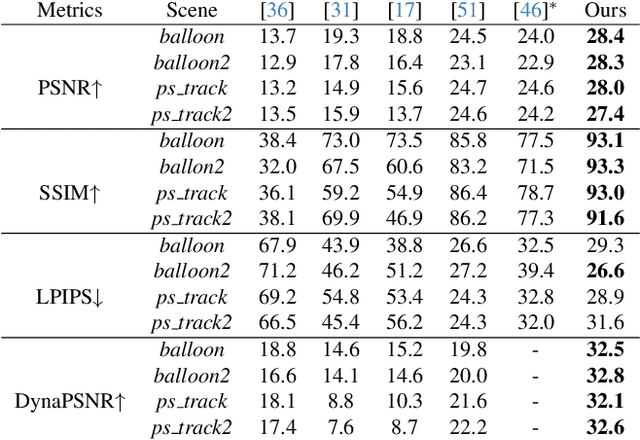
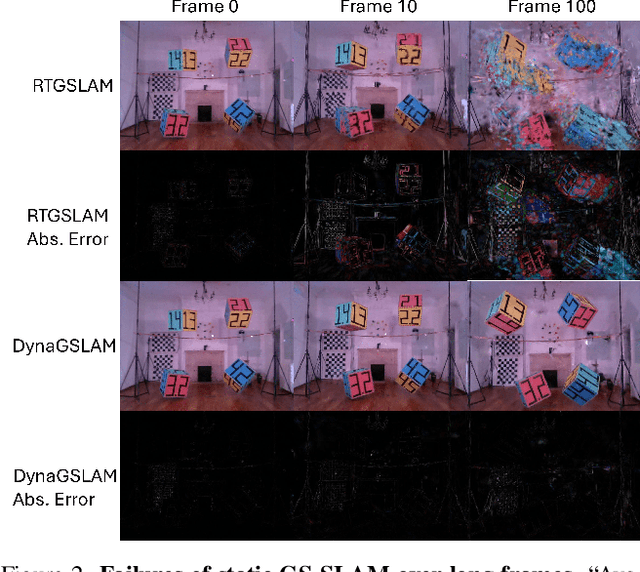
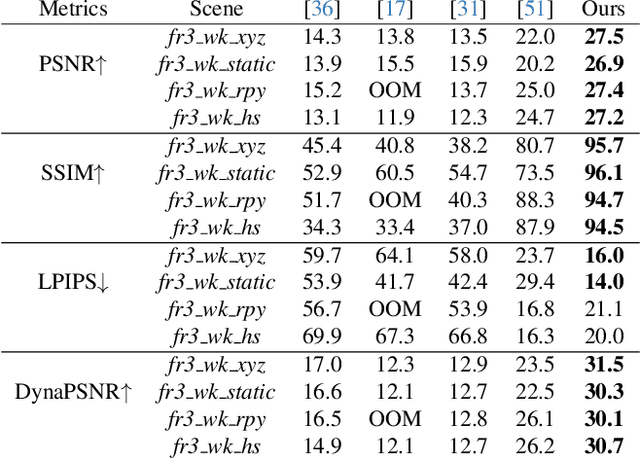
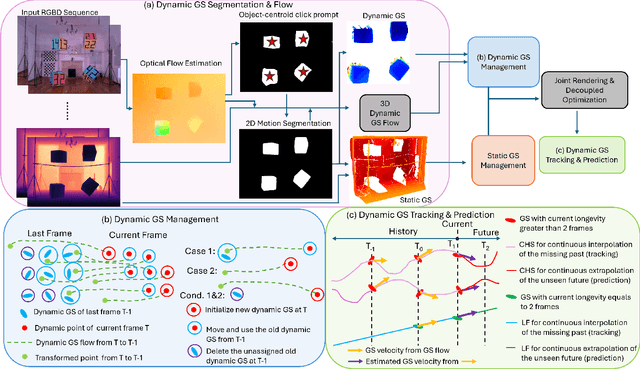
Simultaneous Localization and Mapping (SLAM) is one of the most important environment-perception and navigation algorithms for computer vision, robotics, and autonomous cars/drones. Hence, high quality and fast mapping becomes a fundamental problem. With the advent of 3D Gaussian Splatting (3DGS) as an explicit representation with excellent rendering quality and speed, state-of-the-art (SOTA) works introduce GS to SLAM. Compared to classical pointcloud-SLAM, GS-SLAM generates photometric information by learning from input camera views and synthesize unseen views with high-quality textures. However, these GS-SLAM fail when moving objects occupy the scene that violate the static assumption of bundle adjustment. The failed updates of moving GS affects the static GS and contaminates the full map over long frames. Although some efforts have been made by concurrent works to consider moving objects for GS-SLAM, they simply detect and remove the moving regions from GS rendering ("anti'' dynamic GS-SLAM), where only the static background could benefit from GS. To this end, we propose the first real-time GS-SLAM, "DynaGSLAM'', that achieves high-quality online GS rendering, tracking, motion predictions of moving objects in dynamic scenes while jointly estimating accurate ego motion. Our DynaGSLAM outperforms SOTA static & "Anti'' dynamic GS-SLAM on three dynamic real datasets, while keeping speed and memory efficiency in practice.
Open-Vocabulary Semantic Part Segmentation of 3D Human
Feb 27, 20253D part segmentation is still an open problem in the field of 3D vision and AR/VR. Due to limited 3D labeled data, traditional supervised segmentation methods fall short in generalizing to unseen shapes and categories. Recently, the advancement in vision-language models' zero-shot abilities has brought a surge in open-world 3D segmentation methods. While these methods show promising results for 3D scenes or objects, they do not generalize well to 3D humans. In this paper, we present the first open-vocabulary segmentation method capable of handling 3D human. Our framework can segment the human category into desired fine-grained parts based on the textual prompt. We design a simple segmentation pipeline, leveraging SAM to generate multi-view proposals in 2D and proposing a novel HumanCLIP model to create unified embeddings for visual and textual inputs. Compared with existing pre-trained CLIP models, the HumanCLIP model yields more accurate embeddings for human-centric contents. We also design a simple-yet-effective MaskFusion module, which classifies and fuses multi-view features into 3D semantic masks without complex voting and grouping mechanisms. The design of decoupling mask proposals and text input also significantly boosts the efficiency of per-prompt inference. Experimental results on various 3D human datasets show that our method outperforms current state-of-the-art open-vocabulary 3D segmentation methods by a large margin. In addition, we show that our method can be directly applied to various 3D representations including meshes, point clouds, and 3D Gaussian Splatting.
GlossGau: Efficient Inverse Rendering for Glossy Surface with Anisotropic Spherical Gaussian
Feb 19, 2025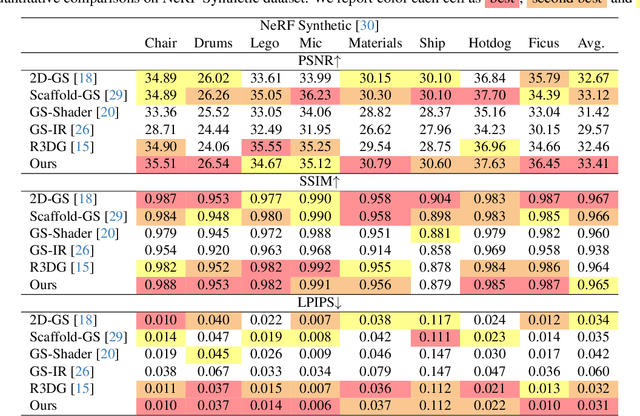
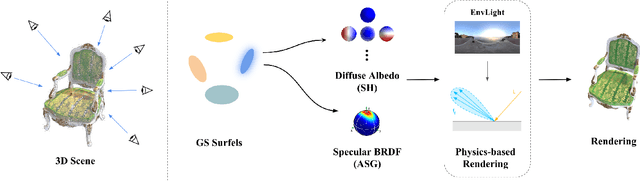
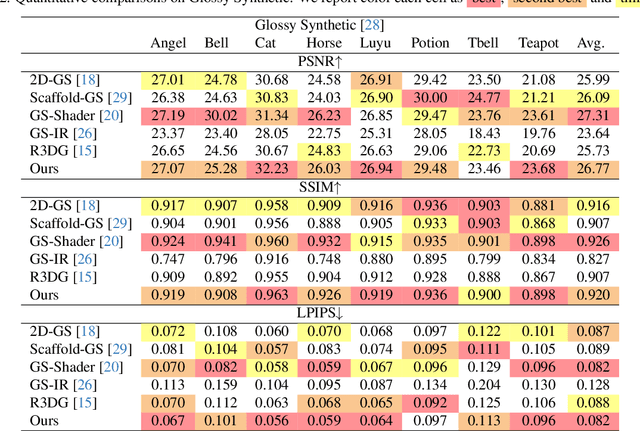
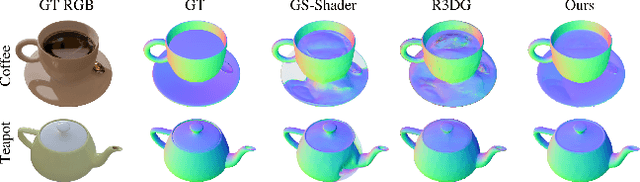
The reconstruction of 3D objects from calibrated photographs represents a fundamental yet intricate challenge in the domains of computer graphics and vision. Although neural reconstruction approaches based on Neural Radiance Fields (NeRF) have shown remarkable capabilities, their processing costs remain substantial. Recently, the advent of 3D Gaussian Splatting (3D-GS) largely improves the training efficiency and facilitates to generate realistic rendering in real-time. However, due to the limited ability of Spherical Harmonics (SH) to represent high-frequency information, 3D-GS falls short in reconstructing glossy objects. Researchers have turned to enhance the specular expressiveness of 3D-GS through inverse rendering. Yet these methods often struggle to maintain the training and rendering efficiency, undermining the benefits of Gaussian Splatting techniques. In this paper, we introduce GlossGau, an efficient inverse rendering framework that reconstructs scenes with glossy surfaces while maintaining training and rendering speeds comparable to vanilla 3D-GS. Specifically, we explicitly model the surface normals, Bidirectional Reflectance Distribution Function (BRDF) parameters, as well as incident lights and use Anisotropic Spherical Gaussian (ASG) to approximate the per-Gaussian Normal Distribution Function under the microfacet model. We utilize 2D Gaussian Splatting (2D-GS) as foundational primitives and apply regularization to significantly alleviate the normal estimation challenge encountered in related works. Experiments demonstrate that GlossGau achieves competitive or superior reconstruction on datasets with glossy surfaces. Compared with previous GS-based works that address the specular surface, our optimization time is considerably less.
SplatSDF: Boosting Neural Implicit SDF via Gaussian Splatting Fusion
Nov 23, 2024

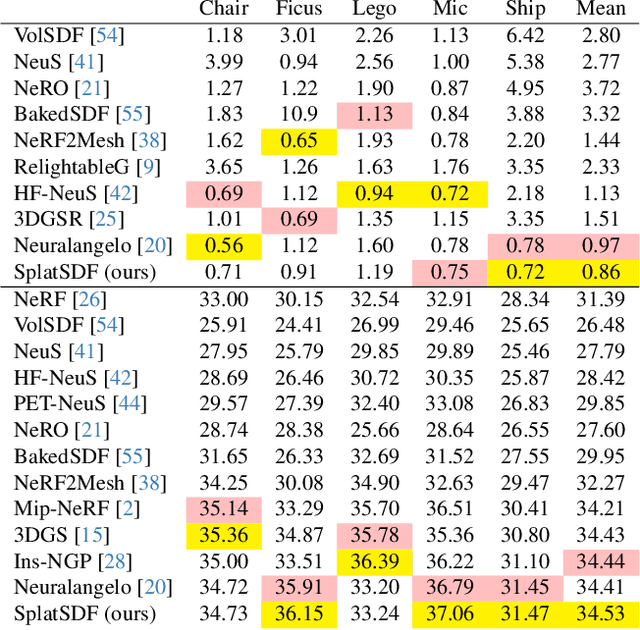

A signed distance function (SDF) is a useful representation for continuous-space geometry and many related operations, including rendering, collision checking, and mesh generation. Hence, reconstructing SDF from image observations accurately and efficiently is a fundamental problem. Recently, neural implicit SDF (SDF-NeRF) techniques, trained using volumetric rendering, have gained a lot of attention. Compared to earlier truncated SDF (TSDF) fusion algorithms that rely on depth maps and voxelize continuous space, SDF-NeRF enables continuous-space SDF reconstruction with better geometric and photometric accuracy. However, the accuracy and convergence speed of scene-level SDF reconstruction require further improvements for many applications. With the advent of 3D Gaussian Splatting (3DGS) as an explicit representation with excellent rendering quality and speed, several works have focused on improving SDF-NeRF by introducing consistency losses on depth and surface normals between 3DGS and SDF-NeRF. However, loss-level connections alone lead to incremental improvements. We propose a novel neural implicit SDF called "SplatSDF" to fuse 3DGSandSDF-NeRF at an architecture level with significant boosts to geometric and photometric accuracy and convergence speed. Our SplatSDF relies on 3DGS as input only during training, and keeps the same complexity and efficiency as the original SDF-NeRF during inference. Our method outperforms state-of-the-art SDF-NeRF models on geometric and photometric evaluation by the time of submission.