 Add to Chrome
 Add to Firefox
 Add to Edge
JARVIS: An Evidence-Grounded Retrieval System for Interpretable Deceptive Reviews Adjudication
Feb 13, 2026
Deceptive reviews, refer to fabricated feedback designed to artificially manipulate the perceived quality of products. Within modern e-commerce ecosystems, these reviews remain a critical governance challenge. Despite advances in review-level and graph-based detection methods, two pivotal limitations remain: inadequate generalization and lack of interpretability. To address these challenges, we propose JARVIS, a framework providing Judgment via Augmented Retrieval and eVIdence graph Structures. Starting from the review to be evaluated, it retrieves semantically similar evidence via hybrid dense-sparse multimodal retrieval, expands relational signals through shared entities, and constructs a heterogeneous evidence graph. Large language model then performs evidence-grounded adjudication to produce interpretable risk assessments. Offline experiments demonstrate that JARVIS enhances performance on our constructed review dataset, achieving a precision increase from 0.953 to 0.988 and a recall boost from 0.830 to 0.901. In the production environment, our framework achieves a 27% increase in the recall volume and reduces manual inspection time by 75%. Furthermore, the adoption rate of the model-generated analysis reaches 96.4%.

Language Model Training Paradigms for Clinical Feature Embeddings
Nov 01, 2023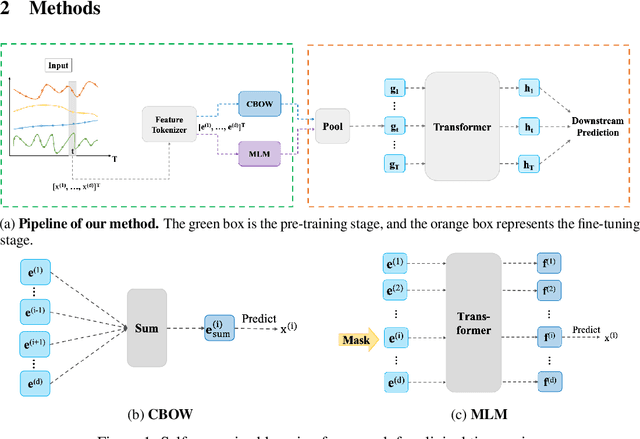
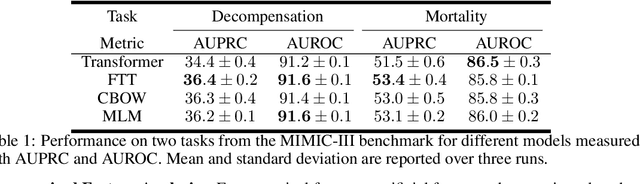
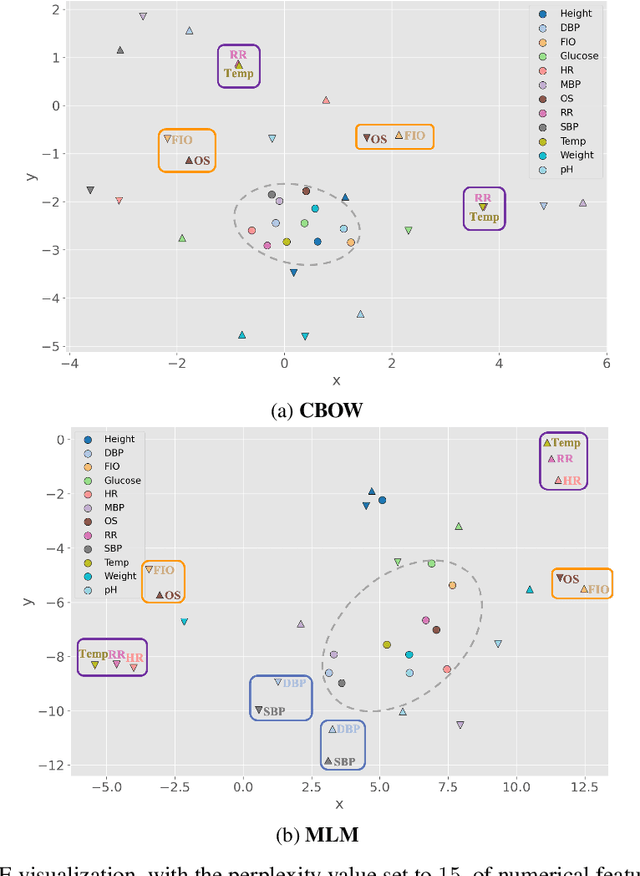
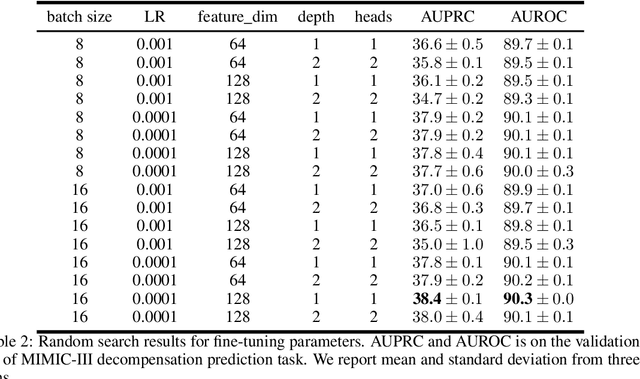
In research areas with scarce data, representation learning plays a significant role. This work aims to enhance representation learning for clinical time series by deriving universal embeddings for clinical features, such as heart rate and blood pressure. We use self-supervised training paradigms for language models to learn high-quality clinical feature embeddings, achieving a finer granularity than existing time-step and patient-level representation learning. We visualize the learnt embeddings via unsupervised dimension reduction techniques and observe a high degree of consistency with prior clinical knowledge. We also evaluate the model performance on the MIMIC-III benchmark and demonstrate the effectiveness of using clinical feature embeddings. We publish our code online for replication.
M-mode Based Prediction of Ejection Fraction using Echocardiograms
Sep 07, 2023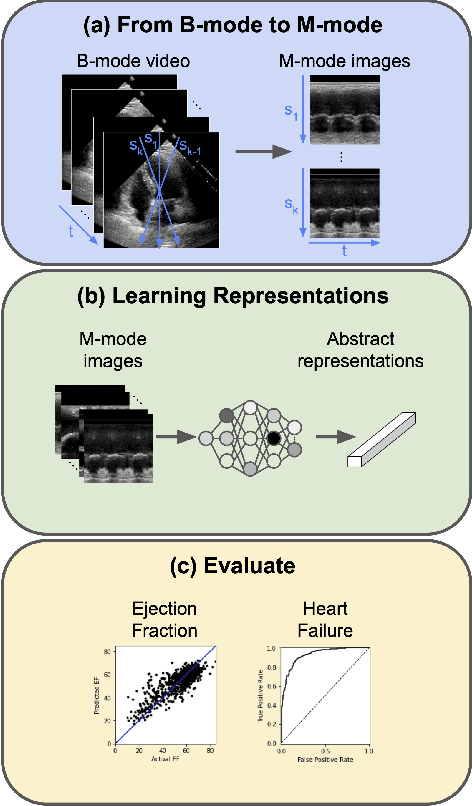
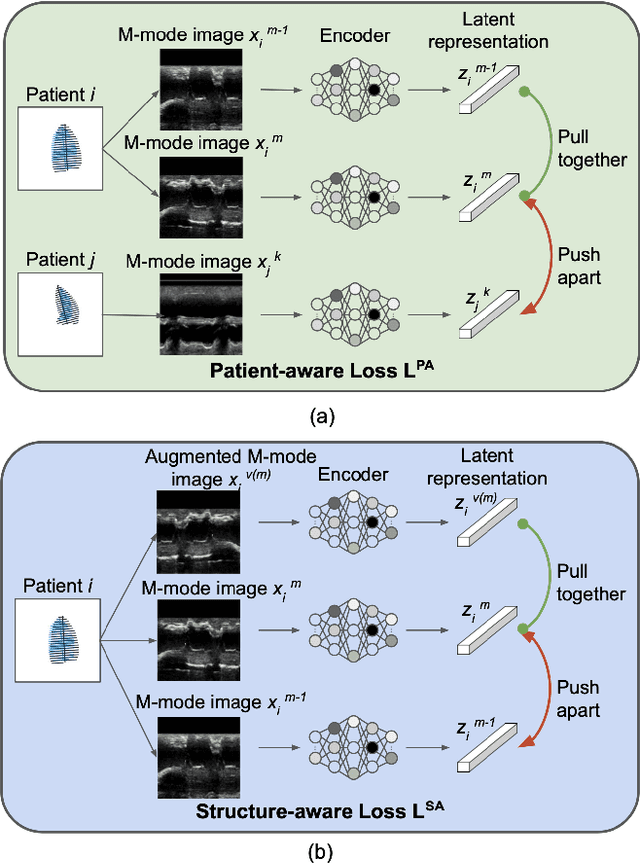

Early detection of cardiac dysfunction through routine screening is vital for diagnosing cardiovascular diseases. An important metric of cardiac function is the left ventricular ejection fraction (EF), where lower EF is associated with cardiomyopathy. Echocardiography is a popular diagnostic tool in cardiology, with ultrasound being a low-cost, real-time, and non-ionizing technology. However, human assessment of echocardiograms for calculating EF is time-consuming and expertise-demanding, raising the need for an automated approach. In this work, we propose using the M(otion)-mode of echocardiograms for estimating the EF and classifying cardiomyopathy. We generate multiple artificial M-mode images from a single echocardiogram and combine them using off-the-shelf model architectures. Additionally, we extend contrastive learning (CL) to cardiac imaging to learn meaningful representations from exploiting structures in unlabeled data allowing the model to achieve high accuracy, even with limited annotations. Our experiments show that the supervised setting converges with only ten modes and is comparable to the baseline method while bypassing its cumbersome training process and being computationally much more efficient. Furthermore, CL using M-mode images is helpful for limited data scenarios, such as having labels for only 200 patients, which is common in medical applications.