 Add to Chrome
 Add to Firefox
 Add to Edge
Regret Bounds for Competitive Resource Allocation with Endogenous Costs
Mar 19, 2026
We study online resource allocation among N interacting modules over T rounds. Unlike standard online optimization, costs are endogenous: they depend on the full allocation vector through an interaction matrix W encoding pairwise cooperation and competition. We analyze three paradigms: (I) uniform allocation (cost-ignorant), (II) gated allocation (cost-estimating), and (III) competitive allocation via multiplicative weights update with interaction feedback (cost-revealing). Our main results establish a strict separation under adversarial sequences with bounded variation: uniform incurs Omega(T) regret, gated achieves O(T^{2/3}), and competitive achieves O(sqrt(T log N)). The performance gap stems from competitive allocation's ability to exploit endogenous cost information revealed through interactions. We further show that W's topology governs a computation-regret tradeoff. Full interaction (|E|=O(N^2)) yields the tightest bound but highest per-step cost, while sparse topologies (|E|=O(N)) increase regret by at most O(sqrt(log N)) while reducing per-step cost from O(N^2) to O(N). Ring-structured topologies with both cooperative and competitive links - of which the five-element Wuxing topology is canonical - minimize the computation x regret product. These results provide the first formal regret-theoretic justification for decentralized competitive allocation in modular architectures and establish cost endogeneity as a fundamental challenge distinct from partial observability. Keywords: online learning, regret bounds, resource allocation, endogenous costs, interaction topology, multiplicative weights, modular systems, Wuxing topology

MIPI 2024 Challenge on Few-shot RAW Image Denoising: Methods and Results
Jun 11, 2024

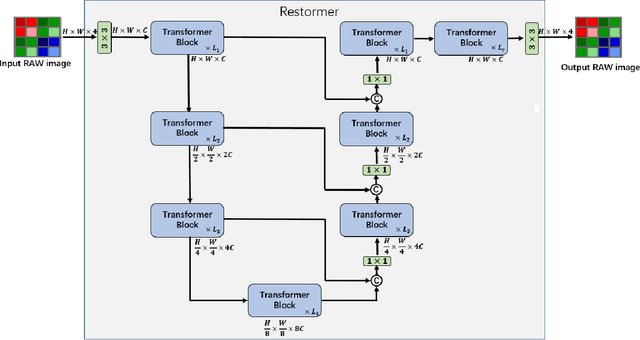

The increasing demand for computational photography and imaging on mobile platforms has led to the widespread development and integration of advanced image sensors with novel algorithms in camera systems. However, the scarcity of high-quality data for research and the rare opportunity for in-depth exchange of views from industry and academia constrain the development of mobile intelligent photography and imaging (MIPI). Building on the achievements of the previous MIPI Workshops held at ECCV 2022 and CVPR 2023, we introduce our third MIPI challenge including three tracks focusing on novel image sensors and imaging algorithms. In this paper, we summarize and review the Few-shot RAW Image Denoising track on MIPI 2024. In total, 165 participants were successfully registered, and 7 teams submitted results in the final testing phase. The developed solutions in this challenge achieved state-of-the-art erformance on Few-shot RAW Image Denoising. More details of this challenge and the link to the dataset can be found at https://mipichallenge.org/MIPI2024.