 Add to Chrome
 Add to Firefox
 Add to Edge
EIBench: A Simulator-Based Benchmark and Turn-Credit RL for Emotion Management
Jun 14, 2026
Emotional intelligence (EI) in Large Language Models (LLMs) is often evaluated through static understanding tasks or single-response dialogue generation. However, emotion management is interactive: a good model should not only recognize a user's emotion, but also improve the user's emotional and relational state over several turns. We introduce EIBench, a simulator-based benchmark for interactive emotion management. EIBench contains 2,222 scenarios, with 2,009 for training and 213 for held-out testing. The scenarios are organized by a 2x2 taxonomy covering Support, Defense, Repair, and Charm, which together capture different forms of support, boundary maintenance, trust repair, and rapport building. In each scenario, an LLM simulator plays the user, updates an emotion-relation state after each turn, and maps the final state to an anchor-based score. This design makes EIBench both an evaluation benchmark and a training environment: the final state gives the outcome reward, while the per-turn state updates provide dense feedback for RL. We evaluate 15 open- and closed-source LLMs. Current models perform well on support and rapport-building scenes, but struggle with boundary maintenance under user pressure. To improve the EI ability of LLMs, we propose Centered Turn-Credit GRPO (CTC-GRPO), a GRPO extension that reuses the simulator's per-turn state updates as dense turn-level feedback while preserving the final outcome reward. CTC-GRPO improves Qwen3-8B from -22.4 to +22.4 on EIBench and also improves on out-of-distribution evaluations including SAGE (+12.4) and EQBench3 (+20.9%). Our results show that simulator-tracked user states can support both evaluation and training for multi-turn emotion management.

Scaling Self-Evolving Agents via Parametric Memory
Jun 03, 2026Existing memory-augmented LLM agents store past experience exclusively in prompt space, as textual summaries or retrieved passages, while keeping model parameters frozen throughout a rollout. Such agents can \emph{look up} what they have seen but cannot \emph{learn from} it: their policy is unchanged by experience, and any information dropped from the context is permanently lost. We introduce \texttt{TMEM}, a self-evolving parametric memory framework in which the agent not only compresses history into explicit memory but also absorbs distilled supervision into fast LoRA weights $Δ_t$ via lightweight online updates, genuinely altering its future behavior within a single episode. We formalize this as an agentic decision process with fast-weight rollout dynamics: actions are sampled from $π_{θ_0+Δ_t}$, while extraction actions produce supervision that updates $Δ_t$ for subsequent decisions. This view makes the extraction policy directly optimizable by RL: training $θ_0$ improves not only task actions but also the quality of the data used for online LoRA adaptation. We further propose SVD-based initialization of the LoRA subspace to accelerate online convergence. Experiments on LoCoMo, LongMemEval-S, multi-objective search, and CL-Bench show that \texttt{TMEM} consistently outperforms summary-based and retrieval-based baselines across different model scales.
When Can Large Reasoning Models Save Thinking? Mechanistic Analysis of Behavioral Divergence in Reasoning
May 21, 2025Large reasoning models (LRMs) have significantly advanced performance on complex tasks, yet their tendency to overthink introduces inefficiencies. This study investigates the internal mechanisms of reinforcement learning (RL)-trained LRMs when prompted to save thinking, revealing three distinct thinking modes: no thinking (NT), explicit thinking (ET), and implicit thinking (IT). Through comprehensive analysis of confidence in thinking termination, attention from thinking to generation, and attentional focus on input sections, we uncover key factors influencing the reasoning behaviors. We further find that NT reduces output length at the cost of accuracy, while ET and IT maintain accuracy with reduced response length. Our findings expose fundamental inconsistencies in RL-optimized LRMs, necessitating adaptive improvements for reliable efficiency.
Mitigating Lost-in-Retrieval Problems in Retrieval Augmented Multi-Hop Question Answering
Feb 20, 2025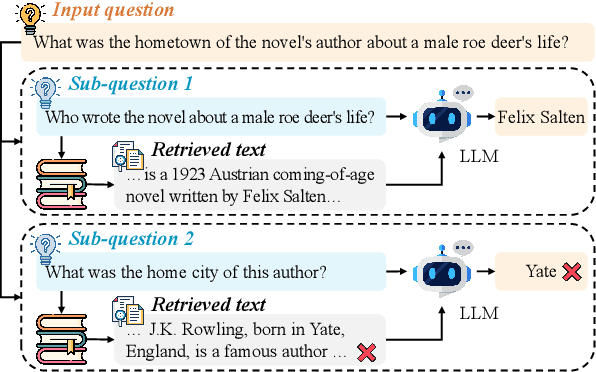
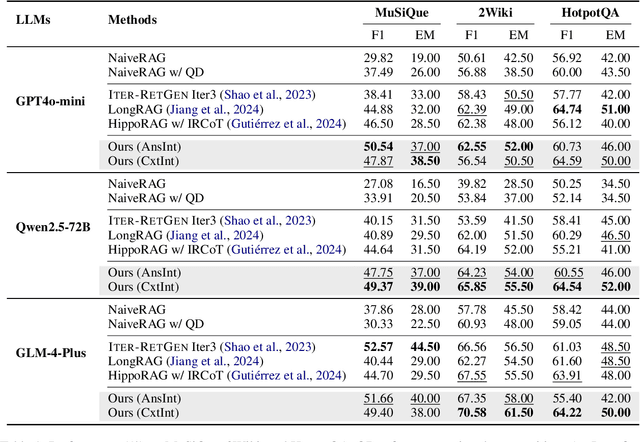
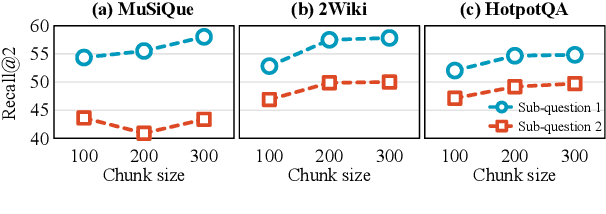
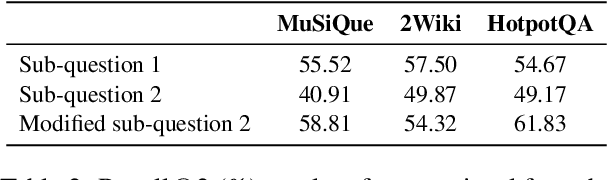
In this paper, we identify a critical problem, "lost-in-retrieval", in retrieval-augmented multi-hop question answering (QA): the key entities are missed in LLMs' sub-question decomposition. "Lost-in-retrieval" significantly degrades the retrieval performance, which disrupts the reasoning chain and leads to the incorrect answers. To resolve this problem, we propose a progressive retrieval and rewriting method, namely ChainRAG, which sequentially handles each sub-question by completing missing key entities and retrieving relevant sentences from a sentence graph for answer generation. Each step in our retrieval and rewriting process builds upon the previous one, creating a seamless chain that leads to accurate retrieval and answers. Finally, all retrieved sentences and sub-question answers are integrated to generate a comprehensive answer to the original question. We evaluate ChainRAG on three multi-hop QA datasets$\unicode{x2013}$MuSiQue, 2Wiki, and HotpotQA$\unicode{x2013}$using three large language models: GPT4o-mini, Qwen2.5-72B, and GLM-4-Plus. Empirical results demonstrate that ChainRAG consistently outperforms baselines in both effectiveness and efficiency.