 Add to Chrome
 Add to Firefox
 Add to Edge
EIBench: A Simulator-Based Benchmark and Turn-Credit RL for Emotion Management
Jun 14, 2026
Emotional intelligence (EI) in Large Language Models (LLMs) is often evaluated through static understanding tasks or single-response dialogue generation. However, emotion management is interactive: a good model should not only recognize a user's emotion, but also improve the user's emotional and relational state over several turns. We introduce EIBench, a simulator-based benchmark for interactive emotion management. EIBench contains 2,222 scenarios, with 2,009 for training and 213 for held-out testing. The scenarios are organized by a 2x2 taxonomy covering Support, Defense, Repair, and Charm, which together capture different forms of support, boundary maintenance, trust repair, and rapport building. In each scenario, an LLM simulator plays the user, updates an emotion-relation state after each turn, and maps the final state to an anchor-based score. This design makes EIBench both an evaluation benchmark and a training environment: the final state gives the outcome reward, while the per-turn state updates provide dense feedback for RL. We evaluate 15 open- and closed-source LLMs. Current models perform well on support and rapport-building scenes, but struggle with boundary maintenance under user pressure. To improve the EI ability of LLMs, we propose Centered Turn-Credit GRPO (CTC-GRPO), a GRPO extension that reuses the simulator's per-turn state updates as dense turn-level feedback while preserving the final outcome reward. CTC-GRPO improves Qwen3-8B from -22.4 to +22.4 on EIBench and also improves on out-of-distribution evaluations including SAGE (+12.4) and EQBench3 (+20.9%). Our results show that simulator-tracked user states can support both evaluation and training for multi-turn emotion management.

Large Language Model based Situational Dialogues for Second Language Learning
Mar 29, 2024In second language learning, scenario-based conversation practice is important for language learners to achieve fluency in speaking, but students often lack sufficient opportunities to practice their conversational skills with qualified instructors or native speakers. To bridge this gap, we propose situational dialogue models for students to engage in conversational practice. Our situational dialogue models are fine-tuned on large language models (LLMs), with the aim of combining the engaging nature of an open-ended conversation with the focused practice of scenario-based tasks. Leveraging the generalization capabilities of LLMs, we demonstrate that our situational dialogue models perform effectively not only on training topics but also on topics not encountered during training. This offers a promising solution to support a wide range of conversational topics without extensive manual work. Additionally, research in the field of dialogue systems still lacks reliable automatic evaluation metrics, leading to human evaluation as the gold standard (Smith et al., 2022), which is typically expensive. To address the limitations of existing evaluation methods, we present a novel automatic evaluation method that employs fine-tuned LLMs to efficiently and effectively assess the performance of situational dialogue models.
AnimateAnything: Fine-Grained Open Domain Image Animation with Motion Guidance
Dec 04, 2023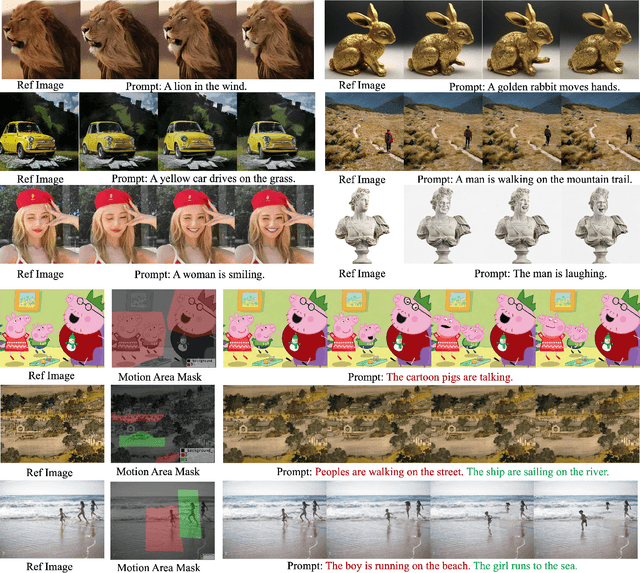
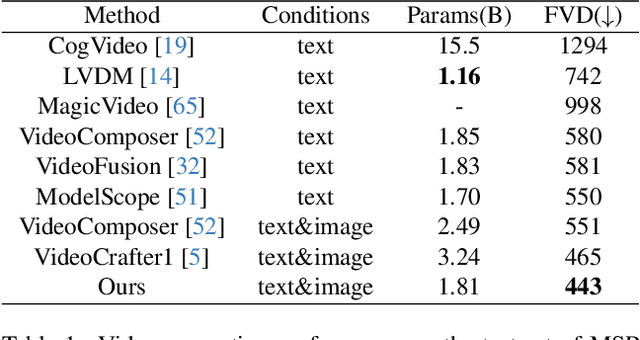
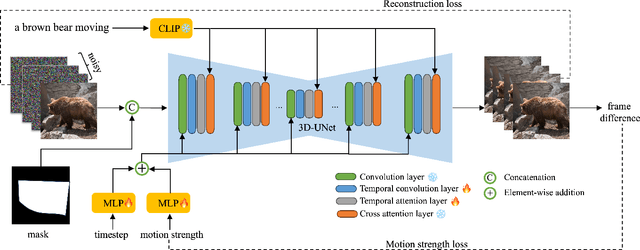
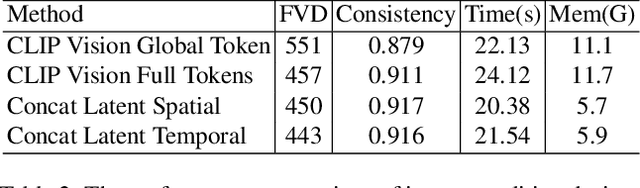
Image animation is a key task in computer vision which aims to generate dynamic visual content from static image. Recent image animation methods employ neural based rendering technique to generate realistic animations. Despite these advancements, achieving fine-grained and controllable image animation guided by text remains challenging, particularly for open-domain images captured in diverse real environments. In this paper, we introduce an open domain image animation method that leverages the motion prior of video diffusion model. Our approach introduces targeted motion area guidance and motion strength guidance, enabling precise control the movable area and its motion speed. This results in enhanced alignment between the animated visual elements and the prompting text, thereby facilitating a fine-grained and interactive animation generation process for intricate motion sequences. We validate the effectiveness of our method through rigorous experiments on an open-domain dataset, with the results showcasing its superior performance. Project page can be found at https://animationai.github.io/AnimateAnything.