 Add to Chrome
 Add to Firefox
 Add to Edge
CoInS-Net: A Continuous Position-Aware Network for Joint Medical Image Interpolation and Segmentation
Aug 10, 2026
Accurate medical image interpolation and anatomical structure segmentation are fundamental for computer-aided diagnosis and treatment planning. Anisotropic medical volumes with sparse through-plane sampling often suffer from structural discontinuity and boundary blur, hindering reliable clinical image analysis. Most existing methods implement interpolation and segmentation independently, which introduces redundant computation and fails to fully exploit complementary cross-slice structural information between sequential slices. To address these issues, we propose a continuous position-aware interaction network, termed CoInS-Net, for joint frame interpolation and lesion segmentation. Unlike conventional cascaded interpolation-then-segmentation paradigms, the framework enables bidirectional interaction under a shared Swin encoder with continuous spatial coordinate queries. A spatially continuous position interpolation module generates target-position features at every scale from the relative coordinate and physical spacing, and a prototype-based task mutual interaction module lets the segmentation and interpolation branches exchange global structure through a small set of shared prototypes rather than dense feature mixing. A multi-scale task-cooperative decoder further separates each scale into shared and task-specific components, so the two tasks reinforce common anatomy while preserving their distinct requirements down to the boundary level, without extra annotations. Experiments on four public medical imaging datasets with diverse modalities and anatomical regions demonstrate that the proposed method outperforms conventional single-task schemes. The joint optimization framework effectively realizes mutual promotion between interpolation and segmentation tasks, providing a reliable and universal technical scheme for intelligent clinical medical image analysis.

Opportunistic Bone-Loss Screening from Routine Knee Radiographs Using a Multi-Task Deep Learning Framework with Sensitivity-Constrained Threshold Optimization
Apr 22, 2026Background: Osteoporosis and osteopenia are often undiagnosed until fragility fractures occur. Dual-energy X-ray absorptiometry (DXA) is the reference standard for bone mineral density (BMD) assessment, but access remains limited. Knee radiographs are obtained at high volume for osteoarthritis evaluation and may offer an opportunity for opportunistic bone-loss screening. Objective: To develop and evaluate a multi-task deep learning system for opportunistic bone-loss screening from routine knee radiographs without additional imaging or patient visits. Methods: We developed STR-Net, a multi-task framework for single-channel grayscale knee radiographs. The model includes a shared backbone, global average pooling feature aggregation, a shared neck, and a task-aware representation routing module connected to three task-specific heads: binary screening (Normal vs. Bone Loss), severity sub-classification (Osteopenia vs. Osteoporosis), and weakly coupled T-score regression with optional clinical variables. A sensitivity-constrained threshold optimization strategy (minimum sensitivity >= 0.86) was applied. The dataset included 1,570 knee radiographs, split at the patient level into training (n=1,120), validation (n=226), and test (n=224) sets. Results: On the held-out test set, STR-Net achieved an AUROC of 0.933, sensitivity of 0.904, specificity of 0.773, and AUPRC of 0.956 for binary screening. Severity sub-classification achieved an AUROC of 0.898. The T-score regression branch showed a Pearson correlation of 0.801 with DXA-measured T-scores in a pilot subset (n=31), with MAE of 0.279 and RMSE of 0.347. Conclusions: STR-Net enables single-pass bone-loss screening, severity stratification, and quantitative T-score estimation from routine knee radiographs. Prospective clinical validation is needed before deployment.
Active Teacher for Semi-Supervised Object Detection
Mar 15, 2023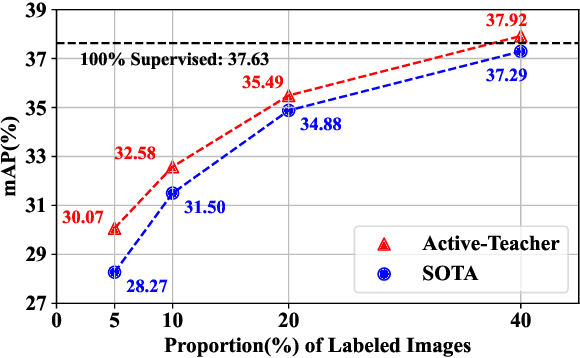

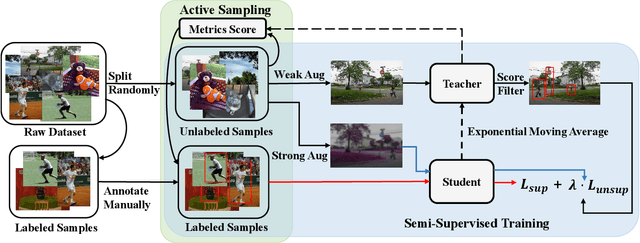

In this paper, we study teacher-student learning from the perspective of data initialization and propose a novel algorithm called Active Teacher(Source code are available at: \url{https://github.com/HunterJ-Lin/ActiveTeacher}) for semi-supervised object detection (SSOD). Active Teacher extends the teacher-student framework to an iterative version, where the label set is partially initialized and gradually augmented by evaluating three key factors of unlabeled examples, including difficulty, information and diversity. With this design, Active Teacher can maximize the effect of limited label information while improving the quality of pseudo-labels. To validate our approach, we conduct extensive experiments on the MS-COCO benchmark and compare Active Teacher with a set of recently proposed SSOD methods. The experimental results not only validate the superior performance gain of Active Teacher over the compared methods, but also show that it enables the baseline network, ie, Faster-RCNN, to achieve 100% supervised performance with much less label expenditure, ie 40% labeled examples on MS-COCO. More importantly, we believe that the experimental analyses in this paper can provide useful empirical knowledge for data annotation in practical applications.