 Add to Chrome
 Add to Firefox
 Add to Edge
Trajectory-Level Automatic Curriculum Learning for Legged Locomotion on Unstructured Terrain
Aug 17, 2026
Training locomotion policies for complex unstructured terrain requires a curriculum to avoid early exploration failures. However, since unstructured terrain lacks explicit difficulty ordering for curriculum design, existing methods resort to heuristic curricula over parameterized terrains. This abstraction limits generalization, as policies can overadapt to near-fixed perceptual patterns. To address this, we propose \textbf{\ourname{}}, an \textbf{T}rajectory-level \textbf{A}utomatic \textbf{C}urriculum \textbf{L}earning framework that generates training tasks directly from unstructured terrain maps. At each curriculum update, the evaluator learns a difficulty function for the current policy that maps a given trajectory task to a difficulty score. The sampler then proposes new trajectories guided by the learned evaluator as the curriculum for the next policy update. This forms a closed loop in which the curriculum is iteratively matched to the evolving policy. Quantitative and qualitative experiments show that \ourname{} continuously provides effective curricula on unstructured terrain, improving trajectory success rate by \(56.3\%\) over direct training without curriculum. Compared with handcrafted curriculum learning, our method improves success rate by \(18.5\%\) on the hardest terrain tasks and by up to \(39.74\%\) when evaluating traversal from diverse approach directions on the same obstacle type.

External Large Foundation Model: How to Efficiently Serve Trillions of Parameters for Online Ads Recommendation
Feb 26, 2025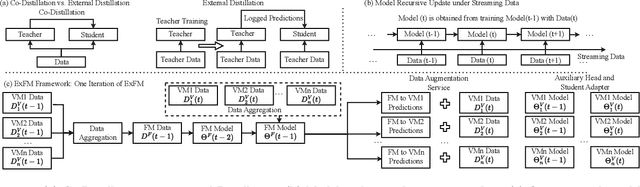
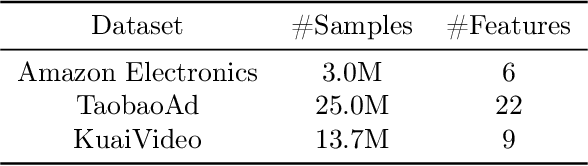
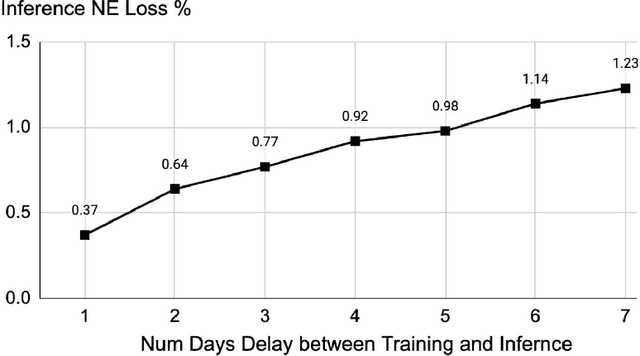
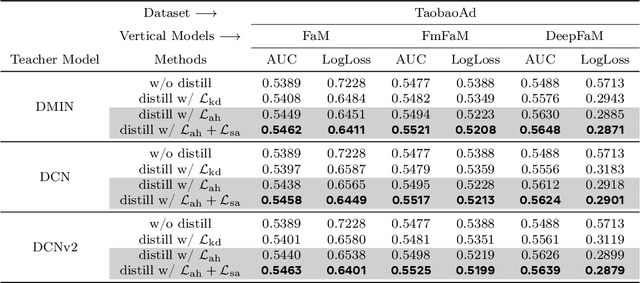
Ads recommendation is a prominent service of online advertising systems and has been actively studied. Recent studies indicate that scaling-up and advanced design of the recommendation model can bring significant performance improvement. However, with a larger model scale, such prior studies have a significantly increasing gap from industry as they often neglect two fundamental challenges in industrial-scale applications. First, training and inference budgets are restricted for the model to be served, exceeding which may incur latency and impair user experience. Second, large-volume data arrive in a streaming mode with data distributions dynamically shifting, as new users/ads join and existing users/ads leave the system. We propose the External Large Foundation Model (ExFM) framework to address the overlooked challenges. Specifically, we develop external distillation and a data augmentation system (DAS) to control the computational cost of training/inference while maintaining high performance. We design the teacher in a way like a foundation model (FM) that can serve multiple students as vertical models (VMs) to amortize its building cost. We propose Auxiliary Head and Student Adapter to mitigate the data distribution gap between FM and VMs caused by the streaming data issue. Comprehensive experiments on internal industrial-scale applications and public datasets demonstrate significant performance gain by ExFM.