 Add to Chrome
 Add to Firefox
 Add to Edge
Can Experts Adapt Without Training? On Test-Time Modality Generalization in MVLMs
Jul 18, 2026
Medical vision-language models (MVLMs) promise broad zero-shot generalization, yet their reliability collapses when confronted with unseen modalities and domains, precisely where clinical robustness matters most. To address this gap, we revisit test-time modality generalization from the perspective of Mixture-of-Experts (MoE) and ask: can experts route-and-adapt without any optimization during inference? We identify a fundamental specialization-generalization dilemma at test time, where blindly aggregating modality experts dilutes modality-specific knowledge, while selecting one highly confident expert risks mismatch under shift. To address this, we propose MoBE: a fully optimization-free framework that performs dynamic expert selection and adaptation at test time. MoBE combines entropy-guided dynamic routing in MoE settings with expert-wise Bayesian adaptation, enabling experts to update their confidence and adapt online without gradient updates. Without parametric updates, MoBE augments a static MVLM with test-time routing and online statistics, achieving average accuracy gains of +4.72, +7.17, and +4.3 over state-of-the-art TTA methods across seen, unseen, and heterogeneous medical benchmarks, highlighting the effectiveness of training-free expert adaptation for robust modality generalization.

Stride-Net: Fairness-Aware Disentangled Representation Learning for Chest X-Ray Diagnosis
Feb 11, 2026Deep neural networks for chest X-ray classification achieve strong average performance, yet often underperform for specific demographic subgroups, raising critical concerns about clinical safety and equity. Existing debiasing methods frequently yield inconsistent improvements across datasets or attain fairness by degrading overall diagnostic utility, treating fairness as a post hoc constraint rather than a property of the learned representation. In this work, we propose Stride-Net (Sensitive Attribute Resilient Learning via Disentanglement and Learnable Masking with Embedding Alignment), a fairness-aware framework that learns disease-discriminative yet demographically invariant representations for chest X-ray analysis. Stride-Net operates at the patch level, using a learnable stride-based mask to select label-aligned image regions while suppressing sensitive attribute information through adversarial confusion loss. To anchor representations in clinical semantics and discourage shortcut learning, we further enforce semantic alignment between image features and BioBERT-based disease label embeddings via Group Optimal Transport. We evaluate Stride-Net on the MIMIC-CXR and CheXpert benchmarks across race and intersectional race-gender subgroups. Across architectures including ResNet and Vision Transformers, Stride-Net consistently improves fairness metrics while matching or exceeding baseline accuracy, achieving a more favorable accuracy-fairness trade-off than prior debiasing approaches. Our code is available at https://github.com/Daraksh/Fairness_StrideNet.
T3: Test-Time Model Merging in VLMs for Zero-Shot Medical Imaging Analysis
Oct 31, 2025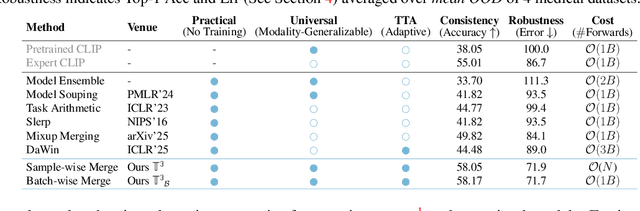
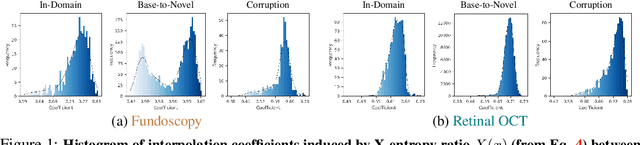
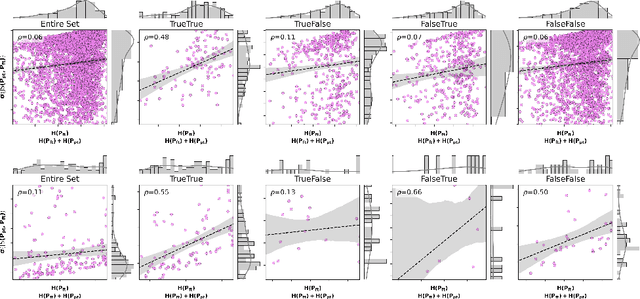
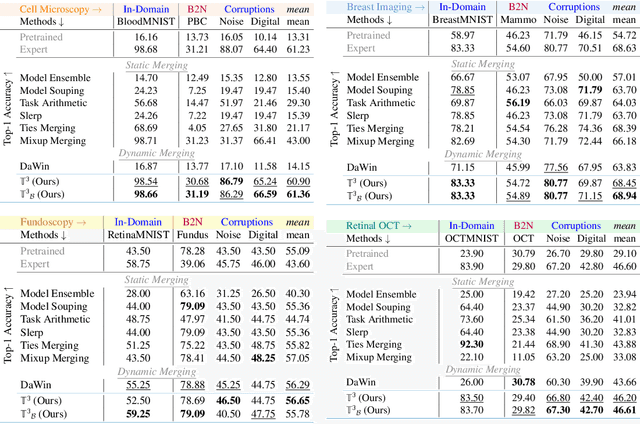
In medical imaging, vision-language models face a critical duality: pretrained networks offer broad robustness but lack subtle, modality-specific characteristics, while fine-tuned expert models achieve high in-distribution accuracy yet falter under modality shift. Existing model-merging techniques, designed for natural-image benchmarks, are simple and efficient but fail to deliver consistent gains across diverse medical modalities; their static interpolation limits reliability in varied clinical tasks. To address this, we introduce Test-Time Task adaptive merging (T^3), a backpropagation-free framework that computes per-sample interpolation coefficients via the Jensen-Shannon divergence between the two models' output distributions. T^3 dynamically preserves local precision when models agree and defers to generalist robustness under drift. To overcome the inference costs of sample-wise merging, we further propose a batch-wise extension, T^3_B, that computes a merging coefficient across a batch of samples, dramatically reducing computational bottleneck. Recognizing the lack of a standardized medical-merging benchmark, we present a rigorous cross-evaluation protocol spanning in-domain, base-to-novel, and corruptions across four modalities. Empirically, T^3 sets new state-of-the-art in Top-1 accuracy and error reduction, outperforming strong baselines while maintaining efficiency, paving the way for adaptive MVLM deployment in clinical settings. Our code is available at https://github.com/Razaimam45/TCube.
Decoupling Clinical and Class-Agnostic Features for Reliable Few-Shot Adaptation under Shift
Sep 11, 2025Medical vision-language models (VLMs) offer promise for clinical decision support, yet their reliability under distribution shifts remains a major concern for safe deployment. These models often learn task-agnostic correlations due to variability in imaging protocols and free-text reports, limiting their generalizability and increasing the risk of failure in real-world settings. We propose DRiFt, a structured feature decoupling framework that explicitly separates clinically relevant signals from task-agnostic noise using parameter-efficient tuning (LoRA) and learnable prompt tokens. To enhance cross-modal alignment and reduce uncertainty, we curate high-quality, clinically grounded image-text pairs by generating captions for a diverse medical dataset. Our approach improves in-distribution performance by +11.4% Top-1 accuracy and +3.3% Macro-F1 over prior prompt-based methods, while maintaining strong robustness across unseen datasets. Ablation studies reveal that disentangling task-relevant features and careful alignment significantly enhance model generalization and reduce unpredictable behavior under domain shift. These insights contribute toward building safer, more trustworthy VLMs for clinical use. The code is available at https://github.com/rumaima/DRiFt.
On the Robustness of Medical Vision-Language Models: Are they Truly Generalizable?
May 21, 2025Medical Vision-Language Models (MVLMs) have achieved par excellence generalization in medical image analysis, yet their performance under noisy, corrupted conditions remains largely untested. Clinical imaging is inherently susceptible to acquisition artifacts and noise; however, existing evaluations predominantly assess generally clean datasets, overlooking robustness -- i.e., the model's ability to perform under real-world distortions. To address this gap, we first introduce MediMeta-C, a corruption benchmark that systematically applies several perturbations across multiple medical imaging datasets. Combined with MedMNIST-C, this establishes a comprehensive robustness evaluation framework for MVLMs. We further propose RobustMedCLIP, a visual encoder adaptation of a pretrained MVLM that incorporates few-shot tuning to enhance resilience against corruptions. Through extensive experiments, we benchmark 5 major MVLMs across 5 medical imaging modalities, revealing that existing models exhibit severe degradation under corruption and struggle with domain-modality tradeoffs. Our findings highlight the necessity of diverse training and robust adaptation strategies, demonstrating that efficient low-rank adaptation when paired with few-shot tuning, improves robustness while preserving generalization across modalities.
Noise is an Efficient Learner for Zero-Shot Vision-Language Models
Feb 09, 2025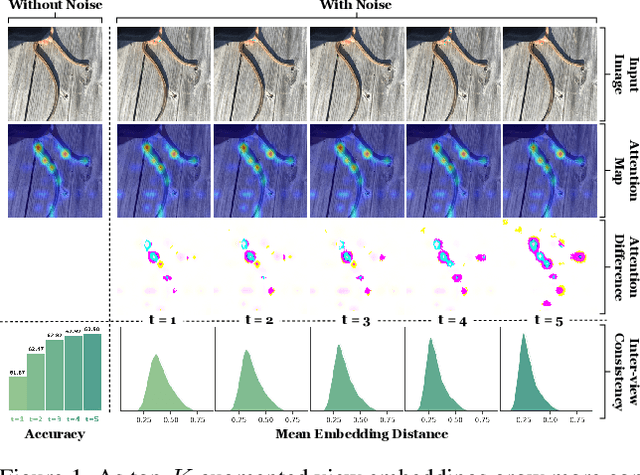
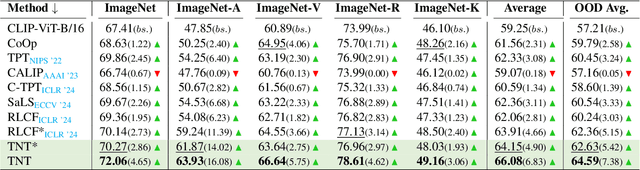
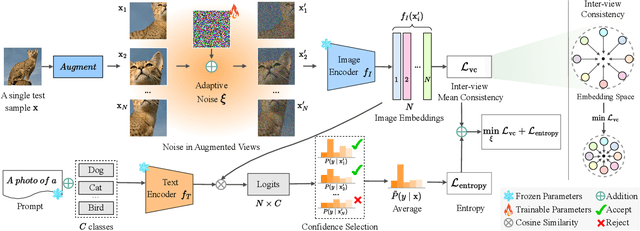
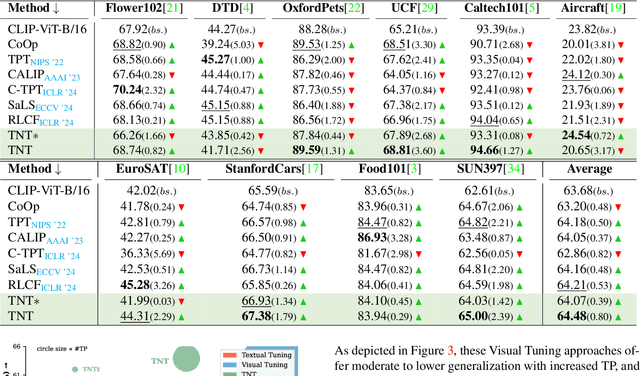
Recently, test-time adaptation has garnered attention as a method for tuning models without labeled data. The conventional modus operandi for adapting pre-trained vision-language models (VLMs) during test-time primarily focuses on tuning learnable prompts; however, this approach overlooks potential distribution shifts in the visual representations themselves. In this work, we address this limitation by introducing Test-Time Noise Tuning (TNT), a novel method for handling unpredictable shifts in the visual space. TNT leverages, for the first time, a noise adaptation strategy that optimizes learnable noise directly in the visual input space, enabling adaptive feature learning from a single test sample. We further introduce a novel approach for inter-view representation alignment by explicitly enforcing coherence in embedding distances, ensuring consistent feature representations across views. Combined with scaled logits and confident view selection at inference, TNT substantially enhances VLM generalization and calibration, achieving average gains of +7.38% on natural distributions benchmark and +0.80% on cross-dataset evaluations over zero-shot CLIP. These improvements lay a strong foundation for adaptive out-of-distribution handling.
Introducing SDICE: An Index for Assessing Diversity of Synthetic Medical Datasets
Sep 28, 2024


Advancements in generative modeling are pushing the state-of-the-art in synthetic medical image generation. These synthetic images can serve as an effective data augmentation method to aid the development of more accurate machine learning models for medical image analysis. While the fidelity of these synthetic images has progressively increased, the diversity of these images is an understudied phenomenon. In this work, we propose the SDICE index, which is based on the characterization of similarity distributions induced by a contrastive encoder. Given a synthetic dataset and a reference dataset of real images, the SDICE index measures the distance between the similarity score distributions of original and synthetic images, where the similarity scores are estimated using a pre-trained contrastive encoder. This distance is then normalized using an exponential function to provide a consistent metric that can be easily compared across domains. Experiments conducted on the MIMIC-chest X-ray and ImageNet datasets demonstrate the effectiveness of SDICE index in assessing synthetic medical dataset diversity.
MedUnA: Language guided Unsupervised Adaptation of Vision-Language Models for Medical Image Classification
Sep 03, 2024In medical image classification, supervised learning is challenging due to the lack of labeled medical images. Contrary to the traditional \textit{modus operandi} of pre-training followed by fine-tuning, this work leverages the visual-textual alignment within Vision-Language models (\texttt{VLMs}) to facilitate the unsupervised learning. Specifically, we propose \underline{Med}ical \underline{Un}supervised \underline{A}daptation (\texttt{MedUnA}), constituting two-stage training: Adapter Pre-training, and Unsupervised Learning. In the first stage, we use descriptions generated by a Large Language Model (\texttt{LLM}) corresponding to class labels, which are passed through the text encoder \texttt{BioBERT}. The resulting text embeddings are then aligned with the class labels by training a lightweight \texttt{adapter}. We choose \texttt{\texttt{LLMs}} because of their capability to generate detailed, contextually relevant descriptions to obtain enhanced text embeddings. In the second stage, the trained \texttt{adapter} is integrated with the visual encoder of \texttt{MedCLIP}. This stage employs a contrastive entropy-based loss and prompt tuning to align visual embeddings. We incorporate self-entropy minimization into the overall training objective to ensure more confident embeddings, which are crucial for effective unsupervised learning and alignment. We evaluate the performance of \texttt{MedUnA} on three different kinds of data modalities - chest X-rays, eye fundus and skin lesion images. The results demonstrate significant accuracy gain on average compared to the baselines across different datasets, highlighting the efficacy of our approach.
Test-Time Low Rank Adaptation via Confidence Maximization for Zero-Shot Generalization of Vision-Language Models
Jul 22, 2024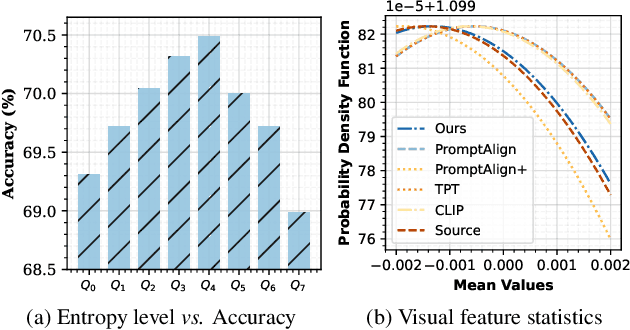
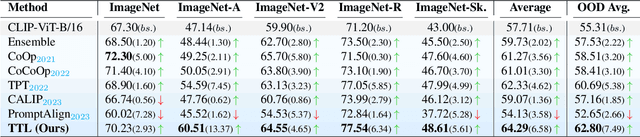
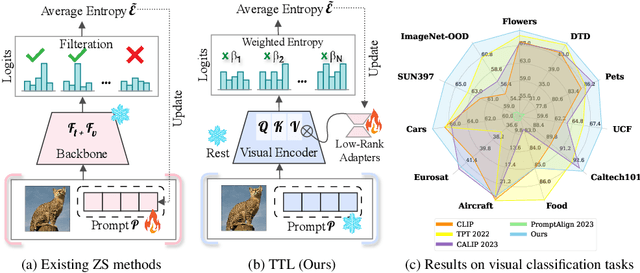
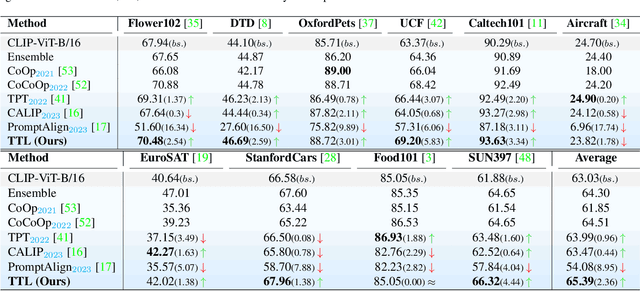
The conventional modus operandi for adapting pre-trained vision-language models (VLMs) during test-time involves tuning learnable prompts, ie, test-time prompt tuning. This paper introduces Test-Time Low-rank adaptation (TTL) as an alternative to prompt tuning for zero-shot generalization of large-scale VLMs. Taking inspiration from recent advancements in efficiently fine-tuning large language models, TTL offers a test-time parameter-efficient adaptation approach that updates the attention weights of the transformer encoder by maximizing prediction confidence. The self-supervised confidence maximization objective is specified using a weighted entropy loss that enforces consistency among predictions of augmented samples. TTL introduces only a small amount of trainable parameters for low-rank adapters in the model space while keeping the prompts and backbone frozen. Extensive experiments on a variety of natural distribution and cross-domain tasks show that TTL can outperform other techniques for test-time optimization of VLMs in strict zero-shot settings. Specifically, TTL outperforms test-time prompt tuning baselines with a significant improvement on average. Our code is available at at https://github.com/Razaimam45/TTL-Test-Time-Low-Rank-Adaptation.
CosmoCLIP: Generalizing Large Vision-Language Models for Astronomical Imaging
Jul 10, 2024


Existing vision-text contrastive learning models enhance representation transferability and support zero-shot prediction by matching paired image and caption embeddings while pushing unrelated pairs apart. However, astronomical image-label datasets are significantly smaller compared to general image and label datasets available from the internet. We introduce CosmoCLIP, an astronomical image-text contrastive learning framework precisely fine-tuned on the pre-trained CLIP model using SpaceNet and BLIP-based captions. SpaceNet, attained via FLARE, constitutes ~13k optimally distributed images, while BLIP acts as a rich knowledge extractor. The rich semantics derived from this SpaceNet and BLIP descriptions, when learned contrastively, enable CosmoCLIP to achieve superior generalization across various in-domain and out-of-domain tasks. Our results demonstrate that CosmoCLIP is a straightforward yet powerful framework, significantly outperforming CLIP in zero-shot classification and image-text retrieval tasks.