 Add to Chrome
 Add to Firefox
 Add to Edge
Learning a Natural Language Interface with Neural Programmer
Mar 02, 2017
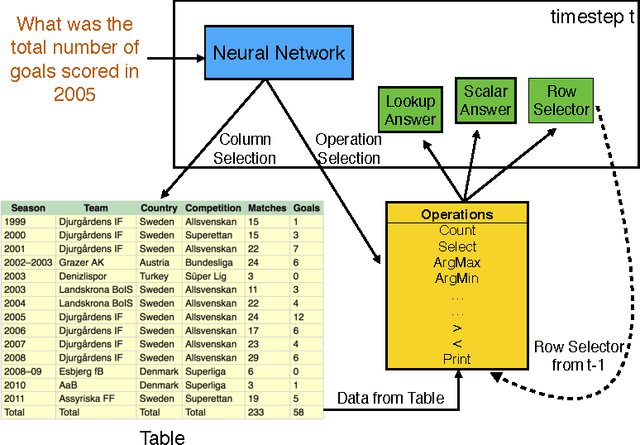
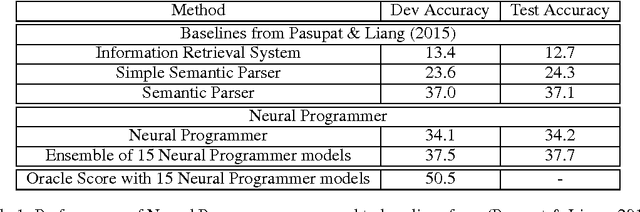
Learning a natural language interface for database tables is a challenging task that involves deep language understanding and multi-step reasoning. The task is often approached by mapping natural language queries to logical forms or programs that provide the desired response when executed on the database. To our knowledge, this paper presents the first weakly supervised, end-to-end neural network model to induce such programs on a real-world dataset. We enhance the objective function of Neural Programmer, a neural network with built-in discrete operations, and apply it on WikiTableQuestions, a natural language question-answering dataset. The model is trained end-to-end with weak supervision of question-answer pairs, and does not require domain-specific grammars, rules, or annotations that are key elements in previous approaches to program induction. The main experimental result in this paper is that a single Neural Programmer model achieves 34.2% accuracy using only 10,000 examples with weak supervision. An ensemble of 15 models, with a trivial combination technique, achieves 37.7% accuracy, which is competitive to the current state-of-the-art accuracy of 37.1% obtained by a traditional natural language semantic parser.

Neural Architecture Search with Reinforcement Learning
Feb 15, 2017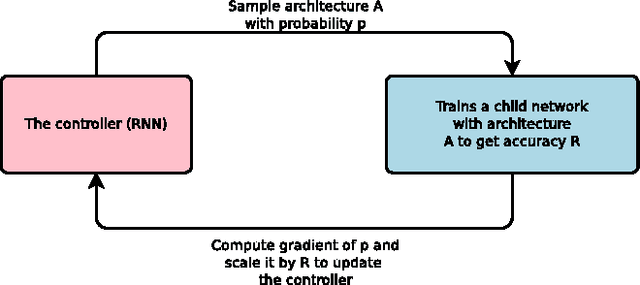
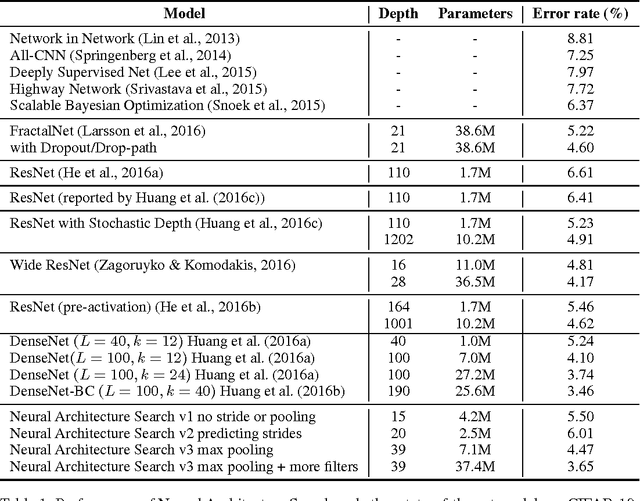
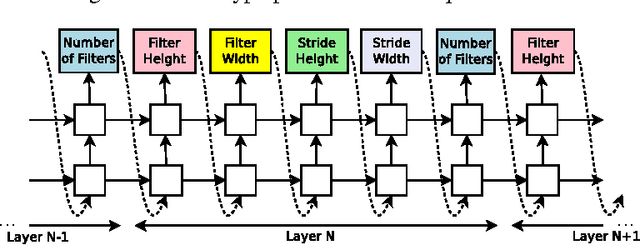
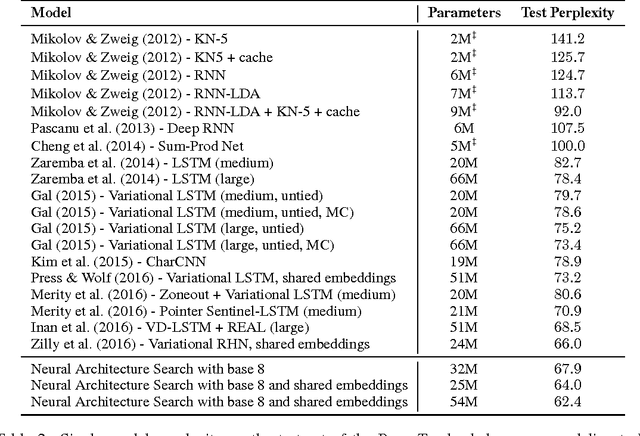
Neural networks are powerful and flexible models that work well for many difficult learning tasks in image, speech and natural language understanding. Despite their success, neural networks are still hard to design. In this paper, we use a recurrent network to generate the model descriptions of neural networks and train this RNN with reinforcement learning to maximize the expected accuracy of the generated architectures on a validation set. On the CIFAR-10 dataset, our method, starting from scratch, can design a novel network architecture that rivals the best human-invented architecture in terms of test set accuracy. Our CIFAR-10 model achieves a test error rate of 3.65, which is 0.09 percent better and 1.05x faster than the previous state-of-the-art model that used a similar architectural scheme. On the Penn Treebank dataset, our model can compose a novel recurrent cell that outperforms the widely-used LSTM cell, and other state-of-the-art baselines. Our cell achieves a test set perplexity of 62.4 on the Penn Treebank, which is 3.6 perplexity better than the previous state-of-the-art model. The cell can also be transferred to the character language modeling task on PTB and achieves a state-of-the-art perplexity of 1.214.
Neural Combinatorial Optimization with Reinforcement Learning
Jan 12, 2017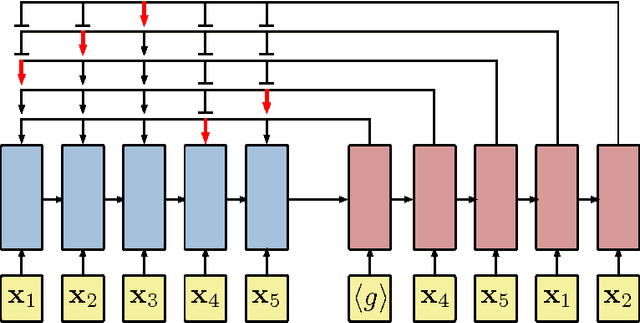
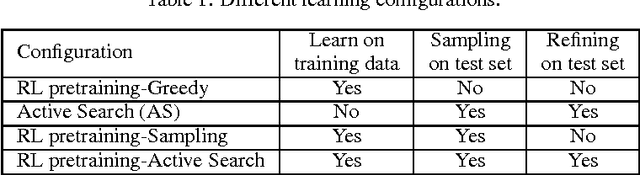


This paper presents a framework to tackle combinatorial optimization problems using neural networks and reinforcement learning. We focus on the traveling salesman problem (TSP) and train a recurrent network that, given a set of city coordinates, predicts a distribution over different city permutations. Using negative tour length as the reward signal, we optimize the parameters of the recurrent network using a policy gradient method. We compare learning the network parameters on a set of training graphs against learning them on individual test graphs. Despite the computational expense, without much engineering and heuristic designing, Neural Combinatorial Optimization achieves close to optimal results on 2D Euclidean graphs with up to 100 nodes. Applied to the KnapSack, another NP-hard problem, the same method obtains optimal solutions for instances with up to 200 items.
HyperNetworks
Dec 01, 2016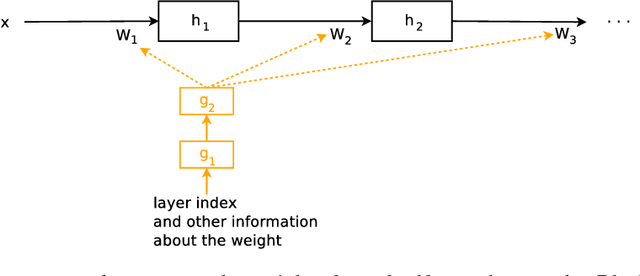
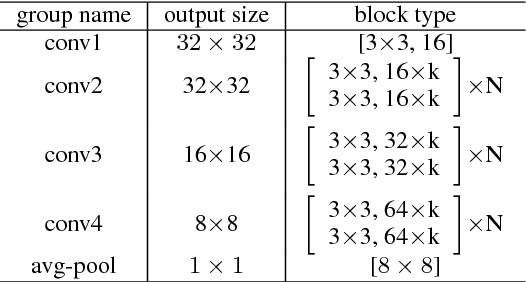
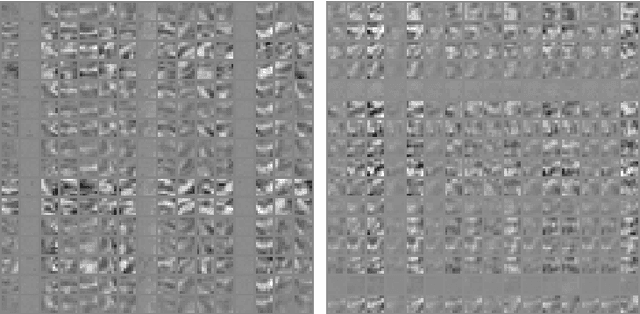
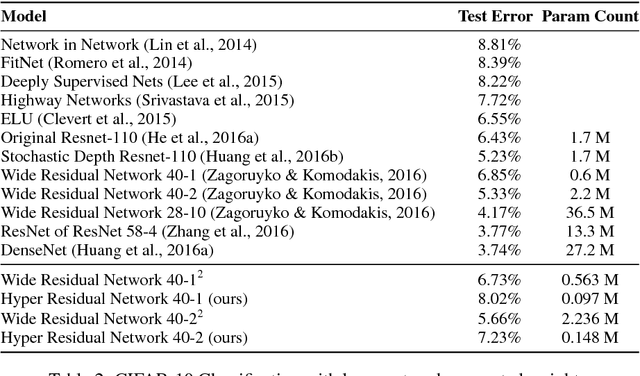
This work explores hypernetworks: an approach of using a one network, also known as a hypernetwork, to generate the weights for another network. Hypernetworks provide an abstraction that is similar to what is found in nature: the relationship between a genotype - the hypernetwork - and a phenotype - the main network. Though they are also reminiscent of HyperNEAT in evolution, our hypernetworks are trained end-to-end with backpropagation and thus are usually faster. The focus of this work is to make hypernetworks useful for deep convolutional networks and long recurrent networks, where hypernetworks can be viewed as relaxed form of weight-sharing across layers. Our main result is that hypernetworks can generate non-shared weights for LSTM and achieve near state-of-the-art results on a variety of sequence modelling tasks including character-level language modelling, handwriting generation and neural machine translation, challenging the weight-sharing paradigm for recurrent networks. Our results also show that hypernetworks applied to convolutional networks still achieve respectable results for image recognition tasks compared to state-of-the-art baseline models while requiring fewer learnable parameters.
Google's Neural Machine Translation System: Bridging the Gap between Human and Machine Translation
Oct 08, 2016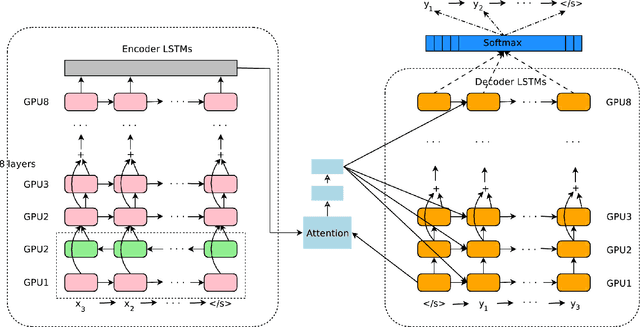
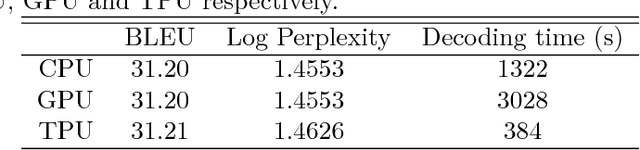
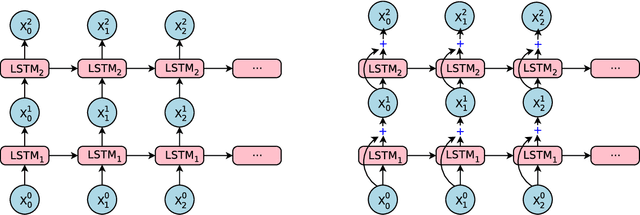
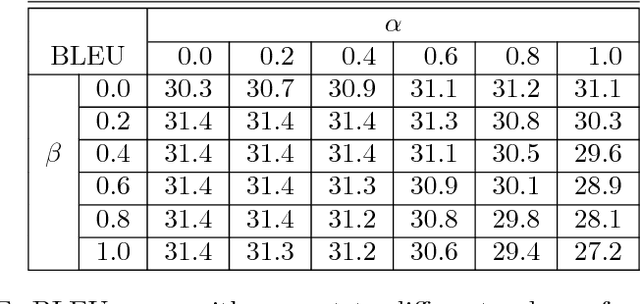
Neural Machine Translation (NMT) is an end-to-end learning approach for automated translation, with the potential to overcome many of the weaknesses of conventional phrase-based translation systems. Unfortunately, NMT systems are known to be computationally expensive both in training and in translation inference. Also, most NMT systems have difficulty with rare words. These issues have hindered NMT's use in practical deployments and services, where both accuracy and speed are essential. In this work, we present GNMT, Google's Neural Machine Translation system, which attempts to address many of these issues. Our model consists of a deep LSTM network with 8 encoder and 8 decoder layers using attention and residual connections. To improve parallelism and therefore decrease training time, our attention mechanism connects the bottom layer of the decoder to the top layer of the encoder. To accelerate the final translation speed, we employ low-precision arithmetic during inference computations. To improve handling of rare words, we divide words into a limited set of common sub-word units ("wordpieces") for both input and output. This method provides a good balance between the flexibility of "character"-delimited models and the efficiency of "word"-delimited models, naturally handles translation of rare words, and ultimately improves the overall accuracy of the system. Our beam search technique employs a length-normalization procedure and uses a coverage penalty, which encourages generation of an output sentence that is most likely to cover all the words in the source sentence. On the WMT'14 English-to-French and English-to-German benchmarks, GNMT achieves competitive results to state-of-the-art. Using a human side-by-side evaluation on a set of isolated simple sentences, it reduces translation errors by an average of 60% compared to Google's phrase-based production system.
A Neural Transducer
Aug 04, 2016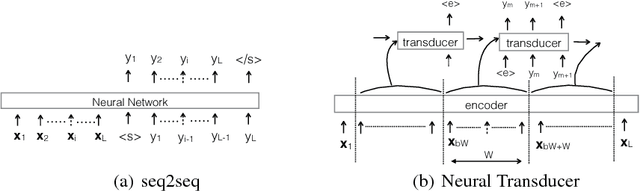

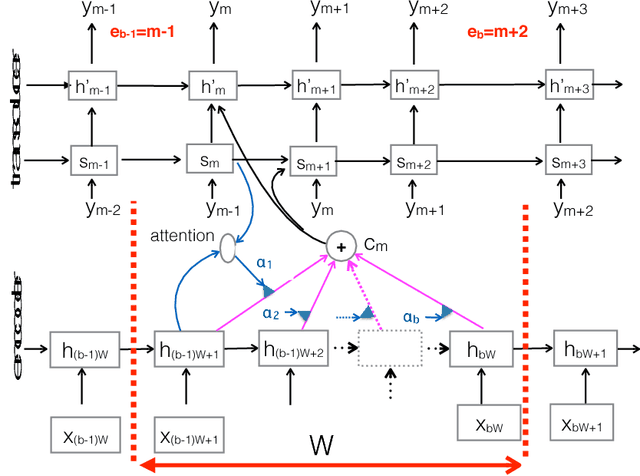
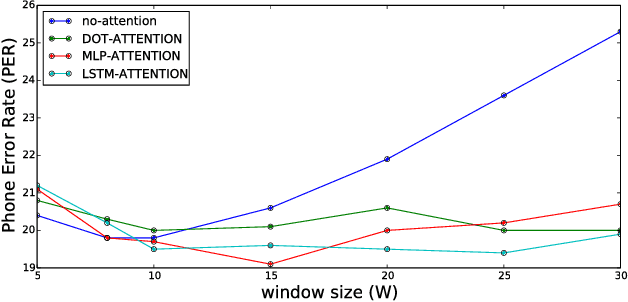
Sequence-to-sequence models have achieved impressive results on various tasks. However, they are unsuitable for tasks that require incremental predictions to be made as more data arrives or tasks that have long input sequences and output sequences. This is because they generate an output sequence conditioned on an entire input sequence. In this paper, we present a Neural Transducer that can make incremental predictions as more input arrives, without redoing the entire computation. Unlike sequence-to-sequence models, the Neural Transducer computes the next-step distribution conditioned on the partially observed input sequence and the partially generated sequence. At each time step, the transducer can decide to emit zero to many output symbols. The data can be processed using an encoder and presented as input to the transducer. The discrete decision to emit a symbol at every time step makes it difficult to learn with conventional backpropagation. It is however possible to train the transducer by using a dynamic programming algorithm to generate target discrete decisions. Our experiments show that the Neural Transducer works well in settings where it is required to produce output predictions as data come in. We also find that the Neural Transducer performs well for long sequences even when attention mechanisms are not used.
Neural Programmer: Inducing Latent Programs with Gradient Descent
Aug 04, 2016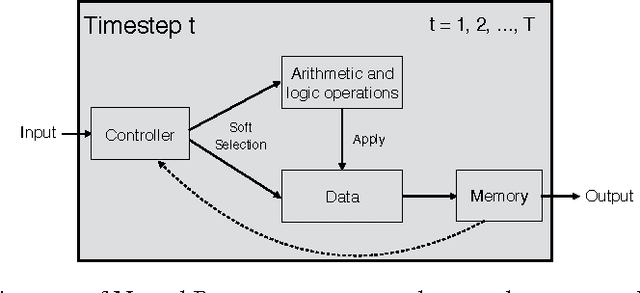
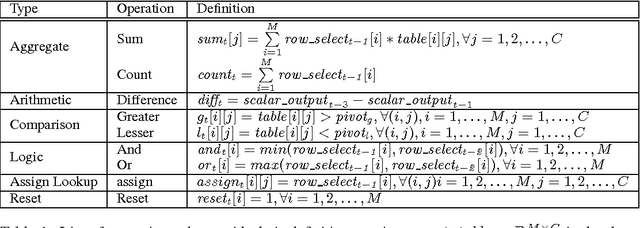
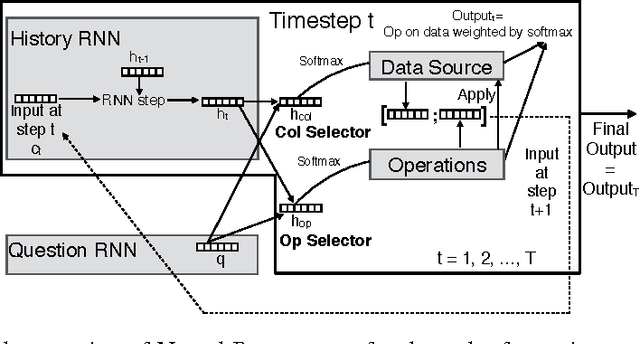
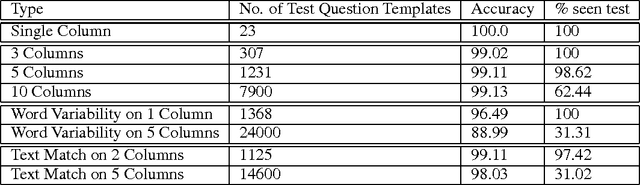
Deep neural networks have achieved impressive supervised classification performance in many tasks including image recognition, speech recognition, and sequence to sequence learning. However, this success has not been translated to applications like question answering that may involve complex arithmetic and logic reasoning. A major limitation of these models is in their inability to learn even simple arithmetic and logic operations. For example, it has been shown that neural networks fail to learn to add two binary numbers reliably. In this work, we propose Neural Programmer, an end-to-end differentiable neural network augmented with a small set of basic arithmetic and logic operations. Neural Programmer can call these augmented operations over several steps, thereby inducing compositional programs that are more complex than the built-in operations. The model learns from a weak supervision signal which is the result of execution of the correct program, hence it does not require expensive annotation of the correct program itself. The decisions of what operations to call, and what data segments to apply to are inferred by Neural Programmer. Such decisions, during training, are done in a differentiable fashion so that the entire network can be trained jointly by gradient descent. We find that training the model is difficult, but it can be greatly improved by adding random noise to the gradient. On a fairly complex synthetic table-comprehension dataset, traditional recurrent networks and attentional models perform poorly while Neural Programmer typically obtains nearly perfect accuracy.
Multi-task Sequence to Sequence Learning
Mar 01, 2016
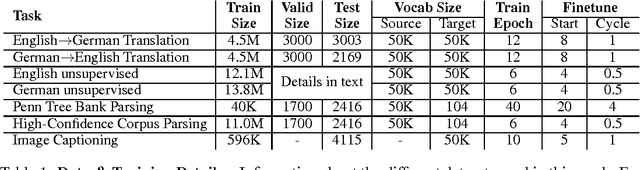
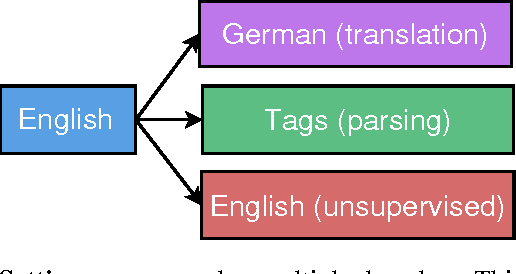
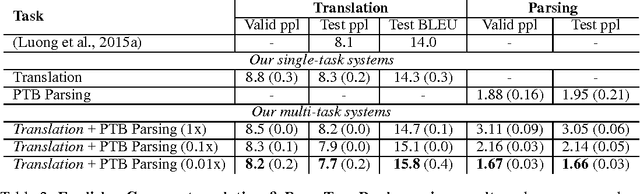
Sequence to sequence learning has recently emerged as a new paradigm in supervised learning. To date, most of its applications focused on only one task and not much work explored this framework for multiple tasks. This paper examines three multi-task learning (MTL) settings for sequence to sequence models: (a) the oneto-many setting - where the encoder is shared between several tasks such as machine translation and syntactic parsing, (b) the many-to-one setting - useful when only the decoder can be shared, as in the case of translation and image caption generation, and (c) the many-to-many setting - where multiple encoders and decoders are shared, which is the case with unsupervised objectives and translation. Our results show that training on a small amount of parsing and image caption data can improve the translation quality between English and German by up to 1.5 BLEU points over strong single-task baselines on the WMT benchmarks. Furthermore, we have established a new state-of-the-art result in constituent parsing with 93.0 F1. Lastly, we reveal interesting properties of the two unsupervised learning objectives, autoencoder and skip-thought, in the MTL context: autoencoder helps less in terms of perplexities but more on BLEU scores compared to skip-thought.
Adding Gradient Noise Improves Learning for Very Deep Networks
Nov 21, 2015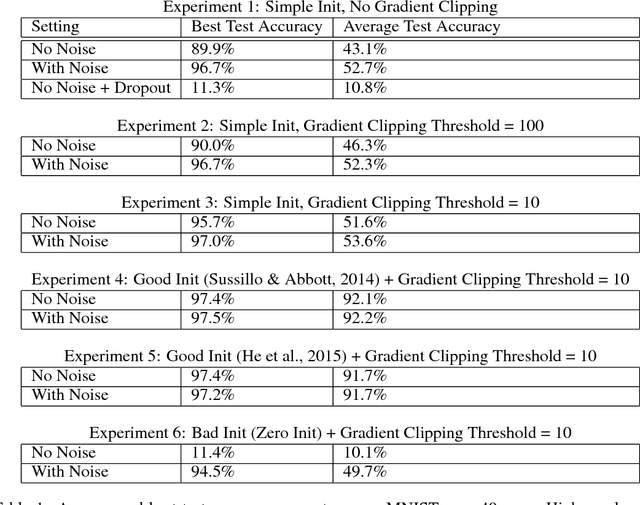
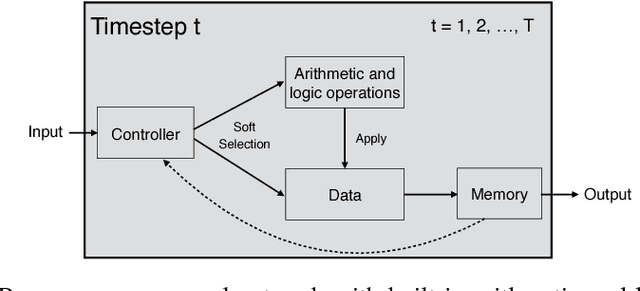
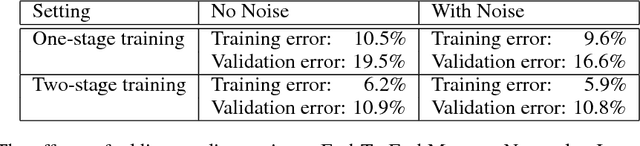
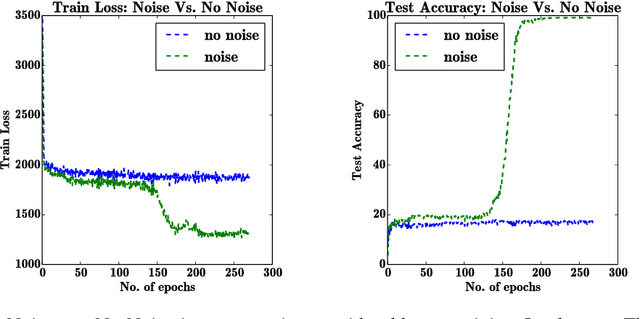
Deep feedforward and recurrent networks have achieved impressive results in many perception and language processing applications. This success is partially attributed to architectural innovations such as convolutional and long short-term memory networks. The main motivation for these architectural innovations is that they capture better domain knowledge, and importantly are easier to optimize than more basic architectures. Recently, more complex architectures such as Neural Turing Machines and Memory Networks have been proposed for tasks including question answering and general computation, creating a new set of optimization challenges. In this paper, we discuss a low-overhead and easy-to-implement technique of adding gradient noise which we find to be surprisingly effective when training these very deep architectures. The technique not only helps to avoid overfitting, but also can result in lower training loss. This method alone allows a fully-connected 20-layer deep network to be trained with standard gradient descent, even starting from a poor initialization. We see consistent improvements for many complex models, including a 72% relative reduction in error rate over a carefully-tuned baseline on a challenging question-answering task, and a doubling of the number of accurate binary multiplication models learned across 7,000 random restarts. We encourage further application of this technique to additional complex modern architectures.
Semi-supervised Sequence Learning
Nov 04, 2015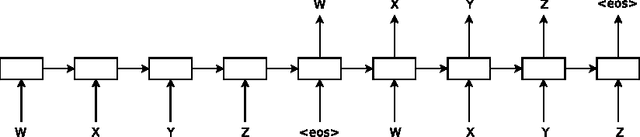
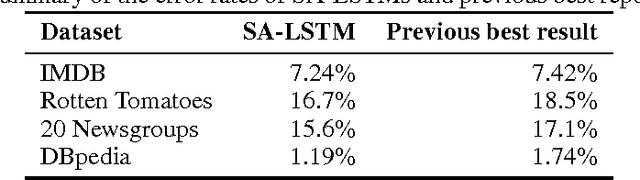
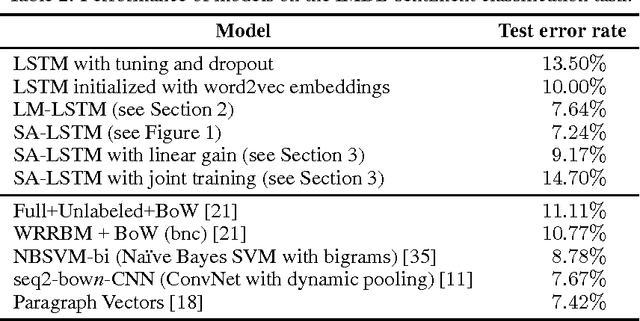
We present two approaches that use unlabeled data to improve sequence learning with recurrent networks. The first approach is to predict what comes next in a sequence, which is a conventional language model in natural language processing. The second approach is to use a sequence autoencoder, which reads the input sequence into a vector and predicts the input sequence again. These two algorithms can be used as a "pretraining" step for a later supervised sequence learning algorithm. In other words, the parameters obtained from the unsupervised step can be used as a starting point for other supervised training models. In our experiments, we find that long short term memory recurrent networks after being pretrained with the two approaches are more stable and generalize better. With pretraining, we are able to train long short term memory recurrent networks up to a few hundred timesteps, thereby achieving strong performance in many text classification tasks, such as IMDB, DBpedia and 20 Newsgroups.