 Add to Chrome
 Add to Firefox
 Add to Edge
Accelerating Masked Image Generation by Learning Latent Controlled Dynamics
Feb 27, 2026
Masked Image Generation Models (MIGMs) have achieved great success, yet their efficiency is hampered by the multiple steps of bi-directional attention. In fact, there exists notable redundancy in their computation: when sampling discrete tokens, the rich semantics contained in the continuous features are lost. Some existing works attempt to cache the features to approximate future features. However, they exhibit considerable approximation error under aggressive acceleration rates. We attribute this to their limited expressivity and the failure to account for sampling information. To fill this gap, we propose to learn a lightweight model that incorporates both previous features and sampled tokens, and regresses the average velocity field of feature evolution. The model has moderate complexity that suffices to capture the subtle dynamics while keeping lightweight compared to the original base model. We apply our method, MIGM-Shortcut, to two representative MIGM architectures and tasks. In particular, on the state-of-the-art Lumina-DiMOO, it achieves over 4x acceleration of text-to-image generation while maintaining quality, significantly pushing the Pareto frontier of masked image generation. The code and model weights are available at https://github.com/Kaiwen-Zhu/MIGM-Shortcut.

DenseVLM: A Retrieval and Decoupled Alignment Framework for Open-Vocabulary Dense Prediction
Dec 09, 2024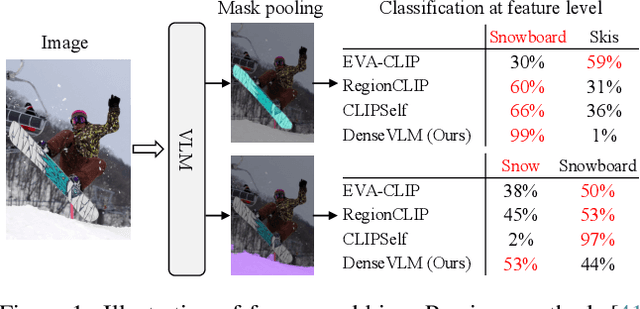
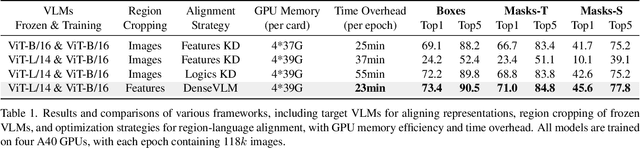
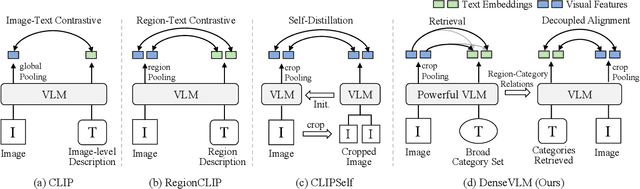
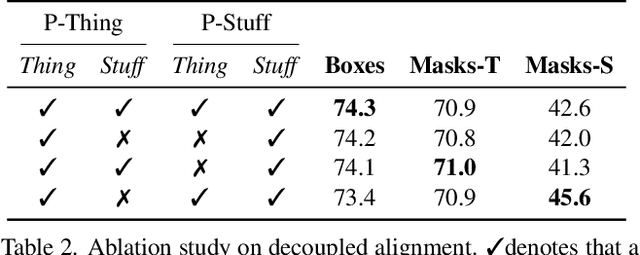
Pre-trained vision-language models (VLMs), such as CLIP, have demonstrated impressive zero-shot recognition capability, but still underperform in dense prediction tasks. Self-distillation recently is emerging as a promising approach for fine-tuning VLMs to better adapt to local regions without requiring extensive annotations. However, previous state-of-the-art approaches often suffer from significant `foreground bias', where models tend to wrongly identify background regions as foreground objects. To alleviate this issue, we propose DenseVLM, a framework designed to learn unbiased region-language alignment from powerful pre-trained VLM representations. By leveraging the pre-trained VLM to retrieve categories for unlabeled regions, DenseVLM effectively decouples the interference between foreground and background region features, ensuring that each region is accurately aligned with its corresponding category. We show that DenseVLM can be seamlessly integrated into open-vocabulary object detection and image segmentation tasks, leading to notable performance improvements. Furthermore, it exhibits promising zero-shot scalability when training on more extensive and diverse datasets.
Cascade-CLIP: Cascaded Vision-Language Embeddings Alignment for Zero-Shot Semantic Segmentation
Jun 02, 2024
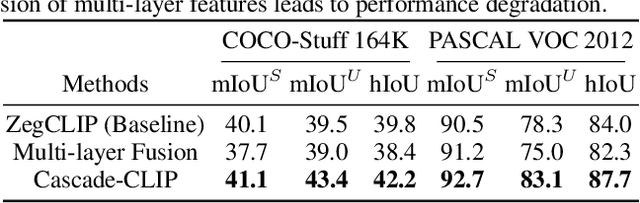
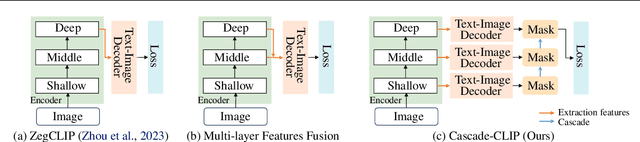
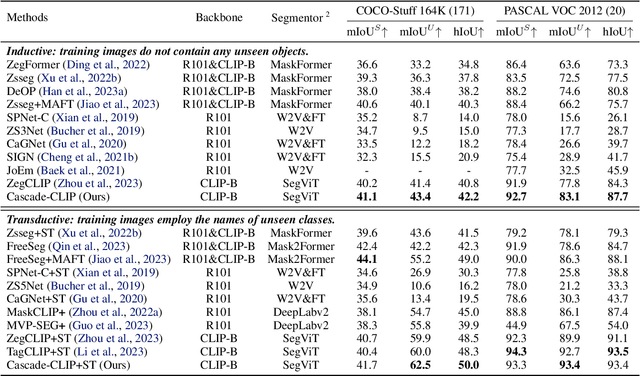
Pre-trained vision-language models, e.g., CLIP, have been successfully applied to zero-shot semantic segmentation. Existing CLIP-based approaches primarily utilize visual features from the last layer to align with text embeddings, while they neglect the crucial information in intermediate layers that contain rich object details. However, we find that directly aggregating the multi-level visual features weakens the zero-shot ability for novel classes. The large differences between the visual features from different layers make these features hard to align well with the text embeddings. We resolve this problem by introducing a series of independent decoders to align the multi-level visual features with the text embeddings in a cascaded way, forming a novel but simple framework named Cascade-CLIP. Our Cascade-CLIP is flexible and can be easily applied to existing zero-shot semantic segmentation methods. Experimental results show that our simple Cascade-CLIP achieves superior zero-shot performance on segmentation benchmarks, like COCO-Stuff, Pascal-VOC, and Pascal-Context. Our code is available at: https://github.com/HVision-NKU/Cascade-CLIP
MCANet: Medical Image Segmentation with Multi-Scale Cross-Axis Attention
Dec 20, 2023Efficiently capturing multi-scale information and building long-range dependencies among pixels are essential for medical image segmentation because of the various sizes and shapes of the lesion regions or organs. In this paper, we present Multi-scale Cross-axis Attention (MCA) to solve the above challenging issues based on the efficient axial attention. Instead of simply connecting axial attention along the horizontal and vertical directions sequentially, we propose to calculate dual cross attentions between two parallel axial attentions to capture global information better. To process the significant variations of lesion regions or organs in individual sizes and shapes, we also use multiple convolutions of strip-shape kernels with different kernel sizes in each axial attention path to improve the efficiency of the proposed MCA in encoding spatial information. We build the proposed MCA upon the MSCAN backbone, yielding our network, termed MCANet. Our MCANet with only 4M+ parameters performs even better than most previous works with heavy backbones (e.g., Swin Transformer) on four challenging tasks, including skin lesion segmentation, nuclei segmentation, abdominal multi-organ segmentation, and polyp segmentation. Code is available at https://github.com/haoshao-nku/medical_seg.