 Add to Chrome
 Add to Firefox
 Add to Edge
Bridging the Gap Between Hyperdimensional Computing and Kernel Methods via the Nyström Method
Aug 07, 2026
Hyperdimensional computing (HDC) is an approach from the cognitive science literature for solving information processing tasks using data represented as high-dimensional random vectors. The technique has a rigorous mathematical backing, and is easy to implement in energy-efficient and highly parallel hardware like FPGAs and "processing-in-memory" architectures. The effectiveness of HDC in machine learning largely depends on how raw data is mapped to high-dimensional space. In this work, we propose NysHD, a new method for constructing this mapping that is based on the Nyström method from the literature on kernel approximation. Our approach provides a simple recipe to turn any user-defined positive-semidefinite similarity function into an equivalent mapping in HDC. There is a vast literature on the design of such functions for learning problems. Our approach provides a mechanism to import them into the HDC setting, expanding the types of problems that can be tackled using HDC. Empirical evaluation against existing HDC encoding methods shows that NysHD can achieve, on average, 11% and 17% better classification accuracy on graph and string datasets respectively.

RGLD: Randomized Global-Local Density Estimation for Tabular Anomaly Detection
Jun 27, 2026Unsupervised tabular anomaly detection requires methods that are accurate, robust across heterogeneous datasets, and computationally efficient. Classical statistical detectors are often efficient, but they usually rely on a fixed data view and a single notion of abnormality. Deep anomaly detectors can learn more flexible scoring functions, but they are substantially slower and difficult to tune in unsupervised settings due to the lack of a reliable supervisory signal. We propose RGLD, a randomized global-local density estimator for efficient unsupervised tabular anomaly detection. RGLD combines a global random-feature density branch, which identifies samples in broadly low-density regions, with a local neighbor branch, which detects samples that are weakly supported by nearby observations. Both branches operate over feature-bagged randomized views, allowing RGLD to expose anomaly evidence that may be hidden in any single representation. We conduct experiments on 47 tabular datasets against 23 statistical and deep anomaly detection baselines under fully unsupervised setting. RGLD achieves the strongest dataset-level AUROC performance, ranking 1st in dataset wins, and ranks 2nd in AUPRC wins. RGLD is also faster than all evaluated deep detectors, achieving 50x-580x speedups, and remains competitive with statistical methods in runtime, yielding a favorable accuracy-efficiency tradeoff.
A3-FPN: Asymptotic Content-Aware Pyramid Attention Network for Dense Visual Prediction
Apr 11, 2026Learning multi-scale representations is the common strategy to tackle object scale variation in dense prediction tasks. Although existing feature pyramid networks have greatly advanced visual recognition, inherent design defects inhibit them from capturing discriminative features and recognizing small objects. In this work, we propose Asymptotic Content-Aware Pyramid Attention Network (A3-FPN), to augment multi-scale feature representation via the asymptotically disentangled framework and content-aware attention modules. Specifically, A3-FPN employs a horizontally-spread column network that enables asymptotically global feature interaction and disentangles each level from all hierarchical representations. In feature fusion, it collects supplementary content from the adjacent level to generate position-wise offsets and weights for context-aware resampling, and learns deep context reweights to improve intra-category similarity. In feature reassembly, it further strengthens intra-scale discriminative feature learning and reassembles redundant features based on information content and spatial variation of feature maps. Extensive experiments on MS COCO, VisDrone2019-DET and Cityscapes demonstrate that A3-FPN can be easily integrated into state-of-the-art CNN and Transformer-based architectures, yielding remarkable performance gains. Notably, when paired with OneFormer and Swin-L backbone, A3-FPN achieves 49.6 mask AP on MS COCO and 85.6 mIoU on Cityscapes. Codes are available at https://github.com/mason-ching/A3-FPN.
Offload Rethinking by Cloud Assistance for Efficient Environmental Sound Recognition on LPWANs
Feb 21, 2025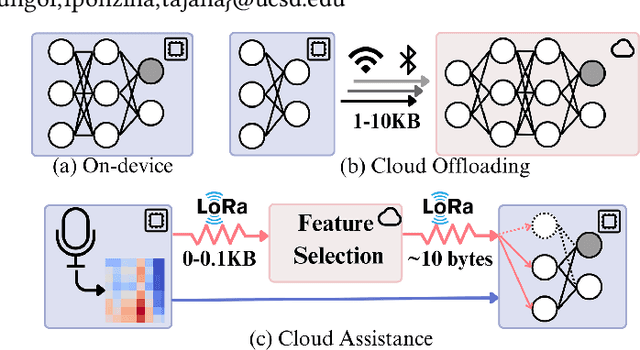
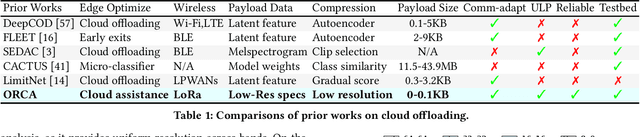
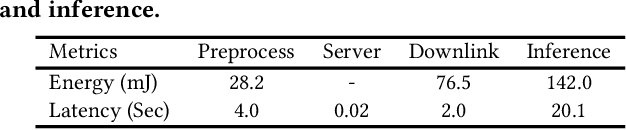
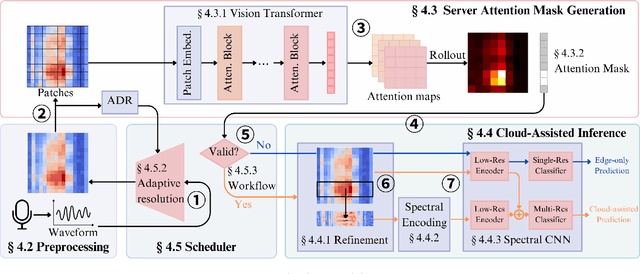
Learning-based environmental sound recognition has emerged as a crucial method for ultra-low-power environmental monitoring in biological research and city-scale sensing systems. These systems usually operate under limited resources and are often powered by harvested energy in remote areas. Recent efforts in on-device sound recognition suffer from low accuracy due to resource constraints, whereas cloud offloading strategies are hindered by high communication costs. In this work, we introduce ORCA, a novel resource-efficient cloud-assisted environmental sound recognition system on batteryless devices operating over the Low-Power Wide-Area Networks (LPWANs), targeting wide-area audio sensing applications. We propose a cloud assistance strategy that remedies the low accuracy of on-device inference while minimizing the communication costs for cloud offloading. By leveraging a self-attention-based cloud sub-spectral feature selection method to facilitate efficient on-device inference, ORCA resolves three key challenges for resource-constrained cloud offloading over LPWANs: 1) high communication costs and low data rates, 2) dynamic wireless channel conditions, and 3) unreliable offloading. We implement ORCA on an energy-harvesting batteryless microcontroller and evaluate it in a real world urban sound testbed. Our results show that ORCA outperforms state-of-the-art methods by up to $80 \times$ in energy savings and $220 \times$ in latency reduction while maintaining comparable accuracy.
Async-HFL: Efficient and Robust Asynchronous Federated Learning in Hierarchical IoT Networks
Jan 17, 2023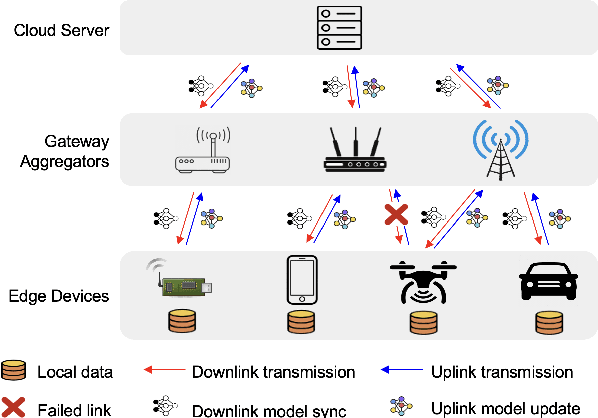
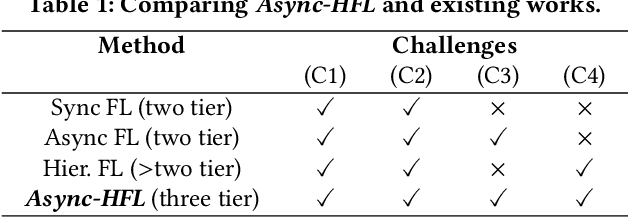
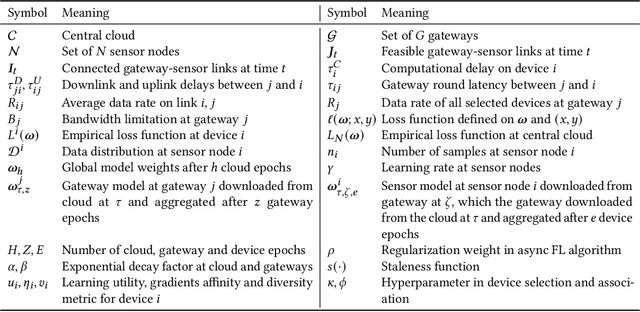
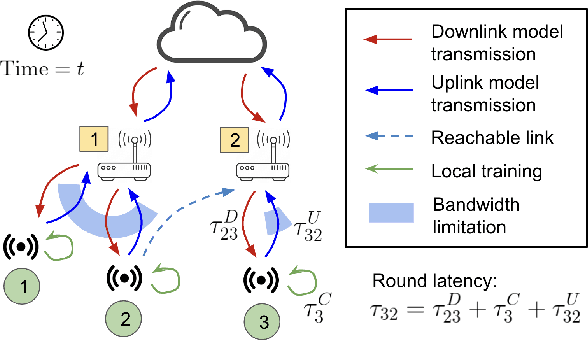
Federated Learning (FL) has gained increasing interest in recent years as a distributed on-device learning paradigm. However, multiple challenges remain to be addressed for deploying FL in real-world Internet-of-Things (IoT) networks with hierarchies. Although existing works have proposed various approaches to account data heterogeneity, system heterogeneity, unexpected stragglers and scalibility, none of them provides a systematic solution to address all of the challenges in a hierarchical and unreliable IoT network. In this paper, we propose an asynchronous and hierarchical framework (Async-HFL) for performing FL in a common three-tier IoT network architecture. In response to the largely varied delays, Async-HFL employs asynchronous aggregations at both the gateway and the cloud levels thus avoids long waiting time. To fully unleash the potential of Async-HFL in converging speed under system heterogeneities and stragglers, we design device selection at the gateway level and device-gateway association at the cloud level. Device selection chooses edge devices to trigger local training in real-time while device-gateway association determines the network topology periodically after several cloud epochs, both satisfying bandwidth limitation. We evaluate Async-HFL's convergence speedup using large-scale simulations based on ns-3 and a network topology from NYCMesh. Our results show that Async-HFL converges 1.08-1.31x faster in wall-clock time and saves up to 21.6% total communication cost compared to state-of-the-art asynchronous FL algorithms (with client selection). We further validate Async-HFL on a physical deployment and observe robust convergence under unexpected stragglers.