 Add to Chrome
 Add to Firefox
 Add to Edge
Dual Strategies for Test-Time Adaptation
Apr 19, 2026
Conventional test-time adaptation (TTA) approaches typically adapt the model using only a small fraction of test samples, often those with low-entropy predictions, thereby failing to fully leverage the available information in the test distribution. This paper introduces DualTTA, a novel framework that improves performance under distribution shifts by utilizing a larger and more diverse set of test samples. DualTTA identifies two distinct groups: one where the model's predictions are likely consistent with the underlying semantics, and another where predictions are likely incorrect. For the first group, it minimizes prediction entropy to reinforce reliable decisions; for the second, it maximizes entropy to suppress overconfident errors and unlearn spurious behavior. These groups are adaptively selected using a new reliability criterion that measures prediction stability under both semantic-preserving and semantic-altering transformations, addressing the limitations of purely entropy-based selection. We further provide theoretical analysis and empirical justification showing that our approach enables a tighter separation between reliable and unreliable samples, in the context of their suitability for adaptation, leading to provably more effective model updates.

SegTransVAE: Hybrid CNN -- Transformer with Regularization for medical image segmentation
Jan 26, 2022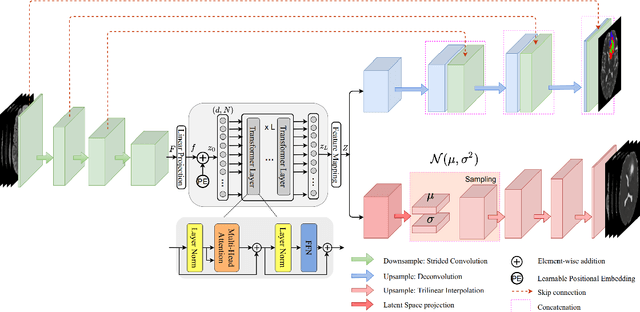
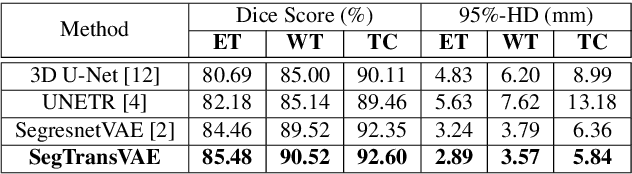
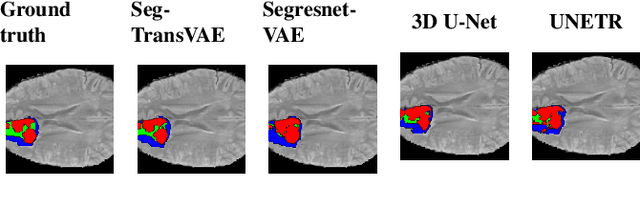
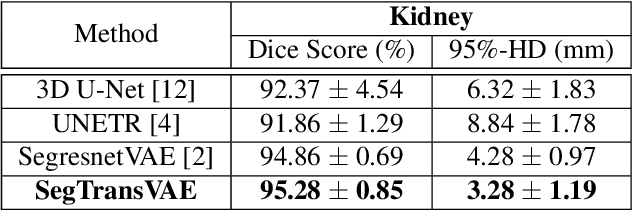
Current research on deep learning for medical image segmentation exposes their limitations in learning either global semantic information or local contextual information. To tackle these issues, a novel network named SegTransVAE is proposed in this paper. SegTransVAE is built upon encoder-decoder architecture, exploiting transformer with the variational autoencoder (VAE) branch to the network to reconstruct the input images jointly with segmentation. To the best of our knowledge, this is the first method combining the success of CNN, transformer, and VAE. Evaluation on various recently introduced datasets shows that SegTransVAE outperforms previous methods in Dice Score and $95\%$-Haudorff Distance while having comparable inference time to a simple CNN-based architecture network. The source code is available at: https://github.com/itruonghai/SegTransVAE.