 Add to Chrome
 Add to Firefox
 Add to Edge
Evaluating Investment Logic in Large Language Models: A Real-World Benchmark Towards Personalzied Financial Agents
Aug 06, 2026
Investment competence is inherently personalized: the same market evidence can justify different actions for investors with different goals, horizons, portfolios, and risk boundaries. Yet financial LLMs are evaluated either by static question answering or by terminal profit and loss. The former omits agency; the latter cannot reveal whether a profitable action was grounded, profile-consistent, or merely lucky. We ask whether the community is using the wrong ruler for consequential agents. We introduce \textsc{InvestLogicBench}, a process-native benchmark containing 201,247 documented decisions from 151 real-world investors. Each episode instantiates a \textbf{P$\rightarrow$E$\rightarrow$R$\rightarrow$D$\rightarrow$O} trace: investor \textit{Profile}, observable market \textit{Events}, investment \textit{Reasoning}, executable \textit{Decision}, and delayed \textit{Outcome}. The release includes profile construction, point-in-time event binding, structured logic, horizons, outcomes, and post-mortems, and supports comprehension, profile-conditioned generation, and end-to-end replay. Across four leading LLMs, logical plausibility remains near 4/5 while event grounding is only 0.8--2.8/5; return and process quality also disagree. These results expose polished but weakly grounded reasoning that outcome-only evaluation hides. We further argue that P$\rightarrow$E$\rightarrow$R$\rightarrow$D$\rightarrow$O should be a data-system interface, requiring versioned profiles, temporal provenance, inspectable retrieval, decision ledgers, and replayable outcomes. Finance is our stress test for a broader class of personalized, consequential agents.

RecGPT-V2 Technical Report
Dec 16, 2025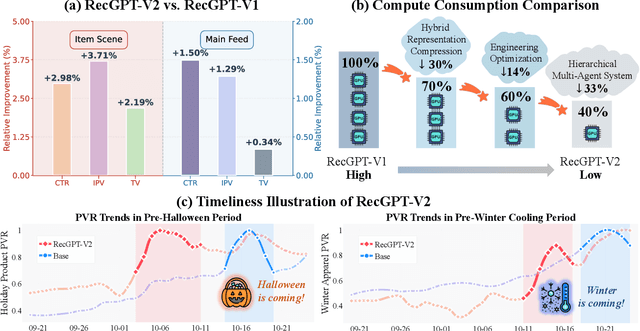
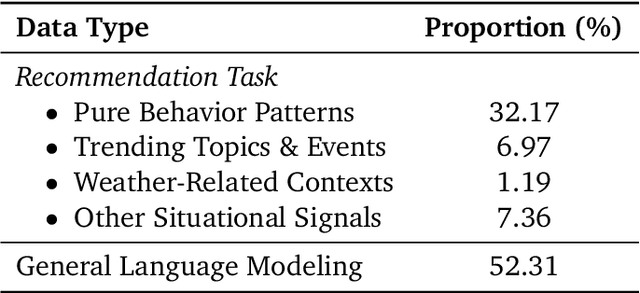
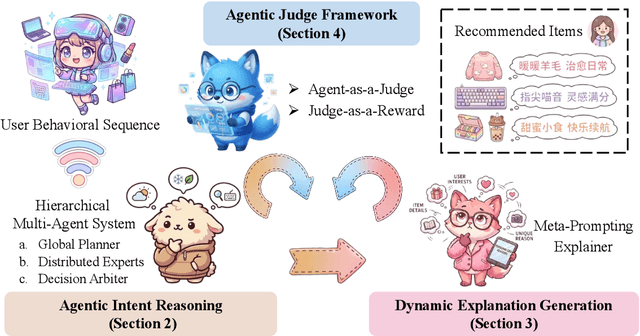

Large language models (LLMs) have demonstrated remarkable potential in transforming recommender systems from implicit behavioral pattern matching to explicit intent reasoning. While RecGPT-V1 successfully pioneered this paradigm by integrating LLM-based reasoning into user interest mining and item tag prediction, it suffers from four fundamental limitations: (1) computational inefficiency and cognitive redundancy across multiple reasoning routes; (2) insufficient explanation diversity in fixed-template generation; (3) limited generalization under supervised learning paradigms; and (4) simplistic outcome-focused evaluation that fails to match human standards. To address these challenges, we present RecGPT-V2 with four key innovations. First, a Hierarchical Multi-Agent System restructures intent reasoning through coordinated collaboration, eliminating cognitive duplication while enabling diverse intent coverage. Combined with Hybrid Representation Inference that compresses user-behavior contexts, our framework reduces GPU consumption by 60% and improves exclusive recall from 9.39% to 10.99%. Second, a Meta-Prompting framework dynamically generates contextually adaptive prompts, improving explanation diversity by +7.3%. Third, constrained reinforcement learning mitigates multi-reward conflicts, achieving +24.1% improvement in tag prediction and +13.0% in explanation acceptance. Fourth, an Agent-as-a-Judge framework decomposes assessment into multi-step reasoning, improving human preference alignment. Online A/B tests on Taobao demonstrate significant improvements: +2.98% CTR, +3.71% IPV, +2.19% TV, and +11.46% NER. RecGPT-V2 establishes both the technical feasibility and commercial viability of deploying LLM-powered intent reasoning at scale, bridging the gap between cognitive exploration and industrial utility.
RecGPT Technical Report
Jul 30, 2025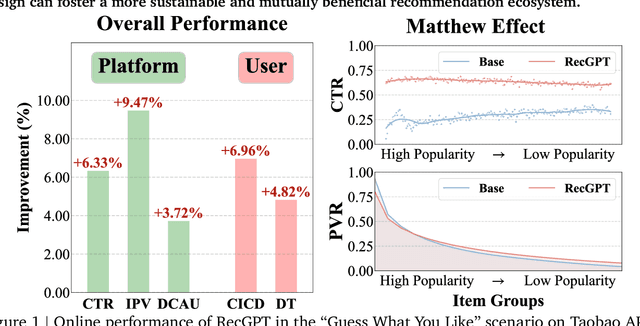
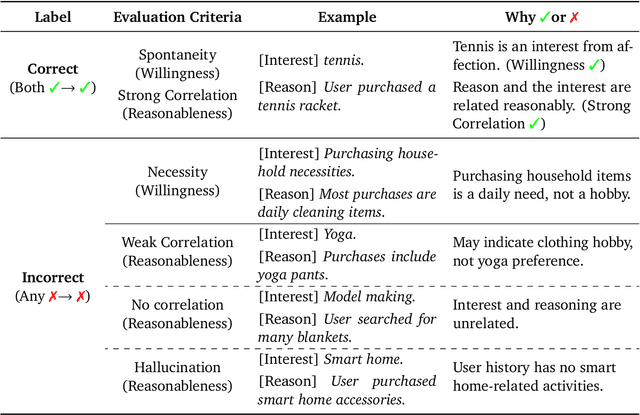
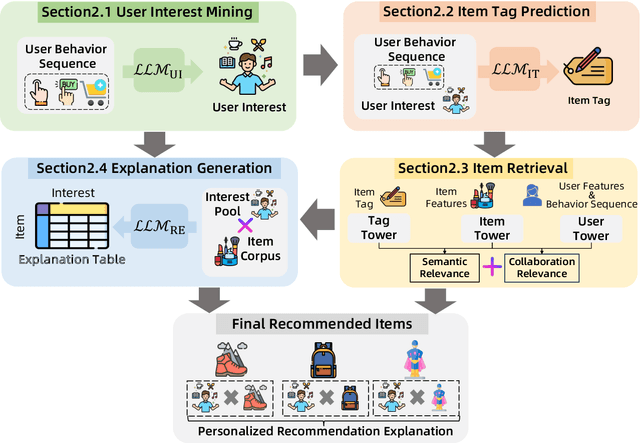

Recommender systems are among the most impactful applications of artificial intelligence, serving as critical infrastructure connecting users, merchants, and platforms. However, most current industrial systems remain heavily reliant on historical co-occurrence patterns and log-fitting objectives, i.e., optimizing for past user interactions without explicitly modeling user intent. This log-fitting approach often leads to overfitting to narrow historical preferences, failing to capture users' evolving and latent interests. As a result, it reinforces filter bubbles and long-tail phenomena, ultimately harming user experience and threatening the sustainability of the whole recommendation ecosystem. To address these challenges, we rethink the overall design paradigm of recommender systems and propose RecGPT, a next-generation framework that places user intent at the center of the recommendation pipeline. By integrating large language models (LLMs) into key stages of user interest mining, item retrieval, and explanation generation, RecGPT transforms log-fitting recommendation into an intent-centric process. To effectively align general-purpose LLMs to the above domain-specific recommendation tasks at scale, RecGPT incorporates a multi-stage training paradigm, which integrates reasoning-enhanced pre-alignment and self-training evolution, guided by a Human-LLM cooperative judge system. Currently, RecGPT has been fully deployed on the Taobao App. Online experiments demonstrate that RecGPT achieves consistent performance gains across stakeholders: users benefit from increased content diversity and satisfaction, merchants and the platform gain greater exposure and conversions. These comprehensive improvement results across all stakeholders validates that LLM-driven, intent-centric design can foster a more sustainable and mutually beneficial recommendation ecosystem.