 Add to Chrome
 Add to Firefox
 Add to Edge
Joint sparse coding and temporal dynamics support context reconfiguration
May 11, 2026
Adaptive behavior requires the brain to transition between distinct contexts while maintaining representations of prior experience. The ability to reconfigure neural representations without erasing previously acquired knowledge is central to learning in dynamic environments, yet the neural mechanisms that support this balance remain unclear. Understanding these mechanisms is also critical for addressing catastrophic forgetting in artificial systems designed for lifelong learning. Here, we identify joint sparse coding and temporal dynamics in both the mouse medial prefrontal cortex (mPFC) and computational networks as mechanisms that help preserve prior representations during context transitions. Specifically, sparsity in context-dependent representations reduces cross-context interference, whereas temporal dynamics within the network activity further enhance context separability across time. Strikingly, networks endowed with both properties, such as spiking neural networks, exhibit improved retention during lifelong learning without auxiliary heuristics. These findings establish joint sparse coding and temporal dynamics as a core mechanism supporting flexible context reconfiguration in lifelong learning and, through their activity constraining nature, as an energy-efficient architectural principle for stable adaptation. Together, they provide a mechanistic framework for understanding how the brain preserves prior knowledge while flexibly adapting to new contexts.

MM-NeuroOnco: A Multimodal Benchmark and Instruction Dataset for MRI-Based Brain Tumor Diagnosis
Feb 26, 2026Accurate brain tumor diagnosis requires models to not only detect lesions but also generate clinically interpretable reasoning grounded in imaging manifestations, yet existing public datasets remain limited in annotation richness and diagnostic semantics. To bridge this gap, we introduce MM-NeuroOnco, a large-scale multimodal benchmark and instruction-tuning dataset for brain tumor MRI understanding, consisting of 24,726 MRI slices from 20 data sources paired with approximately 200,000 semantically enriched multimodal instructions spanning diverse tumor subtypes and imaging modalities. To mitigate the scarcity and high cost of diagnostic semantic annotations, we develop a multi-model collaborative pipeline for automated medical information completion and quality control, enabling the generation of diagnosis-related semantics beyond mask-only annotations. Building upon this dataset, we further construct MM-NeuroOnco-Bench, a manually annotated evaluation benchmark with a rejection-aware setting to reduce biases inherent in closed-ended question formats. Evaluation across ten representative models shows that even the strongest baseline, Gemini 3 Flash, achieves only 41.88% accuracy on diagnosis-related questions, highlighting the substantial challenges of multimodal brain tumor diagnostic understanding. Leveraging MM-NeuroOnco, we further propose NeuroOnco-GPT, which achieves a 27% absolute accuracy improvement on diagnostic questions following fine-tuning. This result demonstrates the effectiveness of our dataset and benchmark in advancing clinically grounded multimodal diagnostic reasoning. Code and dataset are publicly available at: https://github.com/gfnnnb/MM-NeuroOnco
Query Understanding for Natural Language Enterprise Search
Dec 11, 2020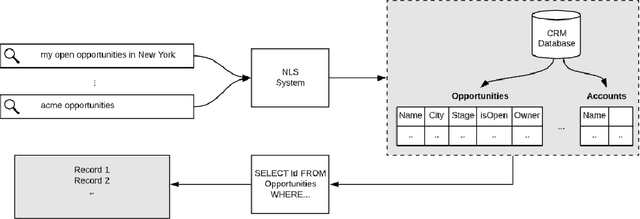
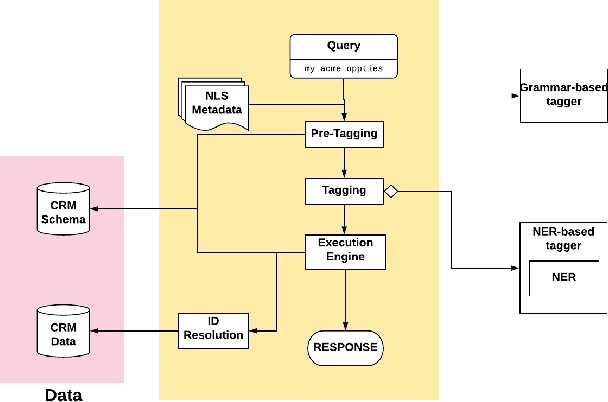
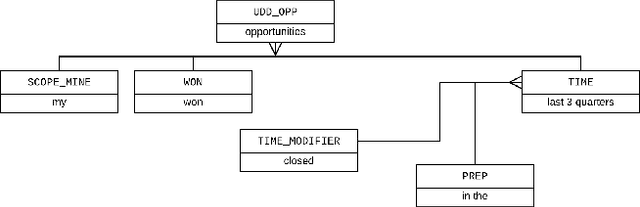
Natural Language Search (NLS) extends the capabilities of search engines that perform keyword search allowing users to issue queries in a more "natural" language. The engine tries to understand the meaning of the queries and to map the query words to the symbols it supports like Persons, Organizations, Time Expressions etc.. It, then, retrieves the information that satisfies the user's need in different forms like an answer, a record or a list of records. We present an NLS system we implemented as part of the Search service of a major CRM platform. The system is currently in production serving thousands of customers. Our user studies showed that creating dynamic reports with NLS saved more than 50% of our user's time compared to achieving the same result with navigational search. We describe the architecture of the system, the particularities of the CRM domain as well as how they have influenced our design decisions. Among several submodules of the system we detail the role of a Deep Learning Named Entity Recognizer. The paper concludes with discussion over the lessons learned while developing this product.