 Add to Chrome
 Add to Firefox
 Add to Edge
ConsistencyPlanner: Real-time Planning with Fast-Sampling Consistency Models
Jun 10, 2026
Closed-loop planning in complex, real-world driving scenarios presents a critical challenge for autonomous driving systems. While traditional rule-based methods are interpretable, their predefined heuristics lack the adaptability for dynamic traffic environments. Learning-based approaches have shown considerable promise. Conversely, learning-based approaches, despite their promise, struggle to balance the modeling diverse and multimodal driving behaviors and real-time planning, often leading to indecisive or unsafe actions. To address this limitation, we propose Consistency Planner, a real-time planning framework with fast-sampling consistency models. Our approach is built upon two key technical contributions. Efficient Multimodal Sampling: We employ fast-sampling consistency models to generate a diverse set of plausible future trajectories. This enables efficient, real-time exploration of multimodal actions, overcoming the computational bottlenecks of previous iterative generative methods. Heterogeneous Feature Fusion: We introduce an attention-enhanced decoder that dynamically integrates heterogeneous input features (including scene feature and action token) into a cohesive representation for robust planning. Extensive evaluation in the Waymax simulator demonstrates superior performance in safety metrics compared to existing methods, with particularly strong results in challenging dynamic scenarios.

Ranking-aware Continual Learning for LiDAR Place Recognition
May 12, 2025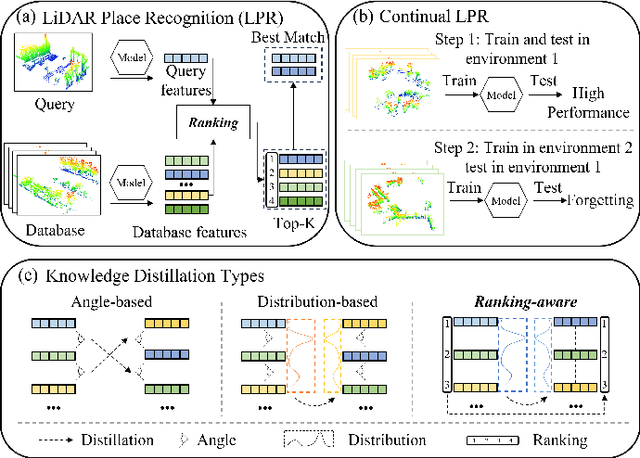
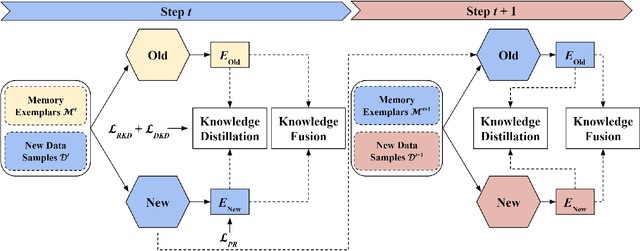
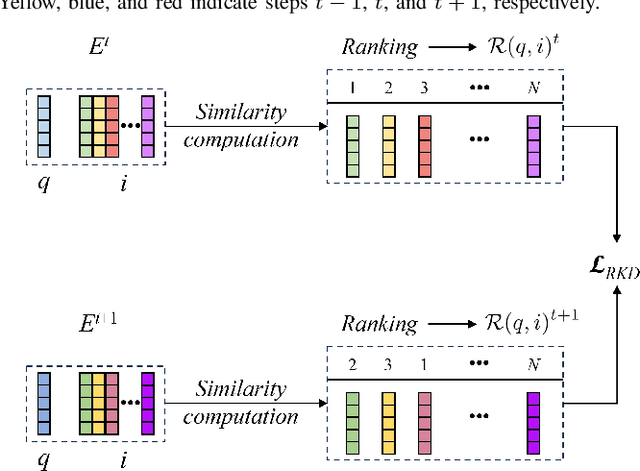
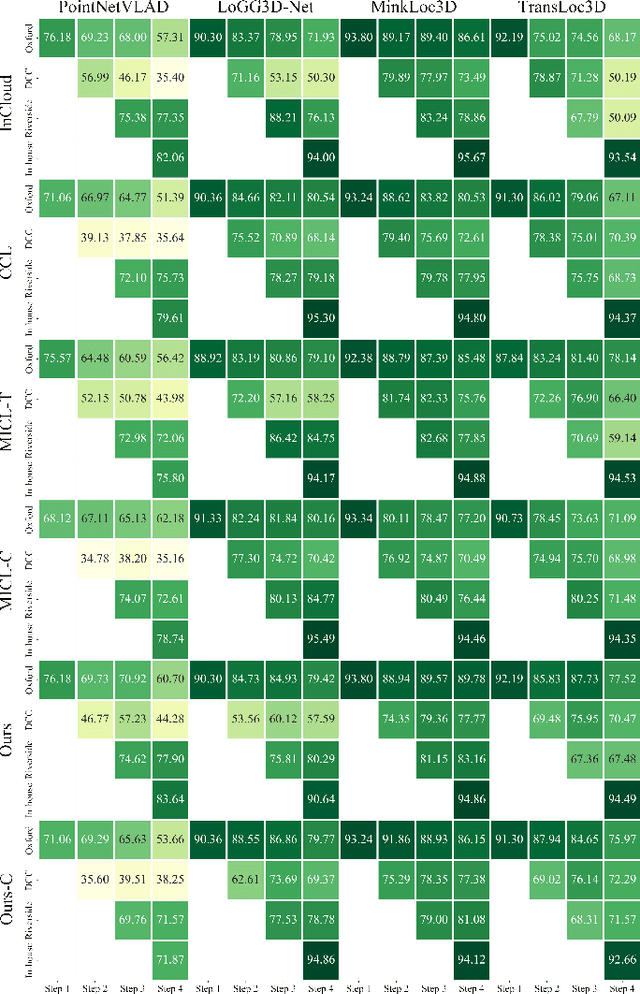
Place recognition plays a significant role in SLAM, robot navigation, and autonomous driving applications. Benefiting from deep learning, the performance of LiDAR place recognition (LPR) has been greatly improved. However, many existing learning-based LPR methods suffer from catastrophic forgetting, which severely harms the performance of LPR on previously trained places after training on a new environment. In this paper, we introduce a continual learning framework for LPR via Knowledge Distillation and Fusion (KDF) to alleviate forgetting. Inspired by the ranking process of place recognition retrieval, we present a ranking-aware knowledge distillation loss that encourages the network to preserve the high-level place recognition knowledge. We also introduce a knowledge fusion module to integrate the knowledge of old and new models for LiDAR place recognition. Our extensive experiments demonstrate that KDF can be applied to different networks to overcome catastrophic forgetting, surpassing the state-of-the-art methods in terms of mean Recall@1 and forgetting score.