 Add to Chrome
 Add to Firefox
 Add to Edge
ConsistencyPlanner: Real-time Planning with Fast-Sampling Consistency Models
Jun 10, 2026
Closed-loop planning in complex, real-world driving scenarios presents a critical challenge for autonomous driving systems. While traditional rule-based methods are interpretable, their predefined heuristics lack the adaptability for dynamic traffic environments. Learning-based approaches have shown considerable promise. Conversely, learning-based approaches, despite their promise, struggle to balance the modeling diverse and multimodal driving behaviors and real-time planning, often leading to indecisive or unsafe actions. To address this limitation, we propose Consistency Planner, a real-time planning framework with fast-sampling consistency models. Our approach is built upon two key technical contributions. Efficient Multimodal Sampling: We employ fast-sampling consistency models to generate a diverse set of plausible future trajectories. This enables efficient, real-time exploration of multimodal actions, overcoming the computational bottlenecks of previous iterative generative methods. Heterogeneous Feature Fusion: We introduce an attention-enhanced decoder that dynamically integrates heterogeneous input features (including scene feature and action token) into a cohesive representation for robust planning. Extensive evaluation in the Waymax simulator demonstrates superior performance in safety metrics compared to existing methods, with particularly strong results in challenging dynamic scenarios.

Joint Edge Optimization Deep Unfolding Network for Accelerated MRI Reconstruction
May 09, 2024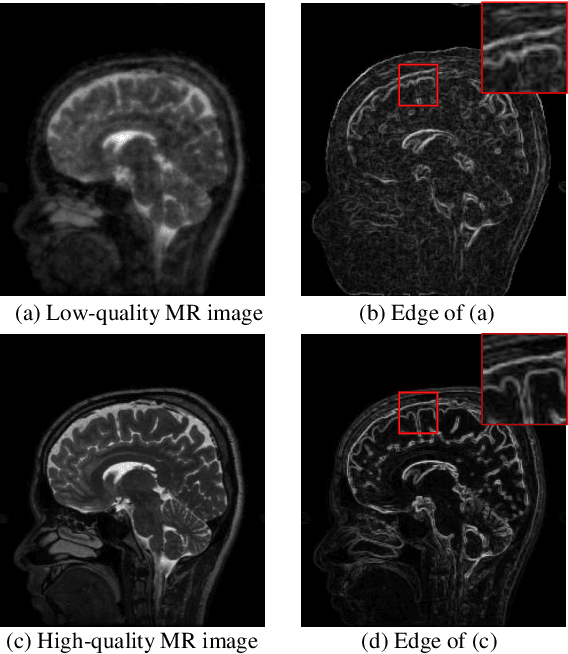
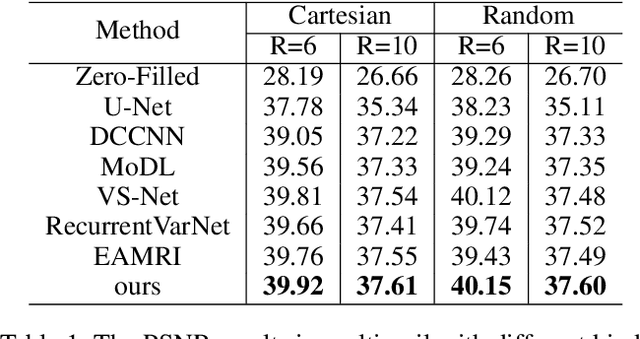
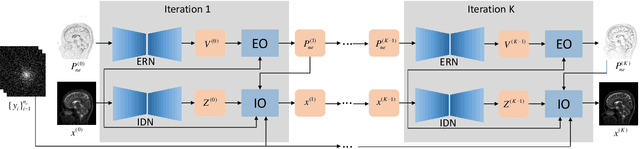
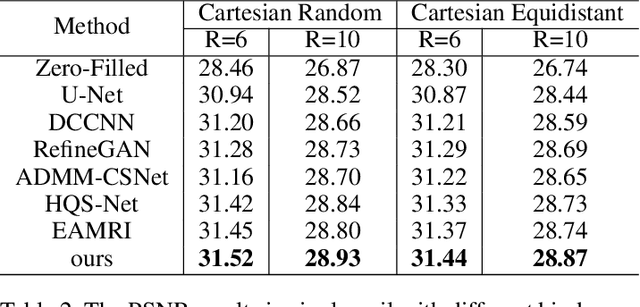
Magnetic Resonance Imaging (MRI) is a widely used imaging technique, however it has the limitation of long scanning time. Though previous model-based and learning-based MRI reconstruction methods have shown promising performance, most of them have not fully utilized the edge prior of MR images, and there is still much room for improvement. In this paper, we build a joint edge optimization model that not only incorporates individual regularizers specific to both the MR image and the edges, but also enforces a co-regularizer to effectively establish a stronger correlation between them. Specifically, the edge information is defined through a non-edge probability map to guide the image reconstruction during the optimization process. Meanwhile, the regularizers pertaining to images and edges are incorporated into a deep unfolding network to automatically learn their respective inherent a-priori information.Numerical experiments, consisting of multi-coil and single-coil MRI data with different sampling schemes at a variety of sampling factors, demonstrate that the proposed method outperforms other compared methods.
Machine Learning based prediction of noncentrosymmetric crystal materials
Feb 26, 2020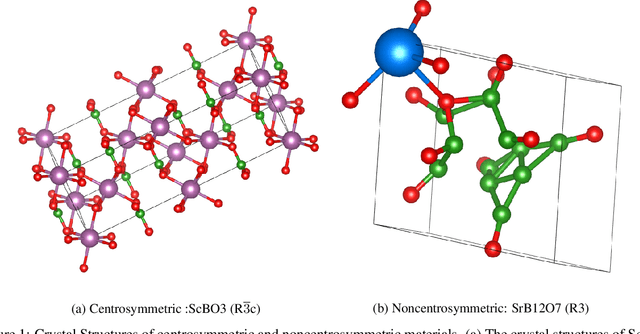
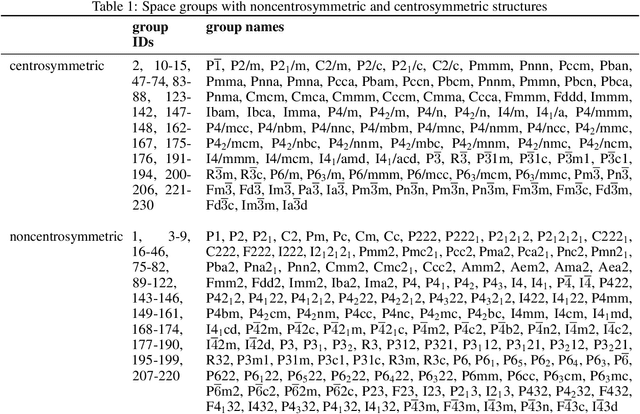
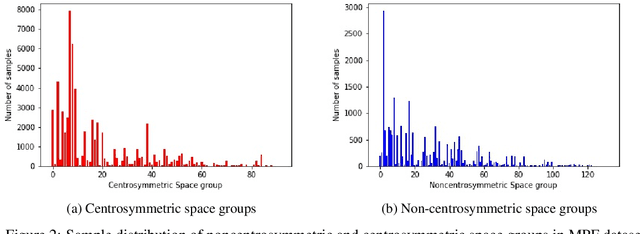
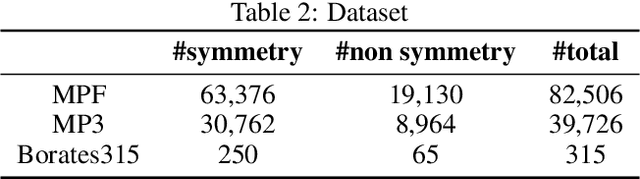
Noncentrosymmetric materials play a critical role in many important applications such as laser technology, communication systems,quantum computing, cybersecurity, and etc. However, the experimental discovery of new noncentrosymmetric materials is extremely difficult. Here we present a machine learning model that could predict whether the composition of a potential crystalline structure would be centrosymmetric or not. By evaluating a diverse set of composition features calculated using matminer featurizer package coupled with different machine learning algorithms, we find that Random Forest Classifiers give the best performance for noncentrosymmetric material prediction, reaching an accuracy of 84.8% when evaluated with 10 fold cross-validation on the dataset with 82,506 samples extracted from Materials Project. A random forest model trained with materials with only 3 elements gives even higher accuracy of 86.9%. We apply our ML model to screen potential noncentrosymmetric materials from 2,000,000 hypothetical materials generated by our inverse design engine and report the top 20 candidate noncentrosymmetric materials with 2 to 4 elements and top 20 borate candidates