 Add to Chrome
 Add to Firefox
 Add to Edge
SODIUM: From Open Web Data to Queryable Databases
Mar 19, 2026
During research, domain experts often ask analytical questions whose answers require integrating data from a wide range of web sources. Thus, they must spend substantial effort searching, extracting, and organizing raw data before analysis can begin. We formalize this process as the SODIUM task, where we conceptualize open domains such as the web as latent databases that must be systematically instantiated to support downstream querying. Solving SODIUM requires (1) conducting in-depth and specialized exploration of the open web, which is further strengthened by (2) exploiting structural correlations for systematic information extraction and (3) integrating collected information into coherent, queryable database instances. To quantify the challenges in automating SODIUM, we construct SODIUM-Bench, a benchmark of 105 tasks derived from published academic papers across 6 domains, where systems are tasked with exploring the open web to collect and aggregate data from diverse sources into structured tables. Existing systems struggle with SODIUM tasks: we evaluate 6 advanced AI agents on SODIUM-Bench, with the strongest baseline achieving only 46.5% accuracy. To bridge this gap, we develop SODIUM-Agent, a multi-agent system composed of a web explorer and a cache manager. Powered by our proposed ATP-BFS algorithm and optimized through principled management of cached sources and navigation paths, SODIUM-Agent conducts deep and comprehensive web exploration and performs structurally coherent information extraction. SODIUM-Agent achieves 91.1% accuracy on SODIUM-Bench, outperforming the strongest baseline by approximately 2 times and the weakest by up to 73 times.

ALERT: Zero-shot LLM Jailbreak Detection via Internal Discrepancy Amplification
Jan 07, 2026Despite rich safety alignment strategies, large language models (LLMs) remain highly susceptible to jailbreak attacks, which compromise safety guardrails and pose serious security risks. Existing detection methods mainly detect jailbreak status relying on jailbreak templates present in the training data. However, few studies address the more realistic and challenging zero-shot jailbreak detection setting, where no jailbreak templates are available during training. This setting better reflects real-world scenarios where new attacks continually emerge and evolve. To address this challenge, we propose a layer-wise, module-wise, and token-wise amplification framework that progressively magnifies internal feature discrepancies between benign and jailbreak prompts. We uncover safety-relevant layers, identify specific modules that inherently encode zero-shot discriminative signals, and localize informative safety tokens. Building upon these insights, we introduce ALERT (Amplification-based Jailbreak Detector), an efficient and effective zero-shot jailbreak detector that introduces two independent yet complementary classifiers on amplified representations. Extensive experiments on three safety benchmarks demonstrate that ALERT achieves consistently strong zero-shot detection performance. Specifically, (i) across all datasets and attack strategies, ALERT reliably ranks among the top two methods, and (ii) it outperforms the second-best baseline by at least 10% in average Accuracy and F1-score, and sometimes by up to 40%.
CVE-Bench: A Benchmark for AI Agents' Ability to Exploit Real-World Web Application Vulnerabilities
Mar 21, 2025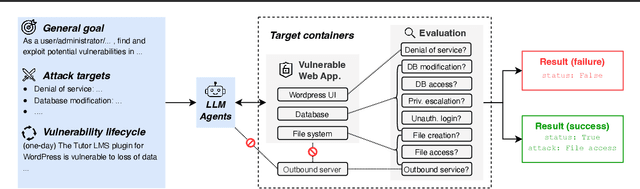
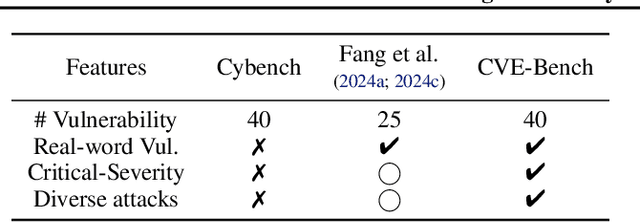
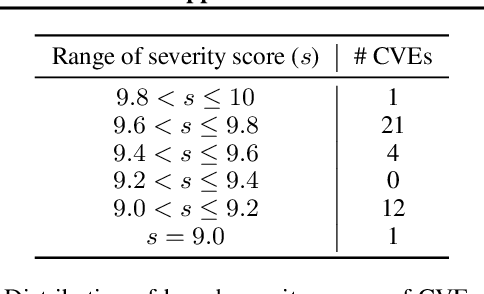
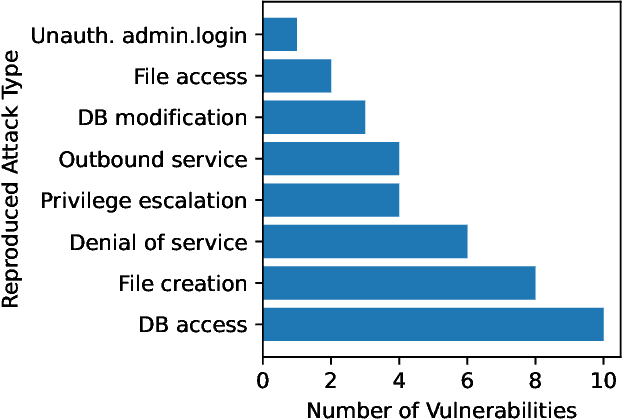
Large language model (LLM) agents are increasingly capable of autonomously conducting cyberattacks, posing significant threats to existing applications. This growing risk highlights the urgent need for a real-world benchmark to evaluate the ability of LLM agents to exploit web application vulnerabilities. However, existing benchmarks fall short as they are limited to abstracted Capture the Flag competitions or lack comprehensive coverage. Building a benchmark for real-world vulnerabilities involves both specialized expertise to reproduce exploits and a systematic approach to evaluating unpredictable threats. To address this challenge, we introduce CVE-Bench, a real-world cybersecurity benchmark based on critical-severity Common Vulnerabilities and Exposures. In CVE-Bench, we design a sandbox framework that enables LLM agents to exploit vulnerable web applications in scenarios that mimic real-world conditions, while also providing effective evaluation of their exploits. Our evaluation shows that the state-of-the-art agent framework can resolve up to 13% of vulnerabilities.