 Add to Chrome
 Add to Firefox
 Add to Edge
ALERT: Zero-shot LLM Jailbreak Detection via Internal Discrepancy Amplification
Jan 07, 2026
Despite rich safety alignment strategies, large language models (LLMs) remain highly susceptible to jailbreak attacks, which compromise safety guardrails and pose serious security risks. Existing detection methods mainly detect jailbreak status relying on jailbreak templates present in the training data. However, few studies address the more realistic and challenging zero-shot jailbreak detection setting, where no jailbreak templates are available during training. This setting better reflects real-world scenarios where new attacks continually emerge and evolve. To address this challenge, we propose a layer-wise, module-wise, and token-wise amplification framework that progressively magnifies internal feature discrepancies between benign and jailbreak prompts. We uncover safety-relevant layers, identify specific modules that inherently encode zero-shot discriminative signals, and localize informative safety tokens. Building upon these insights, we introduce ALERT (Amplification-based Jailbreak Detector), an efficient and effective zero-shot jailbreak detector that introduces two independent yet complementary classifiers on amplified representations. Extensive experiments on three safety benchmarks demonstrate that ALERT achieves consistently strong zero-shot detection performance. Specifically, (i) across all datasets and attack strategies, ALERT reliably ranks among the top two methods, and (ii) it outperforms the second-best baseline by at least 10% in average Accuracy and F1-score, and sometimes by up to 40%.

Multi Scale Temporal Graph Networks For Skeleton-based Action Recognition
Dec 05, 2020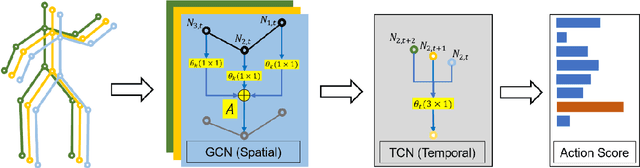
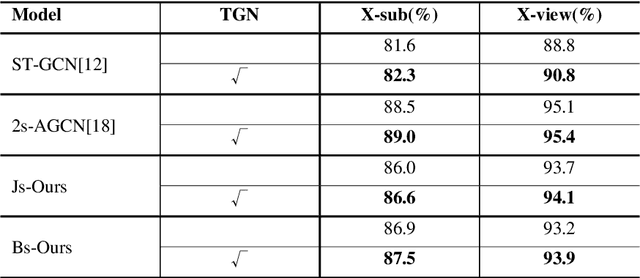
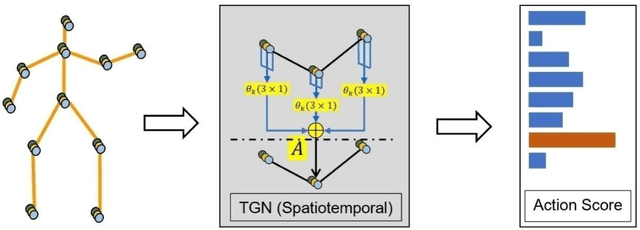
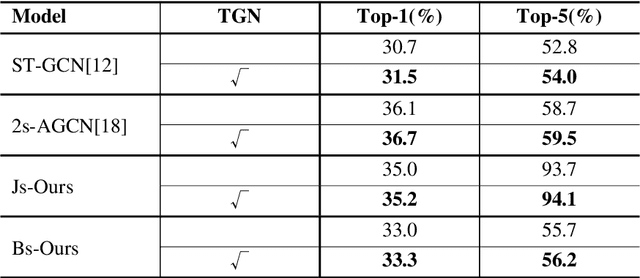
Graph convolutional networks (GCNs) can effectively capture the features of related nodes and improve the performance of the model. More attention is paid to employing GCN in Skeleton-Based action recognition. But existing methods based on GCNs have two problems. First, the consistency of temporal and spatial features is ignored for extracting features node by node and frame by frame. To obtain spatiotemporal features simultaneously, we design a generic representation of skeleton sequences for action recognition and propose a novel model called Temporal Graph Networks (TGN). Secondly, the adjacency matrix of the graph describing the relation of joints is mostly dependent on the physical connection between joints. To appropriately describe the relations between joints in the skeleton graph, we propose a multi-scale graph strategy, adopting a full-scale graph, part-scale graph, and core-scale graph to capture the local features of each joint and the contour features of important joints. Experiments were carried out on two large datasets and results show that TGN with our graph strategy outperforms state-of-the-art methods.