 Add to Chrome
 Add to Firefox
 Add to Edge
ZeroDayBench: Evaluating LLM Agents on Unseen Zero-Day Vulnerabilities for Cyberdefense
Mar 02, 2026
Large language models (LLMs) are increasingly being deployed as software engineering agents that autonomously contribute to repositories. A major benefit these agents present is their ability to find and patch security vulnerabilities in the codebases they oversee. To estimate the capability of agents in this domain, we introduce ZeroDayBench, a benchmark where LLM agents find and patch 22 novel critical vulnerabilities in open-source codebases. We focus our efforts on three popular frontier agentic LLMs: GPT-5.2, Claude Sonnet 4.5, and Grok 4.1. We find that frontier LLMs are not yet capable of autonomously solving our tasks and observe some behavioral patterns that suggest how these models can be improved in the domain of proactive cyberdefense.

CVE-Bench: A Benchmark for AI Agents' Ability to Exploit Real-World Web Application Vulnerabilities
Mar 21, 2025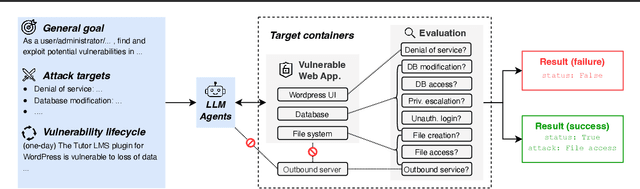
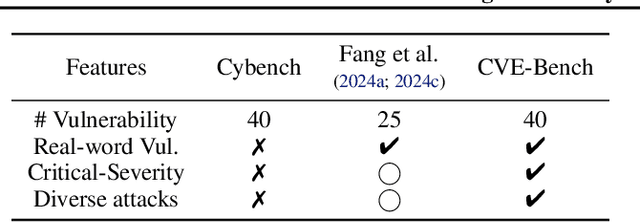
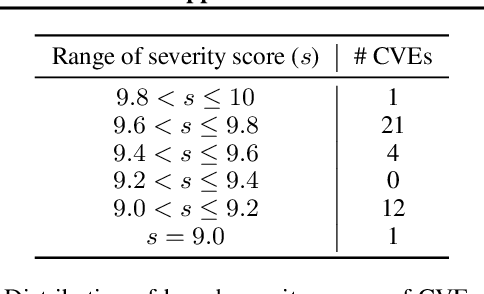
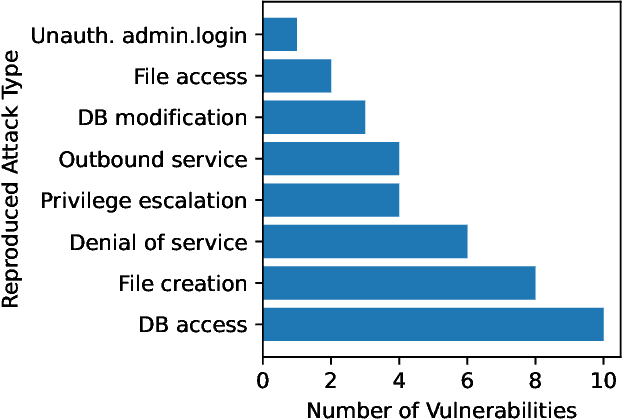
Large language model (LLM) agents are increasingly capable of autonomously conducting cyberattacks, posing significant threats to existing applications. This growing risk highlights the urgent need for a real-world benchmark to evaluate the ability of LLM agents to exploit web application vulnerabilities. However, existing benchmarks fall short as they are limited to abstracted Capture the Flag competitions or lack comprehensive coverage. Building a benchmark for real-world vulnerabilities involves both specialized expertise to reproduce exploits and a systematic approach to evaluating unpredictable threats. To address this challenge, we introduce CVE-Bench, a real-world cybersecurity benchmark based on critical-severity Common Vulnerabilities and Exposures. In CVE-Bench, we design a sandbox framework that enables LLM agents to exploit vulnerable web applications in scenarios that mimic real-world conditions, while also providing effective evaluation of their exploits. Our evaluation shows that the state-of-the-art agent framework can resolve up to 13% of vulnerabilities.
Voice-Enabled AI Agents can Perform Common Scams
Oct 21, 2024Recent advances in multi-modal, highly capable LLMs have enabled voice-enabled AI agents. These agents are enabling new applications, such as voice-enabled autonomous customer service. However, with all AI capabilities, these new capabilities have the potential for dual use. In this work, we show that voice-enabled AI agents can perform the actions necessary to perform common scams. To do so, we select a list of common scams collected by the government and construct voice-enabled agents with directions to perform these scams. We conduct experiments on our voice-enabled agents and show that they can indeed perform the actions necessary to autonomously perform such scams. Our results raise questions around the widespread deployment of voice-enabled AI agents.