 Add to Chrome
 Add to Firefox
 Add to Edge
Stable Attention Response for Reliable Precipitation Nowcasting
May 13, 2026
Precipitation nowcasting remains challenging due to the highly localized, rapidly evolving, and heterogeneous nature of atmospheric dynamics. Although recent methods increasingly adopt attention-based architectures in both unimodal and multimodal settings, they mainly emphasize stronger representation learning and prediction capacity, while paying less attention to the stability of attention responses across samples. In this work, we show that cross-sample instability of attention-response energy is an important and previously underexplored source of forecasting unreliability. Empirically, inaccurate forecasts are associated with larger attention-response energy variance across heads and layers. Theoretically, we show that cross-sample variability can propagate through self-attention, and enlarge a lower bound on prediction error. Based on this insight, we propose HARECast, a Head-wise Attention Response Energy-regulated framework for precipitation nowcasting. HARECast explicitly models head-wise attention-response energy and stabilizes it through a group-wise regularization objective that reduces cross-sample fluctuations. The proposed formulation is generic and applicable to both unimodal and multimodal nowcasting architectures. We instantiate HARECast in a standard forecasting pipeline with reconstruction branches and a diffusion-based predictor, and evaluate it on commonly used benchmarks--SEVIR and MeteoNet. Experimental results demonstrate that HARECast achieves state-of-the-art performance.

Terrain Diffusion Network: Climatic-Aware Terrain Generation with Geological Sketch Guidance
Aug 31, 2023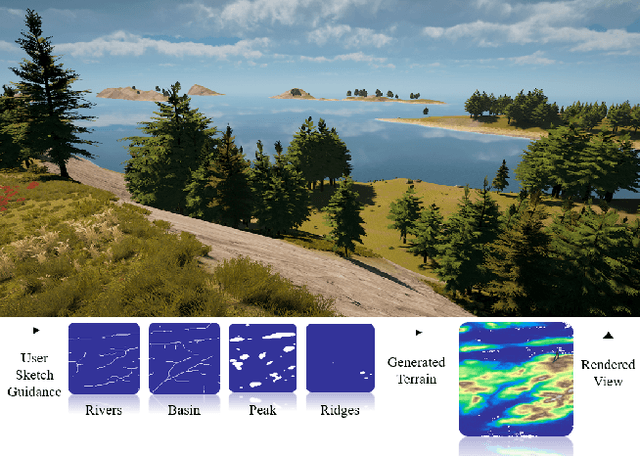
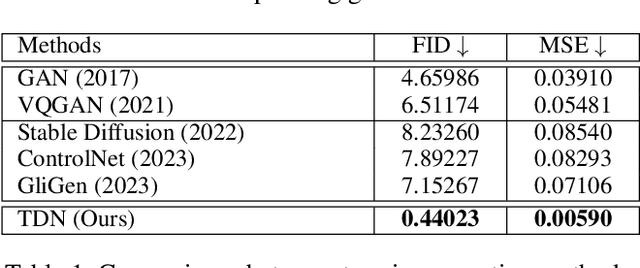
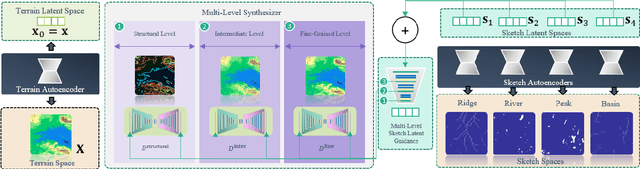
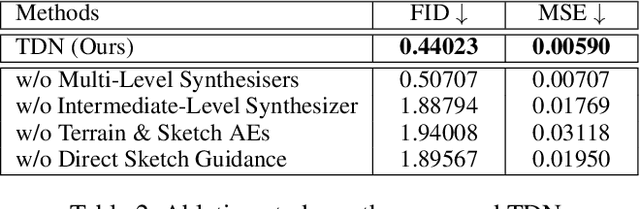
Sketch-based terrain generation seeks to create realistic landscapes for virtual environments in various applications such as computer games, animation and virtual reality. Recently, deep learning based terrain generation has emerged, notably the ones based on generative adversarial networks (GAN). However, these methods often struggle to fulfill the requirements of flexible user control and maintain generative diversity for realistic terrain. Therefore, we propose a novel diffusion-based method, namely terrain diffusion network (TDN), which actively incorporates user guidance for enhanced controllability, taking into account terrain features like rivers, ridges, basins, and peaks. Instead of adhering to a conventional monolithic denoising process, which often compromises the fidelity of terrain details or the alignment with user control, a multi-level denoising scheme is proposed to generate more realistic terrains by taking into account fine-grained details, particularly those related to climatic patterns influenced by erosion and tectonic activities. Specifically, three terrain synthesisers are designed for structural, intermediate, and fine-grained level denoising purposes, which allow each synthesiser concentrate on a distinct terrain aspect. Moreover, to maximise the efficiency of our TDN, we further introduce terrain and sketch latent spaces for the synthesizers with pre-trained terrain autoencoders. Comprehensive experiments on a new dataset constructed from NASA Topology Images clearly demonstrate the effectiveness of our proposed method, achieving the state-of-the-art performance. Our code and dataset will be publicly available.