 Add to Chrome
 Add to Firefox
 Add to Edge
Attention Drift: What Autoregressive Speculative Decoding Models Learn
May 11, 2026
Speculative decoding accelerates LLM inference by drafting future tokens with a small model, but drafter models degrade sharply under template perturbation and long-context inputs. We identify a previously-unreported phenomenon we call \textbf{attention drift}: as the drafter generates successive tokens within a speculation chain, attention progressively moves from the prompt onto its own recently-generated tokens. We observe this across both \emph{EAGLE3} drafters and \emph{MTP heads}, suggesting drift is a property of drafter designs. We trace this to the un-normalized residual path between chain steps: the drafter's hidden state magnitude grows monotonically with chain depth, which exhibits dynamics consistent with additional pre-norm transformer layers stacked on the target rather than as a standalone autoregressive predictor. In order to limit the growth, we propose two architectural changes: Post-norm on the drafter hidden states and per-hidden-state RMSNorm after capturing target hidden states. Our interventions improve acceptance length over the current leading model, pre-norm EAGLE3, by up to $2\times$ under template perturbation, $1.18\times$ on long-context tasks, and $1.10\times$ on seven standard benchmarks spanning multi-turn chat, math, and coding. Our changes also allow shorter train-time-test depths to generalize over longer drafting sequences.

Modality-Aware Zero-Shot Pruning and Sparse Attention for Efficient Multimodal Edge Inference
Apr 10, 2026Edge devices increasingly run multimodal sensing pipelines that must remain accurate despite fluctuating power budgets and unpredictable sensor dropout. Existing pruning methods fail under these conditions: they generally require fine-tuning after compression, consuming over $10\times$ the deployment energy, and they assign static importance scores that are blind to which sensors are present. We present the SentryFuse framework, which addresses both challenges jointly through two key components. First, SentryGate learns modality-conditioned importance scores during training via first-order saliency supervision and then prunes attention heads and feed-forward channels at deployment without fine-tuning. Second, SentryAttend replaces dense self-attention, a key bottleneck in contemporary multimodal architectures, with sparse grouped-query attention, yielding a net 15% reduction in GFLOPs across three different multimodal architectures. Across three applications and multimodal backbones, SentryGate achieves a 12.7% average accuracy improvement over the strongest pruning baseline, and upto to 18% under modality dropout conditions. Together, SentryFuse reduces memory by 28.2% and lowers latency by up to $1.63\times$ without further fine-tuning, establishing modality-aware zero-shot compression as a practical path to multimodal intelligence on heterogeneous edge hardware.
TimeSliver : Symbolic-Linear Decomposition for Explainable Time Series Classification
Jan 29, 2026Identifying the extent to which every temporal segment influences a model's predictions is essential for explaining model decisions and increasing transparency. While post-hoc explainable methods based on gradients and feature-based attributions have been popular, they suffer from reference state sensitivity and struggle to generalize across time-series datasets, as they treat time points independently and ignore sequential dependencies. Another perspective on explainable time-series classification is through interpretable components of the model, for instance, leveraging self-attention mechanisms to estimate temporal attribution; however, recent findings indicate that these attention weights often fail to provide faithful measures of temporal importance. In this work, we advance this perspective and present a novel explainability-driven deep learning framework, TimeSliver, which jointly utilizes raw time-series data and its symbolic abstraction to construct a representation that maintains the original temporal structure. Each element in this representation linearly encodes the contribution of each temporal segment to the final prediction, allowing us to assign a meaningful importance score to every time point. For time-series classification, TimeSliver outperforms other temporal attribution methods by 11% on 7 distinct synthetic and real-world multivariate time-series datasets. TimeSliver also achieves predictive performance within 2% of state-of-the-art baselines across 26 UEA benchmark datasets, positioning it as a strong and explainable framework for general time-series classification.
STEP-LLM: Generating CAD STEP Models from Natural Language with Large Language Models
Jan 19, 2026Computer-aided design (CAD) is vital to modern manufacturing, yet model creation remains labor-intensive and expertise-heavy. To enable non-experts to translate intuitive design intent into manufacturable artifacts, recent large language models-based text-to-CAD efforts focus on command sequences or script-based formats like CadQuery. However, these formats are kernel-dependent and lack universality for manufacturing. In contrast, the Standard for the Exchange of Product Data (STEP, ISO 10303) file is a widely adopted, neutral boundary representation (B-rep) format directly compatible with manufacturing, but its graph-structured, cross-referenced nature poses unique challenges for auto-regressive LLMs. To address this, we curate a dataset of ~40K STEP-caption pairs and introduce novel preprocessing tailored for the graph-structured format of STEP, including a depth-first search-based reserialization that linearizes cross-references while preserving locality and chain-of-thought(CoT)-style structural annotations that guide global coherence. We integrate retrieval-augmented generation to ground predictions in relevant examples for supervised fine-tuning, and refine generation quality through reinforcement learning with a specific Chamfer Distance-based geometric reward. Experiments demonstrate consistent gains of our STEP-LLM in geometric fidelity over the Text2CAD baseline, with improvements arising from multiple stages of our framework: the RAG module substantially enhances completeness and renderability, the DFS-based reserialization strengthens overall accuracy, and the RL further reduces geometric discrepancy. Both metrics and visual comparisons confirm that STEP-LLM generates shapes with higher fidelity than Text2CAD. These results show the feasibility of LLM-driven STEP model generation from natural language, showing its potential to democratize CAD design for manufacturing.
Missingness-resilient Video-enhanced Multimodal Disfluency Detection
Jun 11, 2024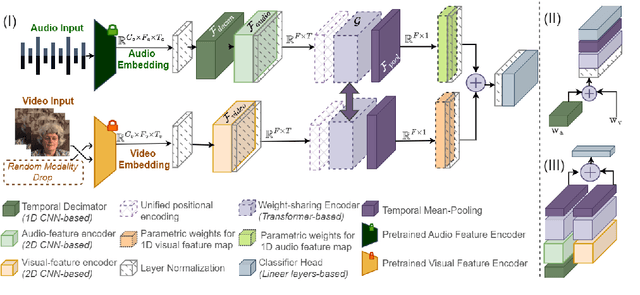
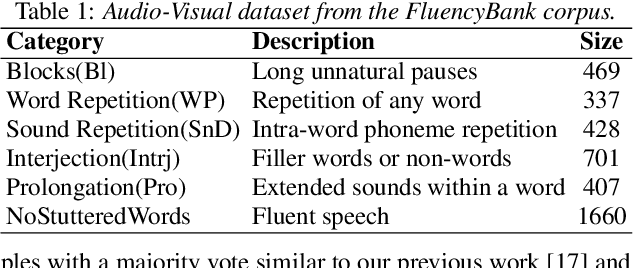
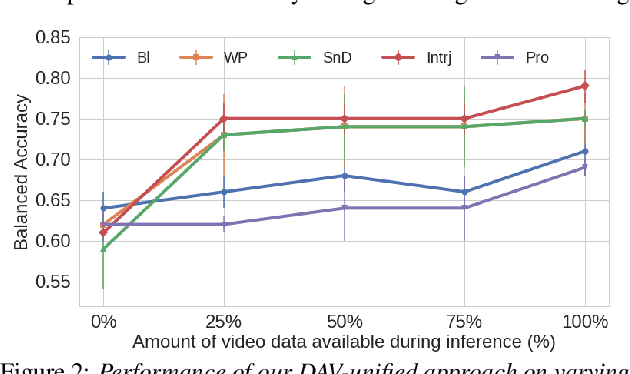
Most existing speech disfluency detection techniques only rely upon acoustic data. In this work, we present a practical multimodal disfluency detection approach that leverages available video data together with audio. We curate an audiovisual dataset and propose a novel fusion technique with unified weight-sharing modality-agnostic encoders to learn the temporal and semantic context. Our resilient design accommodates real-world scenarios where the video modality may sometimes be missing during inference. We also present alternative fusion strategies when both modalities are assured to be complete. In experiments across five disfluency-detection tasks, our unified multimodal approach significantly outperforms Audio-only unimodal methods, yielding an average absolute improvement of 10% (i.e., 10 percentage point increase) when both video and audio modalities are always available, and 7% even when video modality is missing in half of the samples.
Phase-driven Domain Generalizable Learning for Nonstationary Time Series
Feb 05, 2024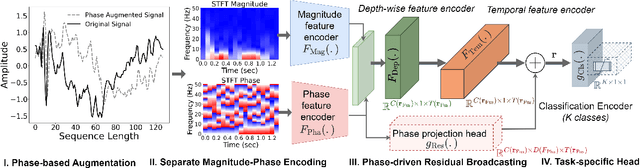
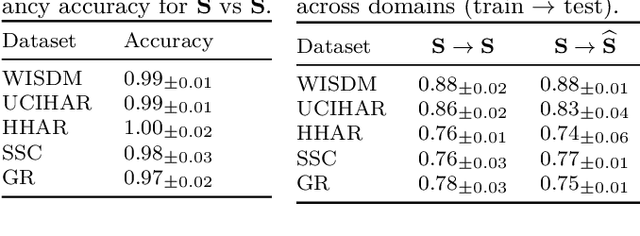
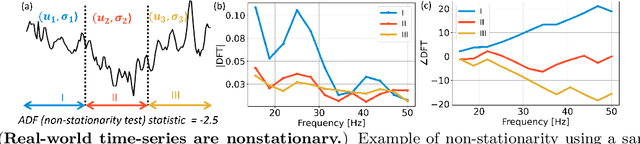
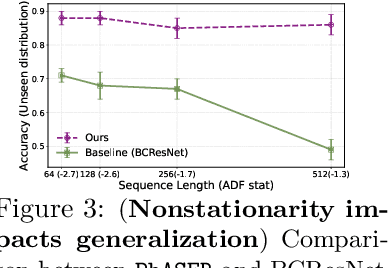
Monitoring and recognizing patterns in continuous sensing data is crucial for many practical applications. These real-world time-series data are often nonstationary, characterized by varying statistical and spectral properties over time. This poses a significant challenge in developing learning models that can effectively generalize across different distributions. In this work, based on our observation that nonstationary statistics are intrinsically linked to the phase information, we propose a time-series learning framework, PhASER. It consists of three novel elements: 1) phase augmentation that diversifies non-stationarity while preserving discriminatory semantics, 2) separate feature encoding by viewing time-varying magnitude and phase as independent modalities, and 3) feature broadcasting by incorporating phase with a novel residual connection for inherent regularization to enhance distribution invariant learning. Upon extensive evaluation on 5 datasets from human activity recognition, sleep-stage classification, and gesture recognition against 10 state-of-the-art baseline methods, we demonstrate that PhASER consistently outperforms the best baselines by an average of 5% and up to 13% in some cases. Moreover, PhASER's principles can be applied broadly to boost the generalization ability of existing time series classification models.
Effect of Attention and Self-Supervised Speech Embeddings on Non-Semantic Speech Tasks
Aug 30, 2023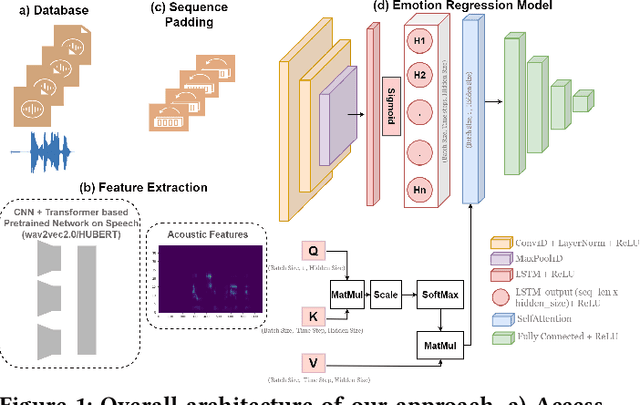
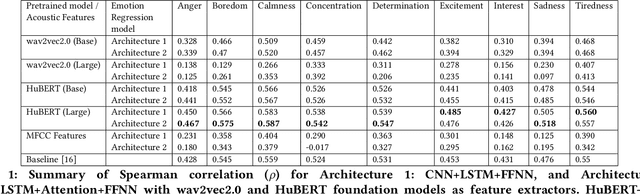
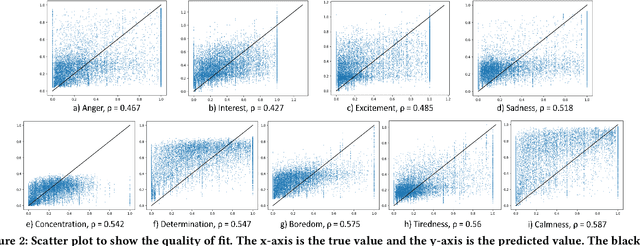
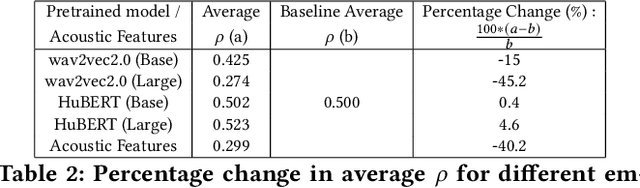
Human emotion understanding is pivotal in making conversational technology mainstream. We view speech emotion understanding as a perception task which is a more realistic setting. With varying contexts (languages, demographics, etc.) different share of people perceive the same speech segment as a non-unanimous emotion. As part of the ACM Multimedia 2023 Computational Paralinguistics ChallengE (ComParE) in the EMotion Share track, we leverage their rich dataset of multilingual speakers and multi-label regression target of 'emotion share' or perception of that emotion. We demonstrate that the training scheme of different foundation models dictates their effectiveness for tasks beyond speech recognition, especially for non-semantic speech tasks like emotion understanding. This is a very complex task due to multilingual speakers, variability in the target labels, and inherent imbalance in the regression dataset. Our results show that HuBERT-Large with a self-attention-based light-weight sequence model provides 4.6% improvement over the reported baseline.