 Add to Chrome
 Add to Firefox
 Add to Edge
From Knowledge to Action: Outcomes of the 2025 Large Language Model (LLM) Hackathon for Applications in Materials Science and Chemistry
May 04, 2026
Large language models (LLMs) are rapidly changing how researchers in materials science and chemistry discover, organize, and act on scientific knowledge. This paper analyzes a broad set of community-developed LLM applications in an effort to identify emerging patterns in how these systems can be used across the scientific research lifecycle. We organize the projects into two complementary categories: Knowledge Infrastructure, systems that structure, retrieve, synthesize, and validate scientific information; and Action Systems, systems that execute, coordinate, or automate scientific work across computational and experimental environments. The submissions reveal a shift from single-purpose LLM tools toward integrated, multi-agent workflows that combine retrieval, reasoning, tool use, and domain-specific validation. Prominent themes include retrieval-augmented generation as grounding infrastructure, persistent structured knowledge representations, multimodal and multilingual scientific inputs, and early progress toward laboratory-integrated closed-loop systems. Together, these results suggest that LLMs are evolving from general-purpose assistants into composable infrastructure for scientific reasoning and action. This work provides a community snapshot of that transition and a practical taxonomy for understanding emerging LLM-enabled workflows in materials science and chemistry.

TimeSliver : Symbolic-Linear Decomposition for Explainable Time Series Classification
Jan 29, 2026Identifying the extent to which every temporal segment influences a model's predictions is essential for explaining model decisions and increasing transparency. While post-hoc explainable methods based on gradients and feature-based attributions have been popular, they suffer from reference state sensitivity and struggle to generalize across time-series datasets, as they treat time points independently and ignore sequential dependencies. Another perspective on explainable time-series classification is through interpretable components of the model, for instance, leveraging self-attention mechanisms to estimate temporal attribution; however, recent findings indicate that these attention weights often fail to provide faithful measures of temporal importance. In this work, we advance this perspective and present a novel explainability-driven deep learning framework, TimeSliver, which jointly utilizes raw time-series data and its symbolic abstraction to construct a representation that maintains the original temporal structure. Each element in this representation linearly encodes the contribution of each temporal segment to the final prediction, allowing us to assign a meaningful importance score to every time point. For time-series classification, TimeSliver outperforms other temporal attribution methods by 11% on 7 distinct synthetic and real-world multivariate time-series datasets. TimeSliver also achieves predictive performance within 2% of state-of-the-art baselines across 26 UEA benchmark datasets, positioning it as a strong and explainable framework for general time-series classification.
Effect of Attention and Self-Supervised Speech Embeddings on Non-Semantic Speech Tasks
Aug 30, 2023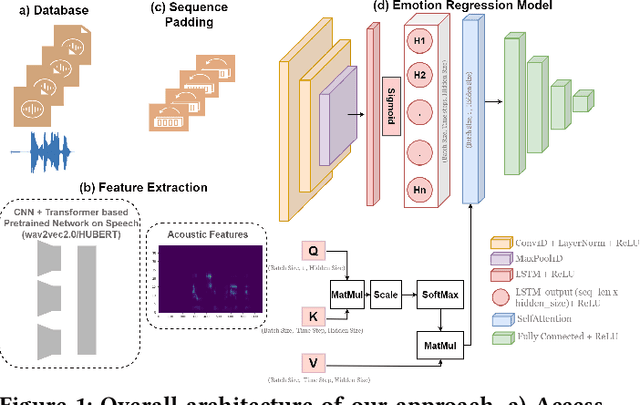
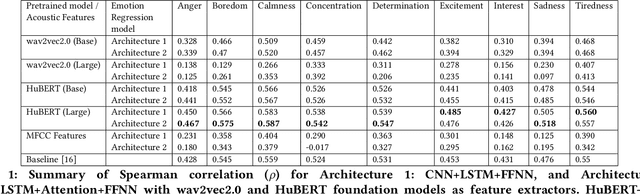
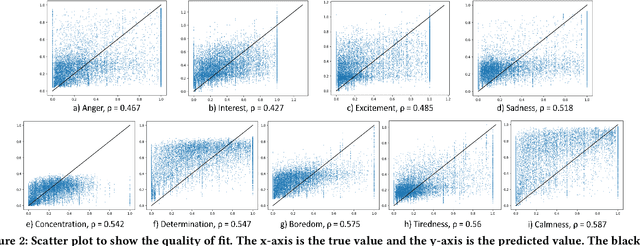
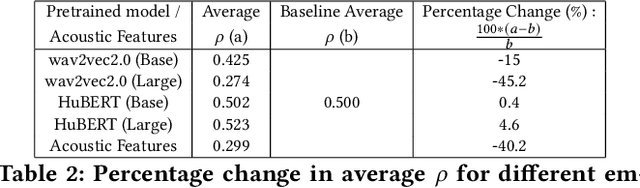
Human emotion understanding is pivotal in making conversational technology mainstream. We view speech emotion understanding as a perception task which is a more realistic setting. With varying contexts (languages, demographics, etc.) different share of people perceive the same speech segment as a non-unanimous emotion. As part of the ACM Multimedia 2023 Computational Paralinguistics ChallengE (ComParE) in the EMotion Share track, we leverage their rich dataset of multilingual speakers and multi-label regression target of 'emotion share' or perception of that emotion. We demonstrate that the training scheme of different foundation models dictates their effectiveness for tasks beyond speech recognition, especially for non-semantic speech tasks like emotion understanding. This is a very complex task due to multilingual speakers, variability in the target labels, and inherent imbalance in the regression dataset. Our results show that HuBERT-Large with a self-attention-based light-weight sequence model provides 4.6% improvement over the reported baseline.