 Add to Chrome
 Add to Firefox
 Add to Edge
Robust Multi-Tier Infant-Centered Audio Understanding with Whisper via Structured Speaker Conditioning
Aug 12, 2026
Recent advances in model design and self-supervised audio representations have improved speech and audio understanding, yet infant-centered naturalistic recordings remain challenging due to limited labeled data, low signal-to-noise ratio, and cross-family domain shifts. We present a family-conditioned, multi-tier audio tagger that combines a LoRA-finetuned Whisper encoder with a lightweight, target-speaker-aware Transformer for long-context inference and framewise prediction across tiers. To improve temporal coherence, we incorporate a simple sequence-level smoothing loss, and to enhance robustness across households, we introduce a factorized speaker-token design with a shared tier token and a learned family-specific offset, reducing family bias and promoting generalizable representations. Together, these choices enable efficient and effective infant-centered audio tagging of daylong audio recordings in home environments.

From Feasibility to Desirability: Plan, Learn, Adapt (PLA) Framework for Personalized On-Device Itinerary Generation
Jul 17, 2026Generating personalized trip itineraries is a complex planning task and involves a tension between hard combinatorial feasibility and soft latent desirability. Classical optimization enforces constraints but fails to capture subjective traveler preferences. While learning-based approaches model preferences, they cannot guarantee feasibility. Mobile deployment imposes additional resource constraints on both. To address this, we propose Plan, Learn, Adapt (PLA), a three-stage framework for personalized on-device itinerary generation. The Plan stage builds a heterogeneous ensemble of lightweight planners that produces structurally diverse feasible candidates. From pairwise itinerary comparisons, Learn fits a compact Bradley-Terry reward model that captures emergent schedule properties such as pacing, geographic coherence, and day balance, which per-POI signals miss. Finally, Adapt applies feasibility-preserving local refinement within a device-aware compute budget; every intermediate state is feasible by construction. On 2,519 pairwise human comparisons across more than 100 U.S. cities, the reward-guided ensemble achieves a 67.8% win rate, 11.2 percentage points above the best single planner, with 100% feasibility. Three frontier LLMs, GPT-5, Claude Opus 4.5, and Gemini 3 Pro, achieve 0% feasibility under the same constraints. The reward model generalizes across held-out cities, with a 67.6% mean leave-one-city-out accuracy. In production deployment within FlyEnJoy, PLA increased itinerary completion rates by 91%, with 109.9 ms average on-device latency.
Hard Rules, Soft Preferences: Bridging Reasoning, Learning, and Optimization for Personalized Packing Checklist Generation
Jul 17, 2026Packing for air travel is recurring and error-prone: the checklist must be personal and context-aware, yet feasible under safety rules, item dependencies, and luggage limits. Existing packing assistants are template-driven and generic, or recommendation-driven but unconstrained, leaving users to manually patch regulatory and capacity violations. We propose a reasoning-guided learning framework with three stages: (1) a symbolic engine that generates a regulation-aware seed checklist with explicit dependency structure, (2) a two-stage preference learner that estimates inclusion and priority utilities from user add and remove actions while mitigating survivorship bias, and (3) a CP-SAT optimizer that selects a compact, compliant subset. The architecture instantiates a general pattern for constrained personalization, applicable wherever hard feasibility coexists with sparse preference signals. On 604 labeled trip scenarios, comprising 29K inclusion labels and 343K pairwise comparisons, the symbolic engine attains 99.7% recall and 0.96 rubric validity, compared with 0.78 to 0.81 for frontier LLMs. Gradient-boosted trees and LambdaMART reach an AUC-ROC of 0.943 and an NDCG@5 of 0.923. CP-SAT attains 100% constraint satisfaction, compared with 28% for greedy selection and 10% for random selection. Deployment in FlyEnJoy, a production iOS travel app, doubled checklist completions and reduced editing and completion time.
Layerwise Progressive Freezing: A Training Scaffold for Depth-Scalable Binary Networks
Jun 26, 2026Training binary neural networks (BNNs) from scratch is dominated by the straight-through estimator (STE), whose forward/backward mismatch produces severe accuracy degradation as networks deepen. We study an orthogonal axis: when and where binarization is enforced during training. We introduce StoMPP (Stochastic Masked Partial Progressive Binarization), which gradually replaces clipped weights and activations with their hard binary counterparts layer by layer from input to output, using stochastic partial masks with soft refresh. StoMPP delivers two complementary benefits. As a standalone training rule, it provides a fully STE-free procedure that improves over vanilla STE with gains that grow with depth (ResNet-50 BNN: +18.0/+13.5/+3.8 on CIFAR-10/100/ImageNet), and the pattern holds across ResNet-18/34/50, MobileNetV2, and BERT fine-tuning. Composed with surrogate gradients by applying STE only to frozen entries, it reaches +27.1/+19.8/+17.7 over vanilla STE on the same setting. Underlying both regimes is a single mechanistic finding: progression order is decisive. Forward layerwise progression prevents depth collapse, reverse progression collapses to near-chance, and binary-weight networks (without binary activations) are insensitive to order. We trace this asymmetry to activation-induced gradient blockades: a committed binary activation severs gradient flow upstream, and ordering controls when these blockades form. To isolate the progression's contribution from any benefit conferred by STE, we conduct all ablations in the STE-free regime; the resulting characterization (schedule, refresh, ordering, dynamics) thus reflects the progression itself rather than its interaction with surrogate gradients.
Layerwise Progressive Freezing Enables STE-Free Training of Deep Binary Neural Networks
Jan 30, 2026We investigate progressive freezing as an alternative to straight-through estimators (STE) for training binary networks from scratch. Under controlled training conditions, we find that while global progressive freezing works for binary-weight networks, it fails for full binary neural networks due to activation-induced gradient blockades. We introduce StoMPP (Stochastic Masked Partial Progressive Binarization), which uses layerwise stochastic masking to progressively replace differentiable clipped weights/activations with hard binary step functions, while only backpropagating through the unfrozen (clipped) subset (i.e., no straight-through estimator). Under a matched minimal training recipe, StoMPP improves accuracy over a BinaryConnect-style STE baseline, with gains that increase with depth (e.g., for ResNet-50 BNN: +18.0 on CIFAR-10, +13.5 on CIFAR-100, and +3.8 on ImageNet; for ResNet-18: +3.1, +4.7, and +1.3). For binary-weight networks, StoMPP achieves 91.2\% accuracy on CIFAR-10 and 69.5\% on CIFAR-100 with ResNet-50. We analyze training dynamics under progressive freezing, revealing non-monotonic convergence and improved depth scaling under binarization constraints.
UnIT: Scalable Unstructured Inference-Time Pruning for MAC-efficient Neural Inference on MCUs
Jul 10, 2025Existing pruning methods are typically applied during training or compile time and often rely on structured sparsity. While compatible with low-power microcontrollers (MCUs), structured pruning underutilizes the opportunity for fine-grained efficiency on devices without SIMD support or parallel compute. To address these limitations, we introduce UnIT (Unstructured Inference-Time pruning), a lightweight method that dynamically identifies and skips unnecessary multiply-accumulate (MAC) operations during inference, guided by input-specific activation patterns. Unlike structured pruning, UnIT embraces irregular sparsity and does not require retraining or hardware specialization. It transforms pruning decisions into lightweight comparisons, replacing multiplications with threshold checks and approximated divisions. UnIT further optimizes compute by reusing threshold computations across multiple connections and applying layer- and group-specific pruning sensitivity. We present three fast, hardware-friendly division approximations tailored to the capabilities of common embedded platforms. Demonstrated on the MSP430 microcontroller, UnIT achieves 11.02% to 82.03% MAC reduction, 27.30% to 84.19% faster inference, and 27.33% to 84.38% lower energy consumption compared to training-time pruned models, while maintaining accuracy with 0.48-7%. Under domain shift, UnIT matches or exceeds the accuracy of retrained models while requiring significantly fewer MACs. These results establish unstructured inference-time pruning as a viable and practical solution for efficient, retraining-free deployment of deep neural networks on MCUs.
RAVEN: Query-Guided Representation Alignment for Question Answering over Audio, Video, Embedded Sensors, and Natural Language
May 21, 2025Multimodal question answering (QA) often requires identifying which video, audio, or sensor tokens are relevant to the question. Yet modality disagreements are common: off-camera speech, background noise, or motion outside the field of view often mislead fusion models that weight all streams equally. We present RAVEN, a unified QA architecture whose core is QuART, a query-conditioned cross-modal gating module that assigns scalar relevance scores to each token across modalities, enabling the model to amplify informative signals and suppress distractors before fusion. RAVEN is trained through a three-stage pipeline comprising unimodal pretraining, query-aligned fusion, and disagreement-oriented fine-tuning -- each stage targeting a distinct challenge in multi-modal reasoning: representation quality, cross-modal relevance, and robustness to modality mismatch. To support training and evaluation, we release AVS-QA, a dataset of 300K synchronized Audio--Video-Sensor streams paired with automatically generated question-answer pairs. Experimental results on seven multi-modal QA benchmarks -- including egocentric and exocentric tasks -- show that RAVEN achieves up to 14.5\% and 8.0\% gains in accuracy compared to state-of-the-art multi-modal large language models, respectively. Incorporating sensor data provides an additional 16.4\% boost, and the model remains robust under modality corruption, outperforming SOTA baselines by 50.23\%. Our code and dataset are available at https://github.com/BASHLab/RAVEN.
QUADS: QUAntized Distillation Framework for Efficient Speech Language Understanding
May 19, 2025Spoken Language Understanding (SLU) systems must balance performance and efficiency, particularly in resource-constrained environments. Existing methods apply distillation and quantization separately, leading to suboptimal compression as distillation ignores quantization constraints. We propose QUADS, a unified framework that optimizes both through multi-stage training with a pre-tuned model, enhancing adaptability to low-bit regimes while maintaining accuracy. QUADS achieves 71.13\% accuracy on SLURP and 99.20\% on FSC, with only minor degradations of up to 5.56\% compared to state-of-the-art models. Additionally, it reduces computational complexity by 60--73$\times$ (GMACs) and model size by 83--700$\times$, demonstrating strong robustness under extreme quantization. These results establish QUADS as a highly efficient solution for real-world, resource-constrained SLU applications.
Forearm Ultrasound based Gesture Recognition on Edge
Sep 16, 2024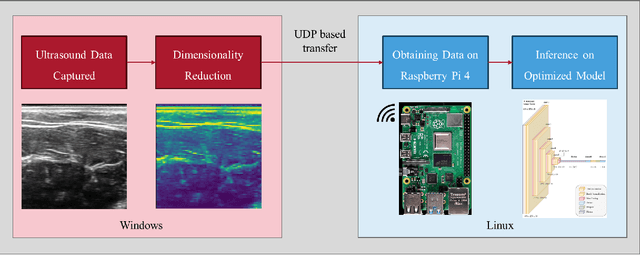
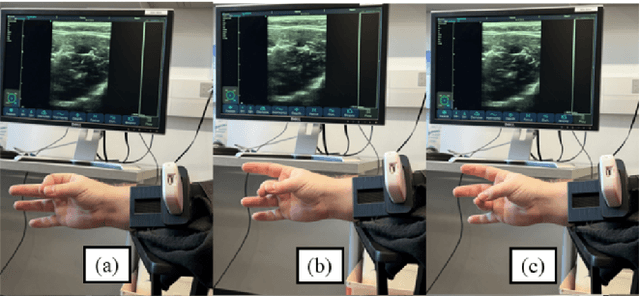
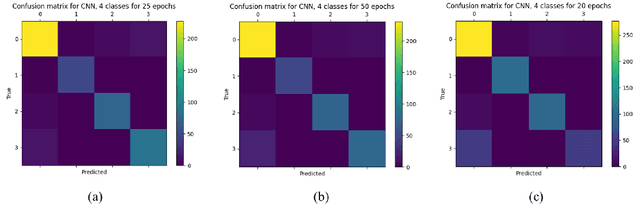

Ultrasound imaging of the forearm has demonstrated significant potential for accurate hand gesture classification. Despite this progress, there has been limited focus on developing a stand-alone end- to-end gesture recognition system which makes it mobile, real-time and more user friendly. To bridge this gap, this paper explores the deployment of deep neural networks for forearm ultrasound-based hand gesture recognition on edge devices. Utilizing quantization techniques, we achieve substantial reductions in model size while maintaining high accuracy and low latency. Our best model, with Float16 quantization, achieves a test accuracy of 92% and an inference time of 0.31 seconds on a Raspberry Pi. These results demonstrate the feasibility of efficient, real-time gesture recognition on resource-limited edge devices, paving the way for wearable ultrasound-based systems.
Sound Tagging in Infant-centric Home Soundscapes
Jun 25, 2024
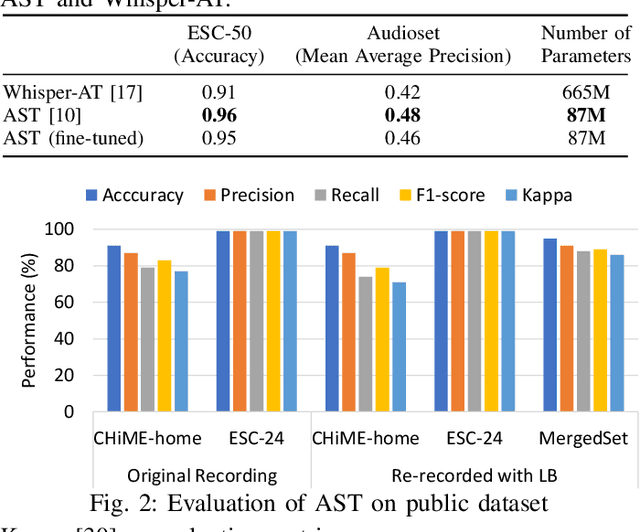
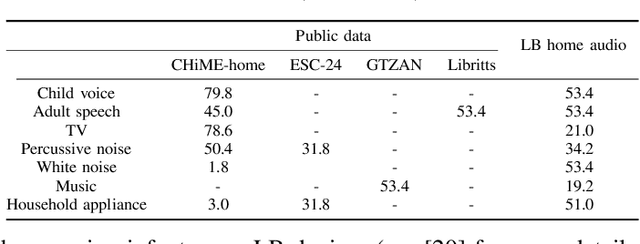
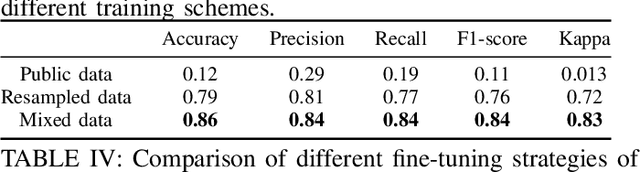
Certain environmental noises have been associated with negative developmental outcomes for infants and young children. Though classifying or tagging sound events in a domestic environment is an active research area, previous studies focused on data collected from a non-stationary microphone placed in the environment or from the perspective of adults. Further, many of these works ignore infants or young children in the environment or have data collected from only a single family where noise from the fixed sound source can be moderate at the infant's position or vice versa. Thus, despite the recent success of large pre-trained models for noise event detection, the performance of these models on infant-centric noise soundscapes in the home is yet to be explored. To bridge this gap, we have collected and labeled noises in home soundscapes from 22 families in an unobtrusive manner, where the data are collected through an infant-worn recording device. In this paper, we explore the performance of a large pre-trained model (Audio Spectrogram Transformer [AST]) on our noise-conditioned infant-centric environmental data as well as publicly available home environmental datasets. Utilizing different training strategies such as resampling, utilizing public datasets, mixing public and infant-centric training sets, and data augmentation using noise and masking, we evaluate the performance of a large pre-trained model on sparse and imbalanced infant-centric data. Our results show that fine-tuning the large pre-trained model by combining our collected dataset with public datasets increases the F1-score from 0.11 (public datasets) and 0.76 (collected datasets) to 0.84 (combined datasets) and Cohen's Kappa from 0.013 (public datasets) and 0.77 (collected datasets) to 0.83 (combined datasets) compared to only training with public or collected datasets, respectively.