 Add to Chrome
 Add to Firefox
 Add to Edge
KVDiagnosis: A Diagnostic Benchmark for KV-Cache Compression in Long-Context Language Models
Aug 10, 2026
KV-cache compression reduces long-context memory, but aggregate task scores reveal neither which correct executions fail nor why. We present KVDiagnosis, a diagnostic dataset and benchmark with three contributions. First, a 25-method taxonomy groups methods into five mechanism families and links them to eight verified implementations and their valid diagnostic measurements. Second, for every supported method setting, we evaluate all sources in each fixed split against a per-source FullCache control before selecting FullCache-correct/compressed-wrong (C-to-W) rows separately for each method-setting, so no compressor defines another's test set. Third, a common record format links paired outputs and run metadata to cache, likelihood, attention, and decoding measurements with explicit applicability states. On Qwen3-8B, four evidence-aware workloads yield 59 800 supported compressed runs over 2600 sources and 12 520 C-to-W rows. Under fixed diagnostic rules, 63.2% have low or partial measured/projected coverage. Only 19 rows (0.2%) combine high measured/projected coverage with strong likelihood drift; another 2,126 (17.0%) preserve structural position addressability, for which representation fidelity remains unknown, while showing the same drift. Against C-to-C success controls, all ten diagnostics separate failed from successful compression (stratified AUROC 0.684-0.871). Among 96 reproducible low-EAR failures, a controlled 4x evidence-attention boost repairs 29.2%, versus 6.3% under a count-matched sham intervention and 3.3% degradation on matched C-to-C controls. Code and data are available at https://github.com/ChosenQC/KVDiagnosis.

EMAS: Stabilizing Multi-Agent System Evolution through Evidence-Guided Revision
Aug 07, 2026Many methods for automated multi-agent system design optimize prompts and topologies during an initial design stage and then deploy the resulting system unchanged on subsequent samples. Experience from these samples is rarely consolidated into reusable system updates, while accuracy-oriented designs may incur high token costs. We introduce EMAS (Evolving Multi-Agent System), which uses this experience to revise MAS topology and prompts without updating LLM parameters, either to improve accuracy or to reduce cost. EMAS converts traces into structured diagnoses that specify a revision operation and target. It generates a candidate revision only when the same diagnosis recurs across samples and applies it only if paired validation against the current MAS meets the corresponding acceptance criterion. Across four benchmarks and two LLMs, EMAS attains the highest task-weighted overall accuracy for both backbones and is best or tied in six of eight model--benchmark settings. Within two evolution epochs, EMAS achieves relative gains of 6.30% and 20.10% in task-weighted accuracy on Kimi-K2-6 and Qwen3.6-27B, respectively. On MBPP with Qwen3.6-27B, EMAS raises accuracy from 55.09% to 89.12% while reducing token use per task by 62.2%. These results show that EMAS can turn experience from new samples into reusable updates to MAS topology and prompts.
PolyKV: Heterogeneous Retention and Allocation for KV Cache Compression
Jun 13, 2026KV cache compression is essential for reducing the memory cost of long-context large language model inference. Existing approaches, however, typically apply a single compression policy and a uniform cache budget across all transformer layers. This uniform design ignores the fact that different layers can play different roles during prefill and decoding, and may therefore require different eviction strategies and cache capacities. We present PolyKV, a layer-wise KV cache optimization framework that considers design space with method selection and budget allocation. PolyKV routes each layer to a suitable KV compression policy based on layer-level signals, while assigning non-uniform budgets under a fixed total budget. This formulation enables heterogeneous compositions of existing KV cache methods. Experiments on LLaMA-3.1-8B and Qwen3-8B show that, under the same 512-token average KV budget, PolyKV recovers 54.5% and 25.7% of the LongBench performance gap between the strongest single-policy baseline and FullKV, respectively. Across 128-1024 budget sweep, PolyKV consistently improves over the strongest baseline by 1.7%-6.4%, corresponding to 40.0%-54.5% recovery of the FullKV gap.
Can Deep Neural Networks Improve Compression of Very Large Scientific Data?
Jun 12, 2026Error-bounded lossy compression is a fundamental technique for managing the rapidly growing volumes of scientific data produced by modern simulations and observational instruments. Most state-of-the-art-compressors follow a prediction-residual paradigm, where compression effectiveness depends on the quality of the predictor: more accurate predictions generate smaller residuals that are easier to compress. This observation raises a question: can modern machine learning models serve as superior predictors for scientific data compression? Answering this question directly is challenging because developing compression-specific ML predictors requires substantial resources. Instead, we leverage the climate domain where highly accurate pretrained weather forecasting foundation models already exist, making them an ideal testbed. We present a framework that integrates spatial and temporal deep learning models into a conventional error-bounded compression pipeline. The framework supports auto-regressive forecasting models and avoids error accumulation. Using ERA5 climate data as a representative large-scale scientific dataset, we evaluate three distinct ML predictors: a VAEformer-based codec (CRA5), a graph neural network forecaster (GraphCast), and a vision-transformer forecaster (Aurora), against the state-of-the-art compressor SZ3.1 under identical quantization and entropy-coding backends. Our evaluation over approximately 1.7 TB of data reveals a surprising result: although ML predictors generate more accurate predictions and can improve reconstruction quality by up to 91% while achieving up to 9.6x higher compression ratios for highly predictable variables, they do not improve overall dataset-level compression ratio. We show that prediction accuracy alone is insufficient: the spatial structure of the resulting residuals plays a decisive role in entropy coding efficiency.
From GPS Points to Travel Patterns: Flexible and Semantic Trajectory Generation with LLMs
May 28, 2026Urban trajectories play a crucial role in modeling urban dynamics and supporting various smart city applications. However, privacy concerns restrict access to large-scale and high-quality trajectory datasets. Trajectory generation provides a promising alternative by synthesizing realistic data to mitigate privacy risks. However, existing methods fail to explicitly capture travel patterns and can only generate fixed-length trajectories under a single condition. To address these limitations, we propose \textbf{HTP}, which \textbf{H}ierarchically generates \textbf{T}ravel patterns first and then generates GPS \textbf{P}oints by using large language models (LLMs), rather than directly generating GPS points. We first design a trajectory-specific residual quantization variational autoencoder (RQ-VAE) that quantizes micro-level GPS trajectories into compact, macro-level travel pattern tokens in a coarse-to-fine manner. These tokens capture rich segment spatial irregularities, such as point density variations caused by traffic conditions. Then, we extend the LLM vocabulary with travel pattern tokens to align trajectory representations with the LLM input, and apply supervised fine-tuning (SFT) to align the LLM with the trajectory generation task, enabling generation of travel pattern sequences under various conditions. Extensive experiments on two real-world datasets show that HTP outperforms the strongest baseline by an average of 29.78\% in terms of generation quality. Our code is available at https://github.com/slzhou-xy/HTP.
Leveraging LLM-GNN Integration for Open-World Question Answering over Knowledge Graphs
Apr 15, 2026Open-world Question Answering (OW-QA) over knowledge graphs (KGs) aims to answer questions over incomplete or evolving KGs. Traditional KGQA assumes a closed world where answers must exist in the KG, limiting real-world applicability. In contrast, open-world QA requires inferring missing knowledge based on graph structure and context. Large language models (LLMs) excel at language understanding but lack structured reasoning. Graph neural networks (GNNs) model graph topology but struggle with semantic interpretation. Existing systems integrate LLMs with GNNs or graph retrievers. Some support open-world QA but rely on structural embeddings without semantic grounding. Most assume observed paths or complete graphs, making them unreliable under missing links or multi-hop reasoning. We present GLOW, a hybrid system that combines a pre-trained GNN and an LLM for open-world KGQA. The GNN predicts top-k candidate answers from the graph structure. These, along with relevant KG facts, are serialized into a structured prompt (e.g., triples and candidates) to guide the LLM's reasoning. This enables joint reasoning over symbolic and semantic signals, without relying on retrieval or fine-tuning. To evaluate generalization, we introduce GLOW-BENCH, a 1,000-question benchmark over incomplete KGs across diverse domains. GLOW outperforms existing LLM-GNN systems on standard benchmarks and GLOW-BENCH, achieving up to 53.3% and an average 38% improvement. GitHub code and data are available.
CHESS: Context-aware Hierarchical Efficient Semantic Selection for Long-Context LLM Inference
Feb 24, 2026Long-context LLMs demand accurate inference at low latency, yet decoding becomes primarily constrained by KV cache as context grows. Prior pruning methods are largely context-agnostic: their token selection ignores step-wise relevance and local semantics, which undermines quality. Moreover, their irregular accesses and selection overheads yield only limited wall-clock speedups. To address this, we propose \textbf{CHESS}, an \textit{algorithm-system co-design} KV-cache management system. Algorithmically, CHESS introduces a context-aware, hierarchical selection policy that dynamically reconstructs a coherent context for the current decoding. System-wise, coarse granularity selection eliminates expensive data movement, fully realizing practical acceleration from theoretical sparsity. Extensive evaluations demonstrate that CHESS surpasses Full-KV quality using only \textbf{1\%} of the KV cache, delivers low-latency stable inference with up to \textbf{4.56$\times$} higher throughput, and consistently outperforms other strong baselines. Code is available at \href{https://anonymous.4open.science/r/CHESS-9958/}{https://anonymous.4open.science/r/CHESS/}.
GraphComp: Extreme Error-bounded Compression of Scientific Data via Temporal Graph Autoencoders
May 08, 2025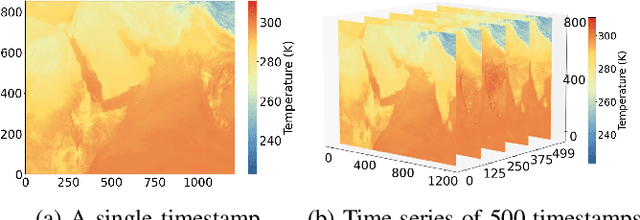
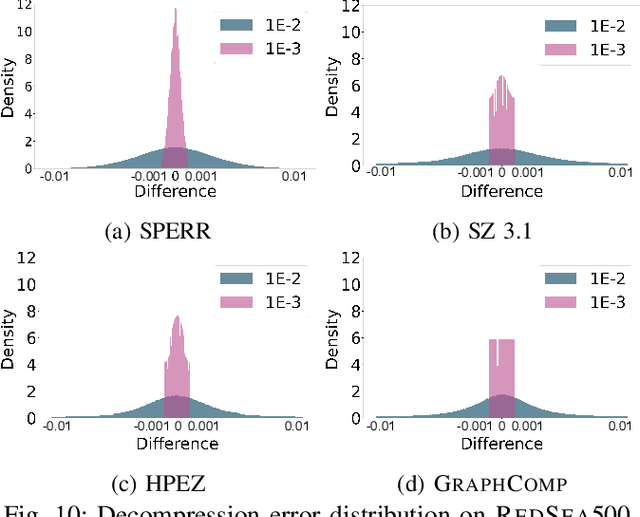
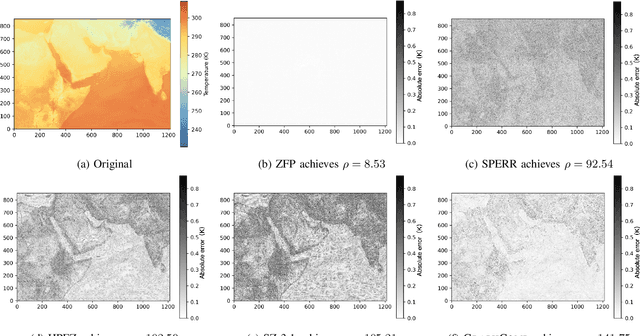
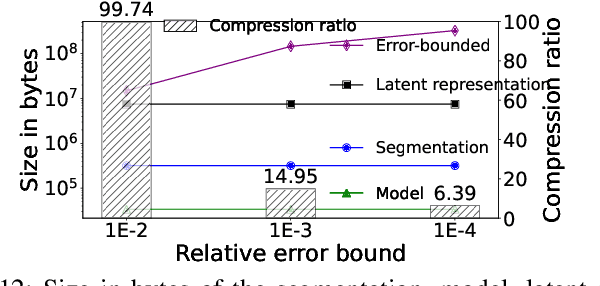
The generation of voluminous scientific data poses significant challenges for efficient storage, transfer, and analysis. Recently, error-bounded lossy compression methods emerged due to their ability to achieve high compression ratios while controlling data distortion. However, they often overlook the inherent spatial and temporal correlations within scientific data, thus missing opportunities for higher compression. In this paper we propose GRAPHCOMP, a novel graph-based method for error-bounded lossy compression of scientific data. We perform irregular segmentation of the original grid data and generate a graph representation that preserves the spatial and temporal correlations. Inspired by Graph Neural Networks (GNNs), we then propose a temporal graph autoencoder to learn latent representations that significantly reduce the size of the graph, effectively compressing the original data. Decompression reverses the process and utilizes the learnt graph model together with the latent representation to reconstruct an approximation of the original data. The decompressed data are guaranteed to satisfy a user-defined point-wise error bound. We compare our method against the state-of-the-art error-bounded lossy methods (i.e., HPEZ, SZ3.1, SPERR, and ZFP) on large-scale real and synthetic data. GRAPHCOMP consistently achieves the highest compression ratio across most datasets, outperforming the second-best method by margins ranging from 22% to 50%.
RED: Effective Trajectory Representation Learning with Comprehensive Information
Nov 22, 2024
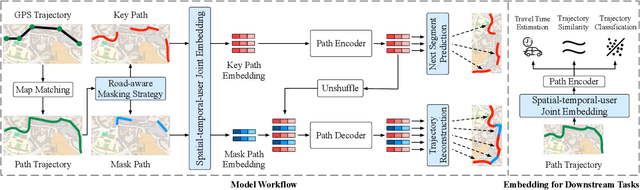


Trajectory representation learning (TRL) maps trajectories to vectors that can then be used for various downstream tasks, including trajectory similarity computation, trajectory classification, and travel-time estimation. However, existing TRL methods often produce vectors that, when used in downstream tasks, yield insufficiently accurate results. A key reason is that they fail to utilize the comprehensive information encompassed by trajectories. We propose a self-supervised TRL framework, called RED, which effectively exploits multiple types of trajectory information. Overall, RED adopts the Transformer as the backbone model and masks the constituting paths in trajectories to train a masked autoencoder (MAE). In particular, RED considers the moving patterns of trajectories by employing a Road-aware masking strategy} that retains key paths of trajectories during masking, thereby preserving crucial information of the trajectories. RED also adopts a spatial-temporal-user joint Embedding scheme to encode comprehensive information when preparing the trajectories as model inputs. To conduct training, RED adopts Dual-objective task learning}: the Transformer encoder predicts the next segment in a trajectory, and the Transformer decoder reconstructs the entire trajectory. RED also considers the spatial-temporal correlations of trajectories by modifying the attention mechanism of the Transformer. We compare RED with 9 state-of-the-art TRL methods for 4 downstream tasks on 3 real-world datasets, finding that RED can usually improve the accuracy of the best-performing baseline by over 5%.
Task-Oriented GNNs Training on Large Knowledge Graphs for Accurate and Efficient Modeling
Mar 09, 2024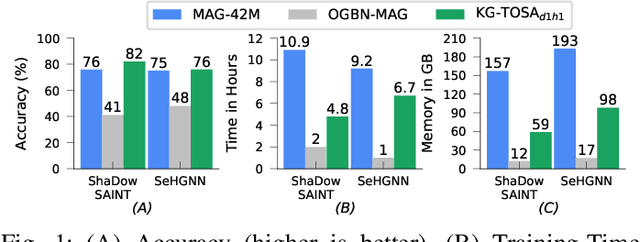
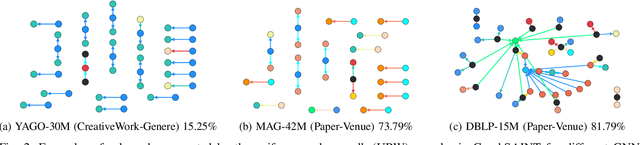
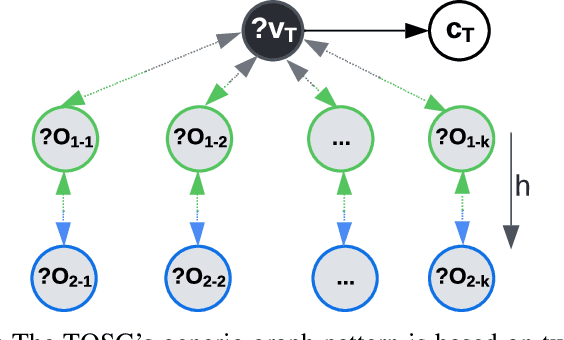
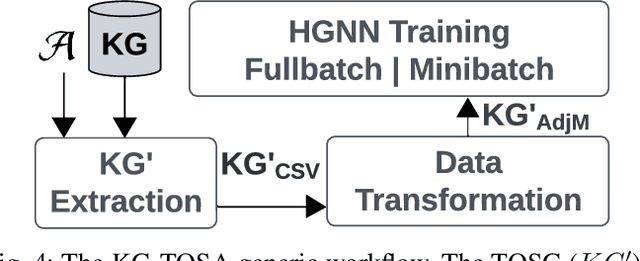
A Knowledge Graph (KG) is a heterogeneous graph encompassing a diverse range of node and edge types. Heterogeneous Graph Neural Networks (HGNNs) are popular for training machine learning tasks like node classification and link prediction on KGs. However, HGNN methods exhibit excessive complexity influenced by the KG's size, density, and the number of node and edge types. AI practitioners handcraft a subgraph of a KG G relevant to a specific task. We refer to this subgraph as a task-oriented subgraph (TOSG), which contains a subset of task-related node and edge types in G. Training the task using TOSG instead of G alleviates the excessive computation required for a large KG. Crafting the TOSG demands a deep understanding of the KG's structure and the task's objectives. Hence, it is challenging and time-consuming. This paper proposes KG-TOSA, an approach to automate the TOSG extraction for task-oriented HGNN training on a large KG. In KG-TOSA, we define a generic graph pattern that captures the KG's local and global structure relevant to a specific task. We explore different techniques to extract subgraphs matching our graph pattern: namely (i) two techniques sampling around targeted nodes using biased random walk or influence scores, and (ii) a SPARQL-based extraction method leveraging RDF engines' built-in indices. Hence, it achieves negligible preprocessing overhead compared to the sampling techniques. We develop a benchmark of real KGs of large sizes and various tasks for node classification and link prediction. Our experiments show that KG-TOSA helps state-of-the-art HGNN methods reduce training time and memory usage by up to 70% while improving the model performance, e.g., accuracy and inference time.