 Add to Chrome
 Add to Firefox
 Add to Edge
KVDiagnosis: A Diagnostic Benchmark for KV-Cache Compression in Long-Context Language Models
Aug 10, 2026
KV-cache compression reduces long-context memory, but aggregate task scores reveal neither which correct executions fail nor why. We present KVDiagnosis, a diagnostic dataset and benchmark with three contributions. First, a 25-method taxonomy groups methods into five mechanism families and links them to eight verified implementations and their valid diagnostic measurements. Second, for every supported method setting, we evaluate all sources in each fixed split against a per-source FullCache control before selecting FullCache-correct/compressed-wrong (C-to-W) rows separately for each method-setting, so no compressor defines another's test set. Third, a common record format links paired outputs and run metadata to cache, likelihood, attention, and decoding measurements with explicit applicability states. On Qwen3-8B, four evidence-aware workloads yield 59 800 supported compressed runs over 2600 sources and 12 520 C-to-W rows. Under fixed diagnostic rules, 63.2% have low or partial measured/projected coverage. Only 19 rows (0.2%) combine high measured/projected coverage with strong likelihood drift; another 2,126 (17.0%) preserve structural position addressability, for which representation fidelity remains unknown, while showing the same drift. Against C-to-C success controls, all ten diagnostics separate failed from successful compression (stratified AUROC 0.684-0.871). Among 96 reproducible low-EAR failures, a controlled 4x evidence-attention boost repairs 29.2%, versus 6.3% under a count-matched sham intervention and 3.3% degradation on matched C-to-C controls. Code and data are available at https://github.com/ChosenQC/KVDiagnosis.

Can Deep Neural Networks Improve Compression of Very Large Scientific Data?
Jun 12, 2026Error-bounded lossy compression is a fundamental technique for managing the rapidly growing volumes of scientific data produced by modern simulations and observational instruments. Most state-of-the-art-compressors follow a prediction-residual paradigm, where compression effectiveness depends on the quality of the predictor: more accurate predictions generate smaller residuals that are easier to compress. This observation raises a question: can modern machine learning models serve as superior predictors for scientific data compression? Answering this question directly is challenging because developing compression-specific ML predictors requires substantial resources. Instead, we leverage the climate domain where highly accurate pretrained weather forecasting foundation models already exist, making them an ideal testbed. We present a framework that integrates spatial and temporal deep learning models into a conventional error-bounded compression pipeline. The framework supports auto-regressive forecasting models and avoids error accumulation. Using ERA5 climate data as a representative large-scale scientific dataset, we evaluate three distinct ML predictors: a VAEformer-based codec (CRA5), a graph neural network forecaster (GraphCast), and a vision-transformer forecaster (Aurora), against the state-of-the-art compressor SZ3.1 under identical quantization and entropy-coding backends. Our evaluation over approximately 1.7 TB of data reveals a surprising result: although ML predictors generate more accurate predictions and can improve reconstruction quality by up to 91% while achieving up to 9.6x higher compression ratios for highly predictable variables, they do not improve overall dataset-level compression ratio. We show that prediction accuracy alone is insufficient: the spatial structure of the resulting residuals plays a decisive role in entropy coding efficiency.
CHESS: Context-aware Hierarchical Efficient Semantic Selection for Long-Context LLM Inference
Feb 24, 2026Long-context LLMs demand accurate inference at low latency, yet decoding becomes primarily constrained by KV cache as context grows. Prior pruning methods are largely context-agnostic: their token selection ignores step-wise relevance and local semantics, which undermines quality. Moreover, their irregular accesses and selection overheads yield only limited wall-clock speedups. To address this, we propose \textbf{CHESS}, an \textit{algorithm-system co-design} KV-cache management system. Algorithmically, CHESS introduces a context-aware, hierarchical selection policy that dynamically reconstructs a coherent context for the current decoding. System-wise, coarse granularity selection eliminates expensive data movement, fully realizing practical acceleration from theoretical sparsity. Extensive evaluations demonstrate that CHESS surpasses Full-KV quality using only \textbf{1\%} of the KV cache, delivers low-latency stable inference with up to \textbf{4.56$\times$} higher throughput, and consistently outperforms other strong baselines. Code is available at \href{https://anonymous.4open.science/r/CHESS-9958/}{https://anonymous.4open.science/r/CHESS/}.
GraphComp: Extreme Error-bounded Compression of Scientific Data via Temporal Graph Autoencoders
May 08, 2025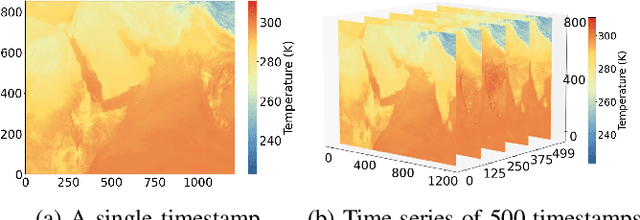
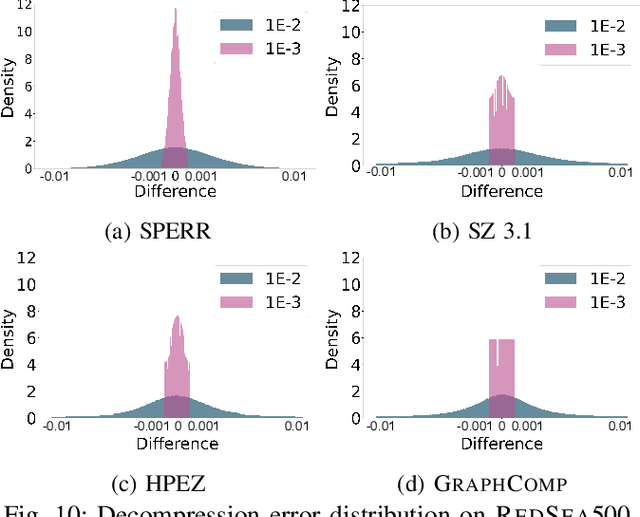
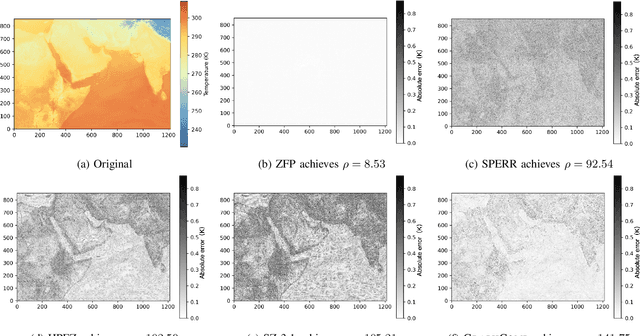
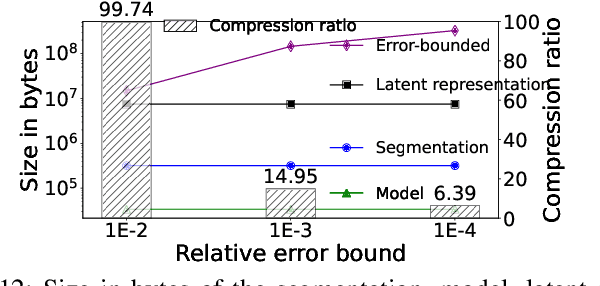
The generation of voluminous scientific data poses significant challenges for efficient storage, transfer, and analysis. Recently, error-bounded lossy compression methods emerged due to their ability to achieve high compression ratios while controlling data distortion. However, they often overlook the inherent spatial and temporal correlations within scientific data, thus missing opportunities for higher compression. In this paper we propose GRAPHCOMP, a novel graph-based method for error-bounded lossy compression of scientific data. We perform irregular segmentation of the original grid data and generate a graph representation that preserves the spatial and temporal correlations. Inspired by Graph Neural Networks (GNNs), we then propose a temporal graph autoencoder to learn latent representations that significantly reduce the size of the graph, effectively compressing the original data. Decompression reverses the process and utilizes the learnt graph model together with the latent representation to reconstruct an approximation of the original data. The decompressed data are guaranteed to satisfy a user-defined point-wise error bound. We compare our method against the state-of-the-art error-bounded lossy methods (i.e., HPEZ, SZ3.1, SPERR, and ZFP) on large-scale real and synthetic data. GRAPHCOMP consistently achieves the highest compression ratio across most datasets, outperforming the second-best method by margins ranging from 22% to 50%.
AUTOSHAPE: An Autoencoder-Shapelet Approach for Time Series Clustering
Aug 06, 2022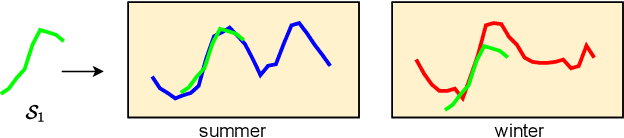
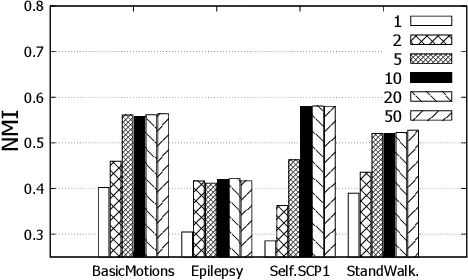
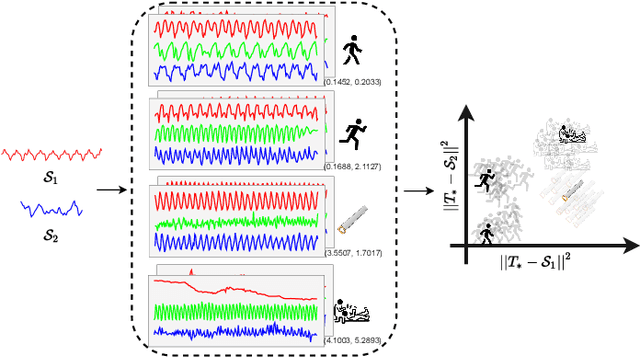

Time series shapelets are discriminative subsequences that have been recently found effective for time series clustering (TSC). The shapelets are convenient for interpreting the clusters. Thus, the main challenge for TSC is to discover high-quality variable-length shapelets to discriminate different clusters. In this paper, we propose a novel autoencoder-shapelet approach (AUTOSHAPE), which is the first study to take the advantage of both autoencoder and shapelet for determining shapelets in an unsupervised manner. An autoencoder is specially designed to learn high-quality shapelets. More specifically, for guiding the latent representation learning, we employ the latest self-supervised loss to learn the unified embeddings for variable-length shapelet candidates (time series subsequences) of different variables, and propose the diversity loss to select the discriminating embeddings in the unified space. We introduce the reconstruction loss to recover shapelets in the original time series space for clustering. Finally, we adopt Davies Bouldin index (DBI) to inform AUTOSHAPE of the clustering performance during learning. We present extensive experiments on AUTOSHAPE. To evaluate the clustering performance on univariate time series (UTS), we compare AUTOSHAPE with 15 representative methods using UCR archive datasets. To study the performance of multivariate time series (MTS), we evaluate AUTOSHAPE on 30 UEA archive datasets with 5 competitive methods. The results validate that AUTOSHAPE is the best among all the methods compared. We interpret clusters with shapelets, and can obtain interesting intuitions about clusters in three UTS case studies and one MTS case study, respectively.