 Add to Chrome
 Add to Firefox
 Add to Edge
Separable Pathways for Causal Reasoning: How Architectural Scaffolding Enables Hypothesis-Space Restructuring in LLM Agents
Apr 21, 2026
Causal discovery through experimentation and intervention is fundamental to robust problem solving. It requires not just updating beliefs within a fixed framework but revising the hypothesis space itself, a capacity current AI agents lack when evidence demands representations they have not previously constructed. We extend the blicket detector paradigm from developmental science to test this capacity in AI agents equipped with architectural scaffolding that targets hypothesis-space restructuring. Our compositional architecture has two discrete components: context graphs, which structure exploration as typed state machines, and dynamic behaviors, which monitor for evidence that the current hypothesis space is inadequate and expand it at runtime. Across 1,085 experimental trials, these components make orthogonal contributions: context graphs drive reasoning quality within the post-switch hypothesis space, accounting for 94\% of the accuracy gain, while dynamic behaviors drive reasoning eligibility by detecting regime changes and preventing premature commitment to outdated hypotheses.

Leveraging Large Language Models for Career Mobility Analysis: A Study of Gender, Race, and Job Change Using U.S. Online Resume Profiles
Nov 15, 2025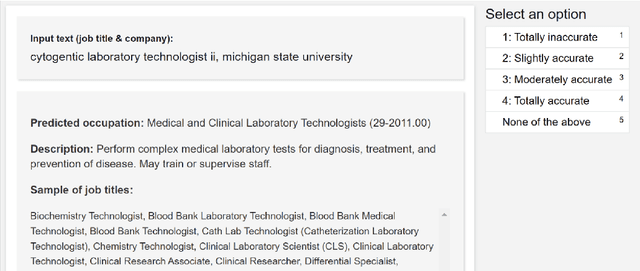
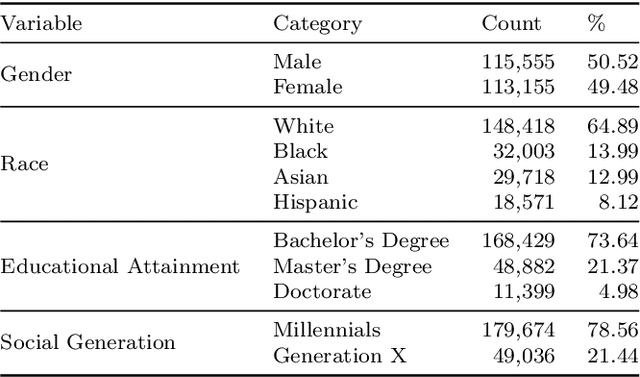
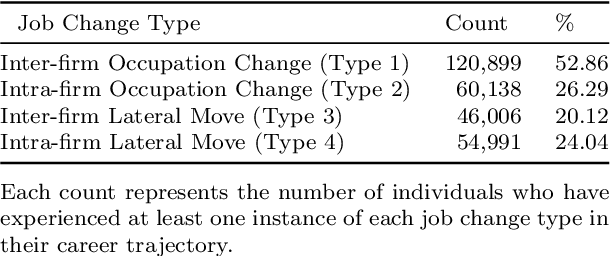
We present a large-scale analysis of career mobility of college-educated U.S. workers using online resume profiles to investigate how gender, race, and job change options are associated with upward mobility. This study addresses key research questions of how the job changes affect their upward career mobility, and how the outcomes of upward career mobility differ by gender and race. We address data challenges -- such as missing demographic attributes, missing wage data, and noisy occupation labels -- through various data processing and Artificial Intelligence (AI) methods. In particular, we develop a large language models (LLMs) based occupation classification method known as FewSOC that achieves accuracy significantly higher than the original occupation labels in the resume dataset. Analysis of 228,710 career trajectories reveals that intra-firm occupation change has been found to facilitate upward mobility most strongly, followed by inter-firm occupation change and inter-firm lateral move. Women and Black college graduates experience significantly lower returns from job changes than men and White peers. Multilevel sensitivity analyses confirm that these disparities are robust to cluster-level heterogeneity and reveal additional intersectional patterns.