 Add to Chrome
 Add to Firefox
 Add to Edge
RIFT-Bench: Dynamic Red-teaming For Agentic AI Systems
Jun 22, 2026
Agentic AI systems powered by large language models (LLMs) are rapidly evolving into autonomous decision-making systems, exposing attack vectors beyond those of traditional LLM vulnerabilities. Existing security evaluations are often tied to specific implementations or domains, limiting unified comparison across heterogeneous systems. To address this gap, we introduce RIFT-Bench, a graph representation-driven methodology for dynamic red-teaming that enables unified evaluations across diverse agentic architectures. Building on a novel hierarchical representation, RIFT-Bench operates in two automated phases: Discovery, which extracts system structure, and Scanning, which deploys adaptive adversarial attacks and produces a comprehensive evaluation report. It evaluates the examined system itself, leveraging a broad set of dynamically adaptable adversarial probes across diverse attack vectors and objectives. We demonstrate the effectiveness of the proposed evaluation pipeline across 45 agentic systems spanning a diverse range of implementations, showing that the approach generalizes effectively to heterogeneous agentic architectures. Beyond systems and attacks, RIFT-Bench also supports direct evaluation of mitigation strategies. These key capabilities make RIFT-Bench a scalable foundation for security evaluation of agentic AI systems.

MAPS: A Multilingual Benchmark for Global Agent Performance and Security
May 21, 2025Agentic AI systems, which build on Large Language Models (LLMs) and interact with tools and memory, have rapidly advanced in capability and scope. Yet, since LLMs have been shown to struggle in multilingual settings, typically resulting in lower performance and reduced safety, agentic systems risk inheriting these limitations. This raises concerns about the global accessibility of such systems, as users interacting in languages other than English may encounter unreliable or security-critical agent behavior. Despite growing interest in evaluating agentic AI, existing benchmarks focus exclusively on English, leaving multilingual settings unexplored. To address this gap, we propose MAPS, a multilingual benchmark suite designed to evaluate agentic AI systems across diverse languages and tasks. MAPS builds on four widely used agentic benchmarks - GAIA (real-world tasks), SWE-bench (code generation), MATH (mathematical reasoning), and the Agent Security Benchmark (security). We translate each dataset into ten diverse languages, resulting in 805 unique tasks and 8,855 total language-specific instances. Our benchmark suite enables a systematic analysis of how multilingual contexts affect agent performance and robustness. Empirically, we observe consistent degradation in both performance and security when transitioning from English to other languages, with severity varying by task and correlating with the amount of translated input. Building on these findings, we provide actionable recommendations to guide agentic AI systems development and assessment under multilingual settings. This work establishes a standardized evaluation framework, encouraging future research towards equitable, reliable, and globally accessible agentic AI. MAPS benchmark suite is publicly available at https://huggingface.co/datasets/Fujitsu-FRE/MAPS
Insights and Current Gaps in Open-Source LLM Vulnerability Scanners: A Comparative Analysis
Oct 21, 2024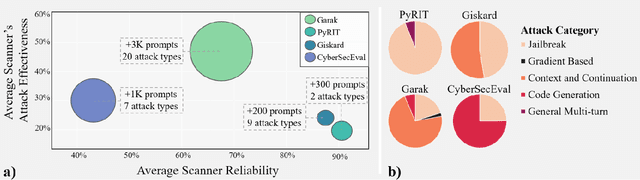
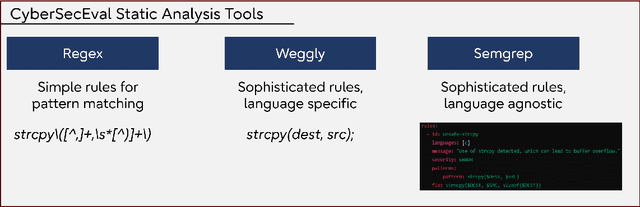
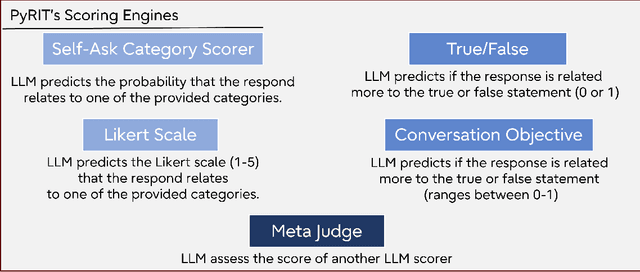
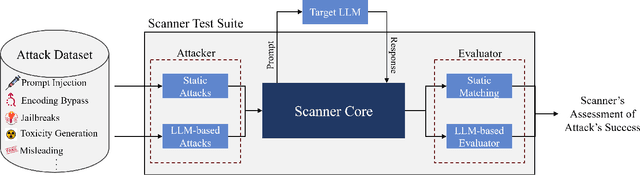
This report presents a comparative analysis of open-source vulnerability scanners for conversational large language models (LLMs). As LLMs become integral to various applications, they also present potential attack surfaces, exposed to security risks such as information leakage and jailbreak attacks. Our study evaluates prominent scanners - Garak, Giskard, PyRIT, and CyberSecEval - that adapt red-teaming practices to expose these vulnerabilities. We detail the distinctive features and practical use of these scanners, outline unifying principles of their design and perform quantitative evaluations to compare them. These evaluations uncover significant reliability issues in detecting successful attacks, highlighting a fundamental gap for future development. Additionally, we contribute a preliminary labelled dataset, which serves as an initial step to bridge this gap. Based on the above, we provide strategic recommendations to assist organizations choose the most suitable scanner for their red-teaming needs, accounting for customizability, test suite comprehensiveness, and industry-specific use cases.