 Add to Chrome
 Add to Firefox
 Add to Edge
Bench-MFG: A Benchmark Suite for Learning in Stationary Mean Field Games
Feb 13, 2026
The intersection of Mean Field Games (MFGs) and Reinforcement Learning (RL) has fostered a growing family of algorithms designed to solve large-scale multi-agent systems. However, the field currently lacks a standardized evaluation protocol, forcing researchers to rely on bespoke, isolated, and often simplistic environments. This fragmentation makes it difficult to assess the robustness, generalization, and failure modes of emerging methods. To address this gap, we propose a comprehensive benchmark suite for MFGs (Bench-MFG), focusing on the discrete-time, discrete-space, stationary setting for the sake of clarity. We introduce a taxonomy of problem classes, ranging from no-interaction and monotone games to potential and dynamics-coupled games, and provide prototypical environments for each. Furthermore, we propose MF-Garnets, a method for generating random MFG instances to facilitate rigorous statistical testing. We benchmark a variety of learning algorithms across these environments, including a novel black-box approach (MF-PSO) for exploitability minimization. Based on our extensive empirical results, we propose guidelines to standardize future experimental comparisons. Code available at \href{https://github.com/lorenzomagnino/Bench-MFG}{https://github.com/lorenzomagnino/Bench-MFG}.

Audio-to-Image Bird Species Retrieval without Audio-Image Pairs via Text Distillation
Jan 31, 2026Audio-to-image retrieval offers an interpretable alternative to audio-only classification for bioacoustic species recognition, but learning aligned audio-image representations is challenging due to the scarcity of paired audio-image data. We propose a simple and data-efficient approach that enables audio-to-image retrieval without any audio-image supervision. Our proposed method uses text as a semantic intermediary: we distill the text embedding space of a pretrained image-text model (BioCLIP-2), which encodes rich visual and taxonomic structure, into a pretrained audio-text model (BioLingual) by fine-tuning its audio encoder with a contrastive objective. This distillation transfers visually grounded semantics into the audio representation, inducing emergent alignment between audio and image embeddings without using images during training. We evaluate the resulting model on multiple bioacoustic benchmarks. The distilled audio encoder preserves audio discriminative power while substantially improving audio-text alignment on focal recordings and soundscape datasets. Most importantly, on the SSW60 benchmark, the proposed approach achieves strong audio-to-image retrieval performance exceeding baselines based on zero-shot model combinations or learned mappings between text embeddings, despite not training on paired audio-image data. These results demonstrate that indirect semantic transfer through text is sufficient to induce meaningful audio-image alignment, providing a practical solution for visually grounded species recognition in data-scarce bioacoustic settings.
Compact Hypercube Embeddings for Fast Text-based Wildlife Observation Retrieval
Jan 30, 2026Large-scale biodiversity monitoring platforms increasingly rely on multimodal wildlife observations. While recent foundation models enable rich semantic representations across vision, audio, and language, retrieving relevant observations from massive archives remains challenging due to the computational cost of high-dimensional similarity search. In this work, we introduce compact hypercube embeddings for fast text-based wildlife observation retrieval, a framework that enables efficient text-based search over large-scale wildlife image and audio databases using compact binary representations. Building on the cross-view code alignment hashing framework, we extend lightweight hashing beyond a single-modality setup to align natural language descriptions with visual or acoustic observations in a shared Hamming space. Our approach leverages pretrained wildlife foundation models, including BioCLIP and BioLingual, and adapts them efficiently for hashing using parameter-efficient fine-tuning. We evaluate our method on large-scale benchmarks, including iNaturalist2024 for text-to-image retrieval and iNatSounds2024 for text-to-audio retrieval, as well as multiple soundscape datasets to assess robustness under domain shift. Results show that retrieval using discrete hypercube embeddings achieves competitive, and in several cases superior, performance compared to continuous embeddings, while drastically reducing memory and search cost. Moreover, we observe that the hashing objective consistently improves the underlying encoder representations, leading to stronger retrieval and zero-shot generalization. These results demonstrate that binary, language-based retrieval enables scalable and efficient search over large wildlife archives for biodiversity monitoring systems.
Crossing the Species Divide: Transfer Learning from Speech to Animal Sounds
Sep 04, 2025Self-supervised speech models have demonstrated impressive performance in speech processing, but their effectiveness on non-speech data remains underexplored. We study the transfer learning capabilities of such models on bioacoustic detection and classification tasks. We show that models such as HuBERT, WavLM, and XEUS can generate rich latent representations of animal sounds across taxa. We analyze the models properties with linear probing on time-averaged representations. We then extend the approach to account for the effect of time-wise information with other downstream architectures. Finally, we study the implication of frequency range and noise on performance. Notably, our results are competitive with fine-tuned bioacoustic pre-trained models and show the impact of noise-robust pre-training setups. These findings highlight the potential of speech-based self-supervised learning as an efficient framework for advancing bioacoustic research.
ShiQ: Bringing back Bellman to LLMs
May 16, 2025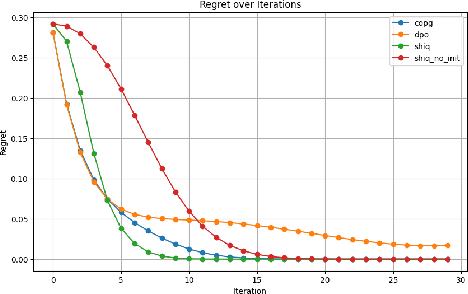
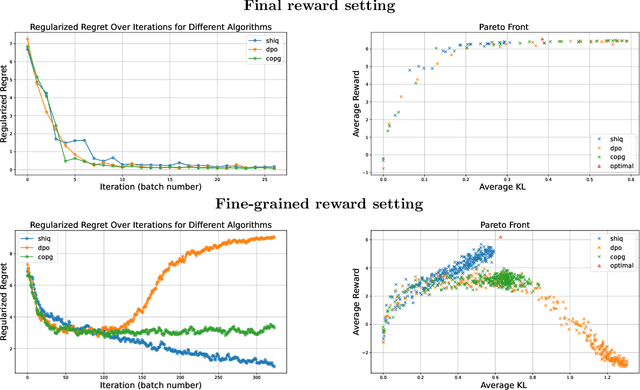
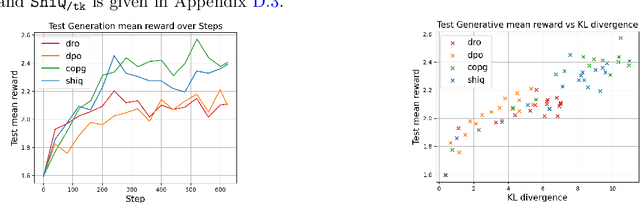
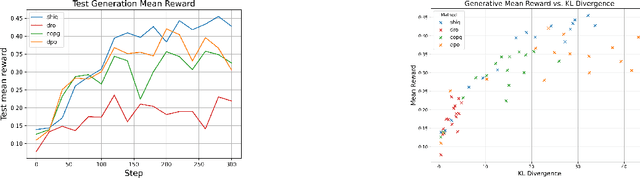
The fine-tuning of pre-trained large language models (LLMs) using reinforcement learning (RL) is generally formulated as direct policy optimization. This approach was naturally favored as it efficiently improves a pretrained LLM, seen as an initial policy. Another RL paradigm, Q-learning methods, has received far less attention in the LLM community while demonstrating major success in various non-LLM RL tasks. In particular, Q-learning effectiveness comes from its sample efficiency and ability to learn offline, which is particularly valuable given the high computational cost of sampling with LLMs. However, naively applying a Q-learning-style update to the model's logits is ineffective due to the specificity of LLMs. Our core contribution is to derive theoretically grounded loss functions from Bellman equations to adapt Q-learning methods to LLMs. To do so, we carefully adapt insights from the RL literature to account for LLM-specific characteristics, ensuring that the logits become reliable Q-value estimates. We then use this loss to build a practical algorithm, ShiQ for Shifted-Q, that supports off-policy, token-wise learning while remaining simple to implement. Finally, we evaluate ShiQ on both synthetic data and real-world benchmarks, e.g., UltraFeedback and BFCL-V3, demonstrating its effectiveness in both single-turn and multi-turn LLM settings
Robust detection of overlapping bioacoustic sound events
Mar 04, 2025We propose a method for accurately detecting bioacoustic sound events that is robust to overlapping events, a common issue in domains such as ethology, ecology and conservation. While standard methods employ a frame-based, multi-label approach, we introduce an onset-based detection method which we name Voxaboxen. It takes inspiration from object detection methods in computer vision, but simultaneously takes advantage of recent advances in self-supervised audio encoders. For each time window, Voxaboxen predicts whether it contains the start of a vocalization and how long the vocalization is. It also does the same in reverse, predicting whether each window contains the end of a vocalization, and how long ago it started. The two resulting sets of bounding boxes are then fused using a graph-matching algorithm. We also release a new dataset designed to measure performance on detecting overlapping vocalizations. This consists of recordings of zebra finches annotated with temporally-strong labels and showing frequent overlaps. We test Voxaboxen on seven existing data sets and on our new data set. We compare Voxaboxen to natural baselines and existing sound event detection methods and demonstrate SotA results. Further experiments show that improvements are robust to frequent vocalization overlap.
NatureLM-audio: an Audio-Language Foundation Model for Bioacoustics
Nov 11, 2024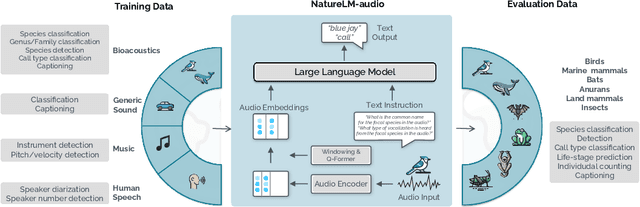

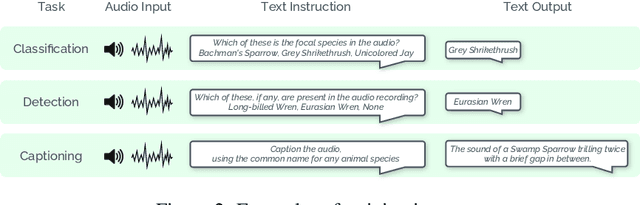
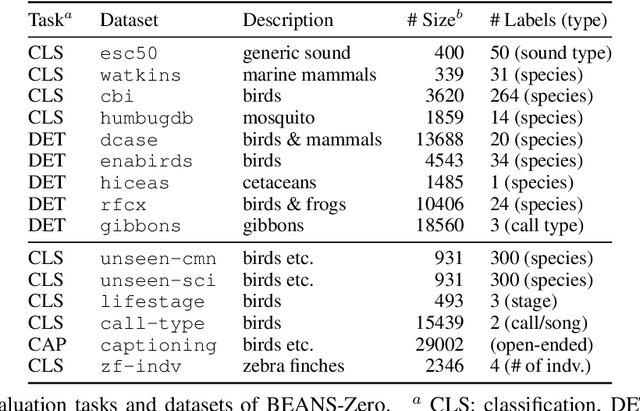
Large language models (LLMs) prompted with text and audio represent the state of the art in various auditory tasks, including speech, music, and general audio, showing emergent abilities on unseen tasks. However, these capabilities have yet to be fully demonstrated in bioacoustics tasks, such as detecting animal vocalizations in large recordings, classifying rare and endangered species, and labeling context and behavior - tasks that are crucial for conservation, biodiversity monitoring, and the study of animal behavior. In this work, we present NatureLM-audio, the first audio-language foundation model specifically designed for bioacoustics. Our carefully curated training dataset comprises text-audio pairs spanning a diverse range of bioacoustics, speech, and music data, designed to address the challenges posed by limited annotated datasets in the field. We demonstrate successful transfer of learned representations from music and speech to bioacoustics, and our model shows promising generalization to unseen taxa and tasks. Importantly, we test NatureLM-audio on a novel benchmark (BEANS-Zero) and it sets the new state of the art (SotA) on several bioacoustics tasks, including zero-shot classification of unseen species. To advance bioacoustics research, we also open-source the code for generating training and benchmark data, as well as for training the model.
Biodenoising: animal vocalization denoising without access to clean data
Oct 04, 2024Animal vocalization denoising is a task similar to human speech enhancement, a well-studied field of research. In contrast to the latter, it is applied to a higher diversity of sound production mechanisms and recording environments, and this higher diversity is a challenge for existing models. Adding to the challenge and in contrast to speech, we lack large and diverse datasets comprising clean vocalizations. As a solution we use as training data pseudo-clean targets, i.e. pre-denoised vocalizations, and segments of background noise without a vocalization. We propose a train set derived from bioacoustics datasets and repositories representing diverse species, acoustic environments, geographic regions. Additionally, we introduce a non-overlapping benchmark set comprising clean vocalizations from different taxa and noise samples. We show that that denoising models (demucs, CleanUNet) trained on pseudo-clean targets obtained with speech enhancement models achieve competitive results on the benchmarking set. We publish data, code, libraries, and demos https://mariusmiron.com/research/biodenoising.
Averaging log-likelihoods in direct alignment
Jun 27, 2024


To better align Large Language Models (LLMs) with human judgment, Reinforcement Learning from Human Feedback (RLHF) learns a reward model and then optimizes it using regularized RL. Recently, direct alignment methods were introduced to learn such a fine-tuned model directly from a preference dataset without computing a proxy reward function. These methods are built upon contrastive losses involving the log-likelihood of (dis)preferred completions according to the trained model. However, completions have various lengths, and the log-likelihood is not length-invariant. On the other side, the cross-entropy loss used in supervised training is length-invariant, as batches are typically averaged token-wise. To reconcile these approaches, we introduce a principled approach for making direct alignment length-invariant. Formally, we introduce a new averaging operator, to be composed with the optimality operator giving the best policy for the underlying RL problem. It translates into averaging the log-likelihood within the loss. We empirically study the effect of such averaging, observing a trade-off between the length of generations and their scores.
Contrastive Policy Gradient: Aligning LLMs on sequence-level scores in a supervised-friendly fashion
Jun 27, 2024Reinforcement Learning (RL) has been used to finetune Large Language Models (LLMs) using a reward model trained from preference data, to better align with human judgment. The recently introduced direct alignment methods, which are often simpler, more stable, and computationally lighter, can more directly achieve this. However, these approaches cannot optimize arbitrary rewards, and the preference-based ones are not the only rewards of interest for LLMs (eg., unit tests for code generation or textual entailment for summarization, among others). RL-finetuning is usually done with a variation of policy gradient, which calls for on-policy or near-on-policy samples, requiring costly generations. We introduce Contrastive Policy Gradient, or CoPG, a simple and mathematically principled new RL algorithm that can estimate the optimal policy even from off-policy data. It can be seen as an off-policy policy gradient approach that does not rely on important sampling techniques and highlights the importance of using (the right) state baseline. We show this approach to generalize the direct alignment method IPO (identity preference optimization) and classic policy gradient. We experiment with the proposed CoPG on a toy bandit problem to illustrate its properties, as well as for finetuning LLMs on a summarization task, using a learned reward function considered as ground truth for the purpose of the experiments.