 Add to Chrome
 Add to Firefox
 Add to Edge
Vernata: Self-Supervised Learning of LiDAR Point Representations
Aug 07, 2026
LiDAR serves as a primary sensing modality for robots operating in outdoor environments. However, the performance of deep learning models in this domain is severely limited by the scarcity of labeled data, a direct result of the high cost of 3D annotation. Self-supervised learning addresses this scarcity by learning general-purpose features from unlabeled data. In this work, we present a multi-modal, multi-teacher distillation framework for self-supervised learning on outdoor LiDAR point clouds. Building upon the Sonata architecture, we introduce Vernata, consisting of three extensions: sparse view augmentation to improve robustness against varying point densities, a memory bank mechanism to stabilize resource-constrained training, and cross-modal distillation utilizing dense, high-resolution 2D image features to enable fine-grained semantic guidance. We evaluate our method on the GrandTour, TartanGround, and Waymo datasets, as well as data collected from our own robotic platforms. Our experiments demonstrate a significant performance improvement over Sonata baselines, yielding mIoU scores of 54.7 on TartanGround (+5.9 points, +12.1%) and 57.1 on Waymo (+7.3 points, +14.7%). Finally, we show that the self-supervised approach maintains strong performance even in reduced-modality settings (lacking color or normals), achieving competitive mIoU scores of 49.4 and 50.2 on the respective datasets.

Spot-Compose: A Framework for Open-Vocabulary Object Retrieval and Drawer Manipulation in Point Clouds
Apr 18, 2024In recent years, modern techniques in deep learning and large-scale datasets have led to impressive progress in 3D instance segmentation, grasp pose estimation, and robotics. This allows for accurate detection directly in 3D scenes, object- and environment-aware grasp prediction, as well as robust and repeatable robotic manipulation. This work aims to integrate these recent methods into a comprehensive framework for robotic interaction and manipulation in human-centric environments. Specifically, we leverage 3D reconstructions from a commodity 3D scanner for open-vocabulary instance segmentation, alongside grasp pose estimation, to demonstrate dynamic picking of objects, and opening of drawers. We show the performance and robustness of our model in two sets of real-world experiments including dynamic object retrieval and drawer opening, reporting a 51% and 82% success rate respectively. Code of our framework as well as videos are available on: https://spot-compose.github.io/.
Entropy Aware Message Passing in Graph Neural Networks
Mar 07, 2024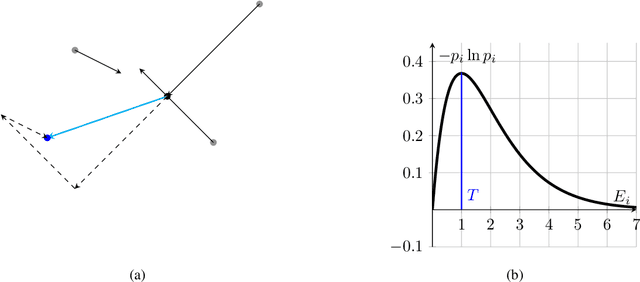
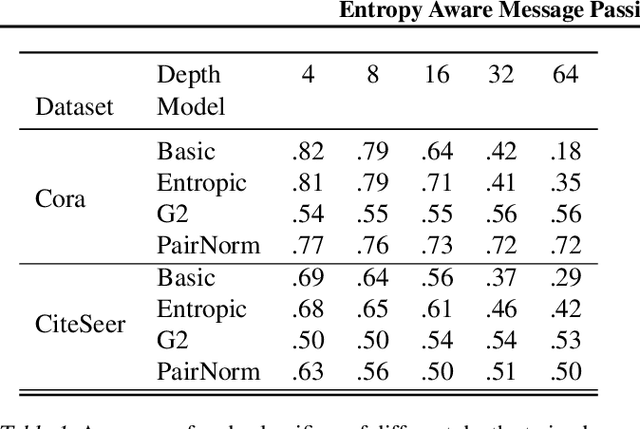
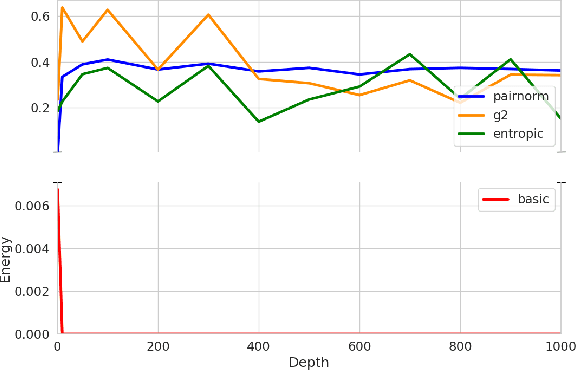
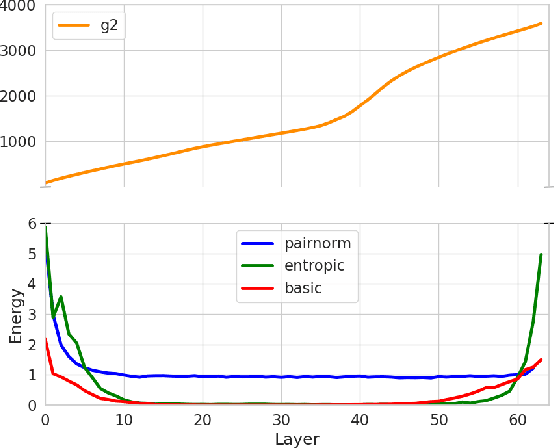
Deep Graph Neural Networks struggle with oversmoothing. This paper introduces a novel, physics-inspired GNN model designed to mitigate this issue. Our approach integrates with existing GNN architectures, introducing an entropy-aware message passing term. This term performs gradient ascent on the entropy during node aggregation, thereby preserving a certain degree of entropy in the embeddings. We conduct a comparative analysis of our model against state-of-the-art GNNs across various common datasets.