 Add to Chrome
 Add to Firefox
 Add to Edge
Visual Reasoning Benchmark: Evaluating Multimodal LLMs on Classroom-Authentic Visual Problems from Primary Education
Feb 12, 2026
AI models have achieved state-of-the-art results in textual reasoning; however, their ability to reason over spatial and relational structures remains a critical bottleneck -- particularly in early-grade maths, which relies heavily on visuals. This paper introduces the visual reasoning benchmark (VRB), a novel dataset designed to evaluate Multimodal Large Language Models (MLLMs) on their ability to solve authentic visual problems from classrooms. This benchmark is built on a set of 701 questions sourced from primary school examinations in Zambia and India, which cover a range of tasks such as reasoning by analogy, pattern completion, and spatial matching. We outline the methodology and development of the benchmark which intentionally uses unedited, minimal-text images to test if models can meet realistic needs of primary education. Our findings reveal a ``jagged frontier'' of capability where models demonstrate better proficiency in static skills such as counting and scaling, but reach a distinct ``spatial ceiling'' when faced with dynamic operations like folding, reflection, and rotation. These weaknesses pose a risk for classroom use on visual reasoning problems, with the potential for incorrect marking, false scaffolding, and reinforcing student misconceptions. Consequently, education-focused benchmarks like the VRB are essential for determining the functional boundaries of multimodal tools used in classrooms.

Deeper Interpretability of Deep Networks
Nov 20, 2018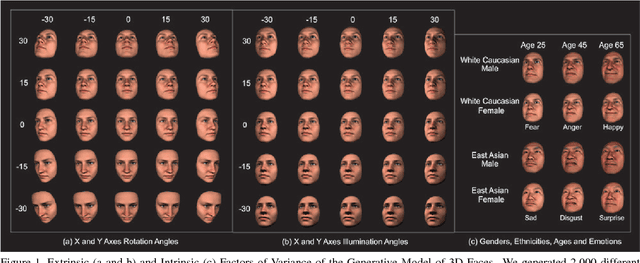
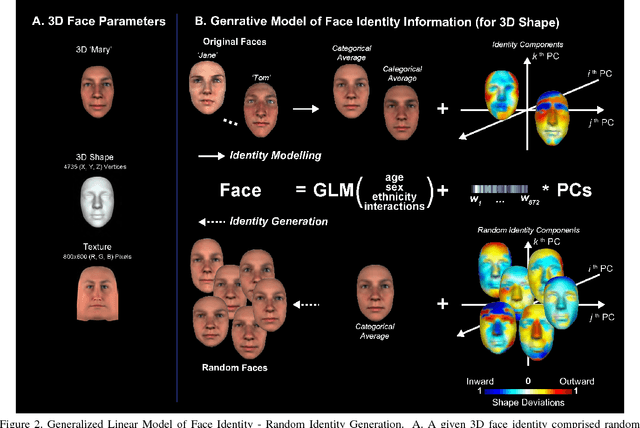
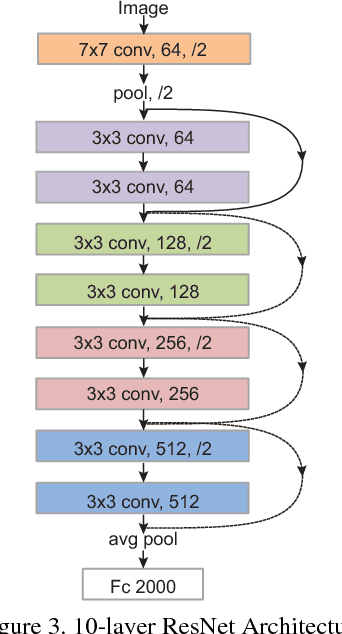
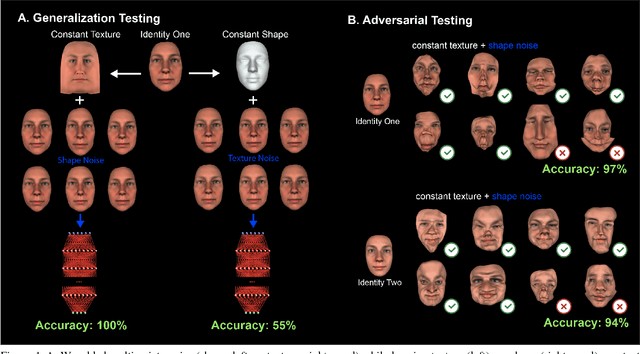
Deep Convolutional Neural Networks (CNNs) have been one of the most influential recent developments in computer vision, particularly for categorization. There is an increasing demand for explainable AI as these systems are deployed in the real world. However, understanding the information represented and processed in CNNs remains in most cases challenging. Within this paper, we explore the use of new information theoretic techniques developed in the field of neuroscience to enable novel understanding of how a CNN represents information. We trained a 10-layer ResNet architecture to identify 2,000 face identities from 26M images generated using a rigorously controlled 3D face rendering model that produced variations of intrinsic (i.e. face morphology, gender, age, expression and ethnicity) and extrinsic factors (i.e. 3D pose, illumination, scale and 2D translation). With our methodology, we demonstrate that unlike human's network overgeneralizes face identities even with extreme changes of face shape, but it is more sensitive to changes of texture. To understand the processing of information underlying these counterintuitive properties, we visualize the features of shape and texture that the network processes to identify faces. Then, we shed a light into the inner workings of the black box and reveal how hidden layers represent these features and whether the representations are invariant to pose. We hope that our methodology will provide an additional valuable tool for interpretability of CNNs.