 Add to Chrome
 Add to Firefox
 Add to Edge
Visual Reasoning Benchmark: Evaluating Multimodal LLMs on Classroom-Authentic Visual Problems from Primary Education
Feb 12, 2026
AI models have achieved state-of-the-art results in textual reasoning; however, their ability to reason over spatial and relational structures remains a critical bottleneck -- particularly in early-grade maths, which relies heavily on visuals. This paper introduces the visual reasoning benchmark (VRB), a novel dataset designed to evaluate Multimodal Large Language Models (MLLMs) on their ability to solve authentic visual problems from classrooms. This benchmark is built on a set of 701 questions sourced from primary school examinations in Zambia and India, which cover a range of tasks such as reasoning by analogy, pattern completion, and spatial matching. We outline the methodology and development of the benchmark which intentionally uses unedited, minimal-text images to test if models can meet realistic needs of primary education. Our findings reveal a ``jagged frontier'' of capability where models demonstrate better proficiency in static skills such as counting and scaling, but reach a distinct ``spatial ceiling'' when faced with dynamic operations like folding, reflection, and rotation. These weaknesses pose a risk for classroom use on visual reasoning problems, with the potential for incorrect marking, false scaffolding, and reinforcing student misconceptions. Consequently, education-focused benchmarks like the VRB are essential for determining the functional boundaries of multimodal tools used in classrooms.

Could AI Leapfrog the Web? Evidence from Teachers in Sierra Leone
Feb 18, 2025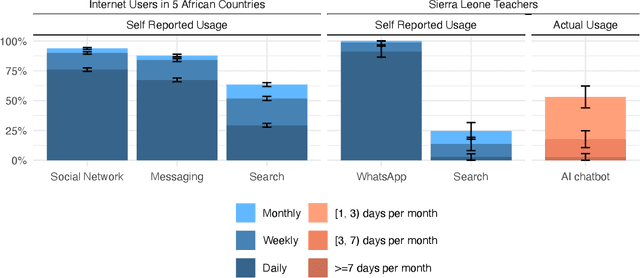
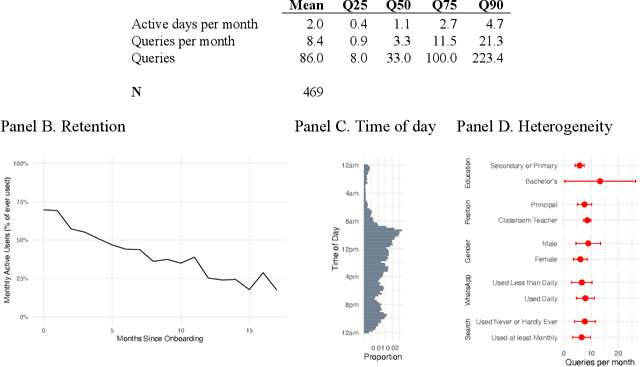
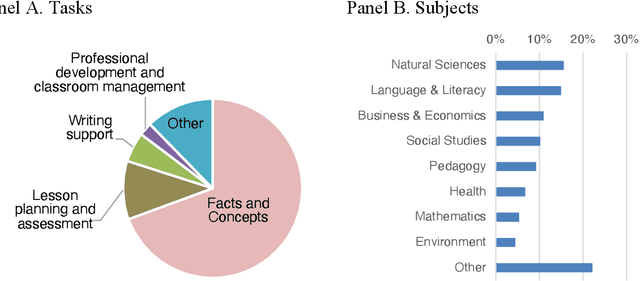
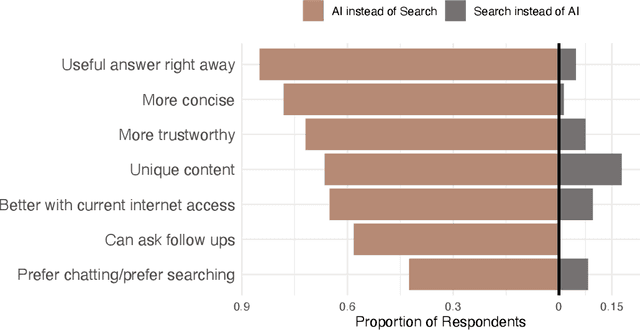
Access to digital information is a driver of economic development. But although 85% of sub-Saharan Africa's population is covered by mobile broadband signal, only 37% use the internet, and those who do seldom use the web. We investigate whether AI can bridge this gap by analyzing how 469 teachers use an AI chatbot in Sierra Leone. The chatbot, accessible via a common messaging app, is compared against traditional web search. Teachers use AI more frequently than web search for teaching assistance. Data cost is the most frequently cited reason for low internet usage across Africa. The average web search result consumes 3,107 times more data than an AI response, making AI 87% less expensive than web search. Additionally, only 2% of results for corresponding web searches contain content from Sierra Leone. In blinded evaluations, an independent sample of teachers rate AI responses as more relevant, helpful, and correct than web search results. These findings suggest that AI-driven solutions can cost-effectively bridge information gaps in low-connectivity regions.