 Add to Chrome
 Add to Firefox
 Add to Edge
Knowledge Index of Noah's Ark
Jun 04, 2026
Knowledge benchmarks for LLMs face three issues: scaling-driven designs that do not operationalize disciplinary representativeness; flat-payment annotation that permits lazy consensus; and unaudited ranking instability under bounded test budgets. We introduce KINA, an 899-item benchmark across 261 fine-grained disciplines, with two formal results. First, we cast representativeness as a coverage-style objective over expert-elicited anchors and operationalize disciplinary representativeness through a proxy, yielding a (1-1/e) greedy approximation (Proposition 1); the guarantee applies to the proxy, not to population representativeness. Second, we prove a bonus-on-bar tournament weakly FOSD-dominates flat payment in released-review quality, with incentive-compatibility threshold B > Delta C / Delta p_min (Theorem 1). Evaluating 42 models from 13 labs, the top model, Gemini-3.1-Pro-Preview, reaches 53.17%, followed by Claude-Opus-4.6 at 49.92% and GPT-5.4 at 48.55%, leaving substantial headroom below saturation. The full leaderboard shows a tiered structure rather than a smooth total order: a small frontier tier lies above 48%, a dense strong-model tier spans roughly 38-45%, and low-performing models remain only modestly above the 10% chance baseline. Tool augmentation adds up to 5.17 points across the five tool-use evaluations, with gains varying substantially across models. We report bootstrap ranking-stability statistics to make bounded-budget variance explicit and to discourage over-interpretation of adjacent ranks.

Prompt-Activation Duality: Improving Activation Steering via Attention-Level Interventions
May 11, 2026Activation steering controls language model behavior by adding directions to internal representations at inference time, but standard residual-stream steering can fail in stateful dialogue. We identify KV-cache contamination as a key failure mode: steered token states are stored and repeatedly reused, turning a local perturbation into cumulative coherence degradation. To address this challenge, we propose Gated Cropped Attention-Delta steering (GCAD), which extracts steering signals from system-prompt contributions to self-attention and applies them with token-level gating. Across persona-steering experiments, GCAD preserves trait control while substantially improving long-horizon coherence. On the main multi-turn benchmark, GCAD improves average coherence drift from -18.6 to -1.9 and raises turn-10 trait expression from 78.0 to 93.1. These results suggest that activation steering becomes more reliable when interventions follow the prompt-mediated pathways that models already use for behavioral control.
The Chameleon's Limit: Investigating Persona Collapse and Homogenization in Large Language Models
Apr 27, 2026Applications based on large language models (LLMs), such as multi-agent simulations, require population diversity among agents. We identify a pervasive failure mode we term \emph{Persona Collapse}: agents each assigned a distinct profile nonetheless converge into a narrow behavioral mode, producing a homogeneous simulated population. To quantify persona collapse, we propose a framework that measures how much of the persona space a population occupies (Coverage), how evenly agents spread across it (Uniformity), and how rich the resulting behavioral patterns are (Complexity). Evaluating ten LLMs on personality simulation (BFI-44), moral reasoning, and self-introduction, we observe persona collapse along two axes: (1) Dimensions: a model can appear diverse on one axis yet structurally degenerate on another, and (2) Domains: the same model may collapse the most in personality yet be the most diverse in moral reasoning. Furthermore, item-level diagnostics reveal that behavioral variation tracks coarse demographic stereotypes rather than the fine-grained individual differences specified in each persona. Counter-intuitively, \textbf{the models achieving the highest per-persona fidelity consistently produce the most stereotyped populations}. We release our toolkit and data to support population-level evaluation of LLMs.
Say Something Else: Rethinking Contextual Privacy as Information Sufficiency
Apr 07, 2026LLM agents increasingly draft messages on behalf of users, yet users routinely overshare sensitive information and disagree on what counts as private. Existing systems support only suppression (omitting sensitive information) and generalization (replacing information with an abstraction), and are typically evaluated on single isolated messages, leaving both the strategy space and evaluation setting incomplete. We formalize privacy-preserving LLM communication as an \textbf{Information Sufficiency (IS)} task, introduce \textbf{free-text pseudonymization} as a third strategy that replaces sensitive attributes with functionally equivalent alternatives, and propose a \textbf{conversational evaluation protocol} that assesses strategies under realistic multi-turn follow-up pressure. Across 792 scenarios spanning three power-relation types (institutional, peer, intimate) and three sensitivity categories (discrimination risk, social cost, boundary), we evaluate seven frontier LLMs on privacy at two granularities, covertness, and utility. Pseudonymization yields the strongest privacy\textendash utility tradeoff overall, and single-message evaluation systematically underestimates leakage, with generalization losing up to 16.3 percentage points of privacy under follow-up.
Rewarded Region Replay (R3) for Policy Learning with Discrete Action Space
May 26, 2024
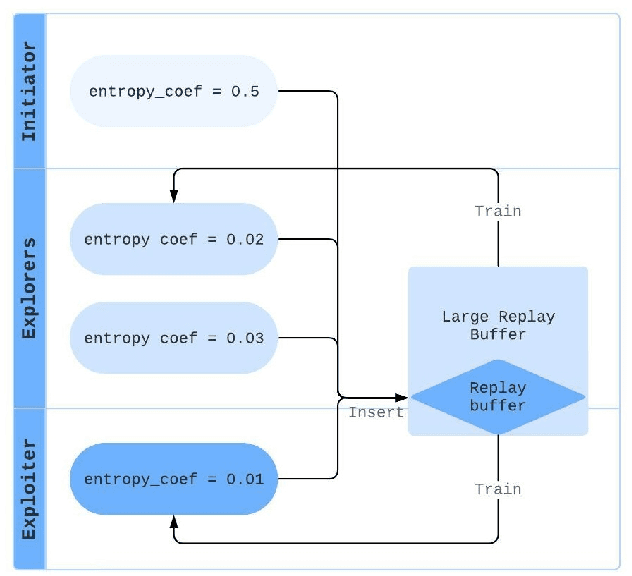


We introduce a new on-policy algorithm called Rewarded Region Replay (R3), which significantly improves on PPO in solving environments with discrete action spaces. R3 improves sample efficiency by using a replay buffer which contains past successful trajectories with reward above a certain threshold, which are used to update a PPO agent with importance sampling. Crucially, we discard the importance sampling factors which are above a certain ratio to reduce variance and stabilize training. We found that R3 significantly outperforms PPO in Minigrid environments with sparse rewards and discrete action space, such as DoorKeyEnv and CrossingEnv, and moreover we found that the improvement margin of our method versus baseline PPO increases with the complexity of the environment. We also benchmarked the performance of R3 against DDQN (Double Deep Q-Network), which is a standard baseline in off-policy methods for discrete actions, and found that R3 also outperforms DDQN agent in DoorKeyEnv. Lastly, we adapt the idea of R3 to dense reward setting to obtain the Dense R3 algorithm (or DR3) and benchmarked it against PPO on Cartpole-V1 environment. We found that DR3 outperforms PPO significantly on this dense reward environment. Our code can be found at https://github.com/chry-santhemum/R3.