 Add to Chrome
 Add to Firefox
 Add to Edge
Efficient Real-Time Adaptation of ROMs for Unsteady Flows Using Data Assimilation
Feb 26, 2026
We propose an efficient retraining strategy for a parameterized Reduced Order Model (ROM) that attains accuracy comparable to full retraining while requiring only a fraction of the computational time and relying solely on sparse observations of the full system. The architecture employs an encode-process-decode structure: a Variational Autoencoder (VAE) to perform dimensionality reduction, and a transformer network to evolve the latent states and model the dynamics. The ROM is parameterized by an external control variable, the Reynolds number in the Navier-Stokes setting, with the transformer exploiting attention mechanisms to capture both temporal dependencies and parameter effects. The probabilistic VAE enables stochastic sampling of trajectory ensembles, providing predictive means and uncertainty quantification through the first two moments. After initial training on a limited set of dynamical regimes, the model is adapted to out-of-sample parameter regions using only sparse data. Its probabilistic formulation naturally supports ensemble generation, which we employ within an ensemble Kalman filtering framework to assimilate data and reconstruct full-state trajectories from minimal observations. We further show that, for the dynamical system considered, the dominant source of error in out-of-sample forecasts stems from distortions of the latent manifold rather than changes in the latent dynamics. Consequently, retraining can be limited to the autoencoder, allowing for a lightweight, computationally efficient, real-time adaptation procedure with very sparse fine-tuning data.

UP-ROM : Uncertainty-Aware and Parametrised dynamic Reduced-Order Model, application to unsteady flows
Mar 29, 2025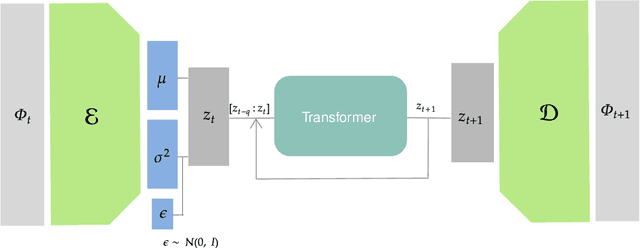

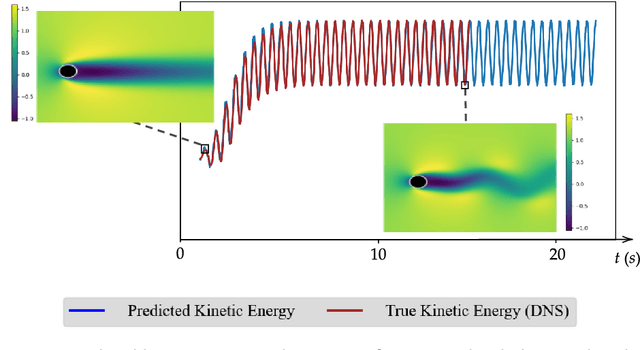

Reduced order models (ROMs) play a critical role in fluid mechanics by providing low-cost predictions, making them an attractive tool for engineering applications. However, for ROMs to be widely applicable, they must not only generalise well across different regimes, but also provide a measure of confidence in their predictions. While recent data-driven approaches have begun to address nonlinear reduction techniques to improve predictions in transient environments, challenges remain in terms of robustness and parametrisation. In this work, we present a nonlinear reduction strategy specifically designed for transient flows that incorporates parametrisation and uncertainty quantification. Our reduction strategy features a variational auto-encoder (VAE) that uses variational inference for confidence measurement. We use a latent space transformer that incorporates recent advances in attention mechanisms to predict dynamical systems. Attention's versatility in learning sequences and capturing their dependence on external parameters enhances generalisation across a wide range of dynamics. Prediction, coupled with confidence, enables more informed decision making and addresses the need for more robust models. In addition, this confidence is used to cost-effectively sample the parameter space, improving model performance a priori across the entire parameter space without requiring evaluation data for the entire domain.