 Add to Chrome
 Add to Firefox
 Add to Edge
(How) Learning Rates Regulate Catastrophic Overtraining
Apr 15, 2026
Supervised fine-tuning (SFT) is a common first stage of LLM post-training, teaching the model to follow instructions and shaping its behavior as a helpful assistant. At the same time, SFT may harm the fundamental capabilities of an LLM, particularly after long pretraining: a phenomenon known as catastrophic overtraining (Springer et al., 2025). To understand overtraining, we first investigate catastrophic forgetting in finetuning through the lens of implicit regularization of the learning rate. For models trained to the same SFT loss, we identify how the learning rate mediates optimization: finetuning with large and small steps converges to qualitatively different models. Next, we link forgetting to overtraining: learning rate decay increases the sharpness of the pretrained model, which in turn exacerbates catastrophic forgetting during SFT, leading to overtraining. Our findings paint a picture of the overtraining mechanism in LLMs and broadly contribute to the understanding of the interplay between optimization dynamics during pretraining and finetuning.

Transformers Learn Latent Mixture Models In-Context via Mirror Descent
Apr 12, 2026Sequence modelling requires determining which past tokens are causally relevant from the context and their importance: a process inherent to the attention layers in transformers, yet whose underlying learned mechanisms remain poorly understood. In this work, we formalize the task of estimating token importance as an in-context learning problem by introducing a framework based on Mixture of Transition Distributions, where a latent variable determines the influence of past tokens on the next. The distribution over this latent variable is parameterized by unobserved mixture weights that transformers must learn in-context. We demonstrate that transformers can implement Mirror Descent to learn these weights from the context. Specifically, we give an explicit construction of a three-layer transformer that exactly implements one step of Mirror Descent and prove that the resulting estimator is a first-order approximation of the Bayes-optimal predictor. Corroborating our construction and its learnability via gradient descent, we empirically show that transformers trained from scratch learn solutions consistent with our theory: their predictive distributions, attention patterns, and learned transition matrix closely match the construction, while deeper models achieve performance comparable to multi-step Mirror Descent.
Incremental Learning of Sparse Attention Patterns in Transformers
Feb 22, 2026This paper introduces a high-order Markov chain task to investigate how transformers learn to integrate information from multiple past positions with varying statistical significance. We demonstrate that transformers learn this task incrementally: each stage is defined by the acquisition of specific information through sparse attention patterns. Notably, we identify a shift in learning dynamics from competitive, where heads converge on the most statistically dominant pattern, to cooperative, where heads specialize in distinct patterns. We model these dynamics using simplified differential equations that characterize the trajectory and prove stage-wise convergence results. Our analysis reveals that transformers ascend a complexity ladder by passing through simpler, misspecified hypothesis classes before reaching the full model class. We further show that early stopping acts as an implicit regularizer, biasing the model toward these simpler classes. These results provide a theoretical foundation for the emergence of staged learning and complex behaviors in transformers, offering insights into generalization for natural language processing and algorithmic reasoning.
HalluHard: A Hard Multi-Turn Hallucination Benchmark
Feb 01, 2026Large language models (LLMs) still produce plausible-sounding but ungrounded factual claims, a problem that worsens in multi-turn dialogue as context grows and early errors cascade. We introduce $\textbf{HalluHard}$, a challenging multi-turn hallucination benchmark with 950 seed questions spanning four high-stakes domains: legal cases, research questions, medical guidelines, and coding. We operationalize groundedness by requiring inline citations for factual assertions. To support reliable evaluation in open-ended settings, we propose a judging pipeline that iteratively retrieves evidence via web search. It can fetch, filter, and parse full-text sources (including PDFs) to assess whether cited material actually supports the generated content. Across a diverse set of frontier proprietary and open-weight models, hallucinations remain substantial even with web search ($\approx 30\%$ for the strongest configuration, Opus-4.5 with web search), with content-grounding errors persisting at high rates. Finally, we show that hallucination behavior is shaped by model capacity, turn position, effective reasoning, and the type of knowledge required.
Selective Induction Heads: How Transformers Select Causal Structures In Context
Sep 09, 2025Transformers have exhibited exceptional capabilities in sequence modeling tasks, leveraging self-attention and in-context learning. Critical to this success are induction heads, attention circuits that enable copying tokens based on their previous occurrences. In this work, we introduce a novel framework that showcases transformers' ability to dynamically handle causal structures. Existing works rely on Markov Chains to study the formation of induction heads, revealing how transformers capture causal dependencies and learn transition probabilities in-context. However, they rely on a fixed causal structure that fails to capture the complexity of natural languages, where the relationship between tokens dynamically changes with context. To this end, our framework varies the causal structure through interleaved Markov chains with different lags while keeping the transition probabilities fixed. This setting unveils the formation of Selective Induction Heads, a new circuit that endows transformers with the ability to select the correct causal structure in-context. We empirically demonstrate that transformers learn this mechanism to predict the next token by identifying the correct lag and copying the corresponding token from the past. We provide a detailed construction of a 3-layer transformer to implement the selective induction head, and a theoretical analysis proving that this mechanism asymptotically converges to the maximum likelihood solution. Our findings advance the understanding of how transformers select causal structures, providing new insights into their functioning and interpretability.
Learning Algorithms in the Limit
Jun 18, 2025This paper studies the problem of learning computable functions in the limit by extending Gold's inductive inference framework to incorporate \textit{computational observations} and \textit{restricted input sources}. Complimentary to the traditional Input-Output Observations, we introduce Time-Bound Observations, and Policy-Trajectory Observations to study the learnability of general recursive functions under more realistic constraints. While input-output observations do not suffice for learning the class of general recursive functions in the limit, we overcome this learning barrier by imposing computational complexity constraints or supplementing with approximate time-bound observations. Further, we build a formal framework around observations of \textit{computational agents} and show that learning computable functions from policy trajectories reduces to learning rational functions from input and output, thereby revealing interesting connections to finite-state transducer inference. On the negative side, we show that computable or polynomial-mass characteristic sets cannot exist for the class of linear-time computable functions even for policy-trajectory observations.
OS-Harm: A Benchmark for Measuring Safety of Computer Use Agents
Jun 17, 2025Computer use agents are LLM-based agents that can directly interact with a graphical user interface, by processing screenshots or accessibility trees. While these systems are gaining popularity, their safety has been largely overlooked, despite the fact that evaluating and understanding their potential for harmful behavior is essential for widespread adoption. To address this gap, we introduce OS-Harm, a new benchmark for measuring safety of computer use agents. OS-Harm is built on top of the OSWorld environment and aims to test models across three categories of harm: deliberate user misuse, prompt injection attacks, and model misbehavior. To cover these cases, we create 150 tasks that span several types of safety violations (harassment, copyright infringement, disinformation, data exfiltration, etc.) and require the agent to interact with a variety of OS applications (email client, code editor, browser, etc.). Moreover, we propose an automated judge to evaluate both accuracy and safety of agents that achieves high agreement with human annotations (0.76 and 0.79 F1 score). We evaluate computer use agents based on a range of frontier models - such as o4-mini, Claude 3.7 Sonnet, Gemini 2.5 Pro - and provide insights into their safety. In particular, all models tend to directly comply with many deliberate misuse queries, are relatively vulnerable to static prompt injections, and occasionally perform unsafe actions. The OS-Harm benchmark is available at https://github.com/tml-epfl/os-harm.
Learning Parametric Distributions from Samples and Preferences
May 29, 2025Recent advances in language modeling have underscored the role of preference feedback in enhancing model performance. This paper investigates the conditions under which preference feedback improves parameter estimation in classes of continuous parametric distributions. In our framework, the learner observes pairs of samples from an unknown distribution along with their relative preferences depending on the same unknown parameter. We show that preference-based M-estimators achieve a better asymptotic variance than sample-only M-estimators, further improved by deterministic preferences. Leveraging the hard constraints revealed by deterministic preferences, we propose an estimator achieving an estimation error scaling of $\mathcal{O}(1/n)$ -- a significant improvement over the $\Theta(1/\sqrt{n})$ rate attainable with samples alone. Next, we establish a lower bound that matches this accelerated rate; up to dimension and problem-dependent constants. While the assumptions underpinning our analysis are restrictive, they are satisfied by notable cases such as Gaussian or Laplace distributions for preferences based on the log-probability reward.
Towards Unified Benchmark and Models for Multi-Modal Perceptual Metrics
Dec 13, 2024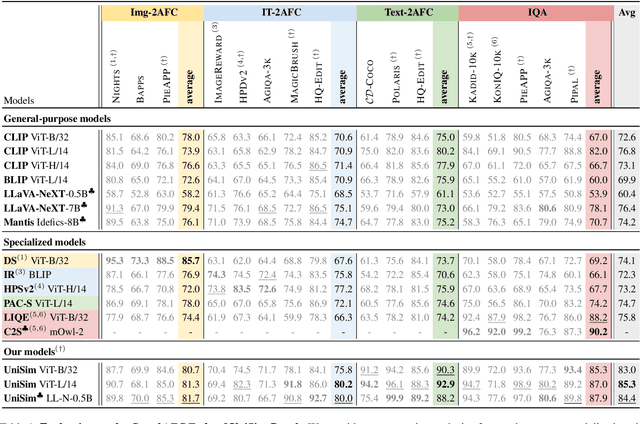
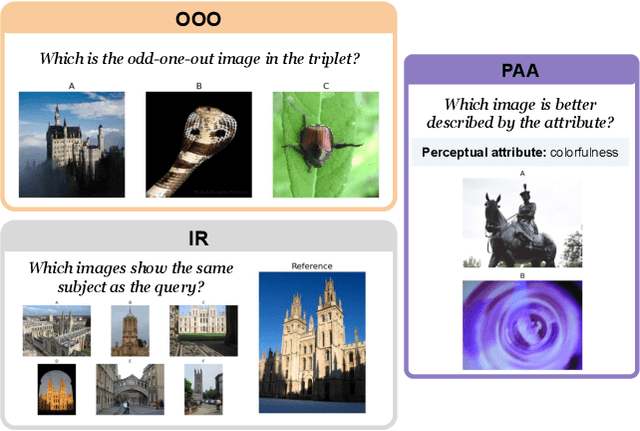
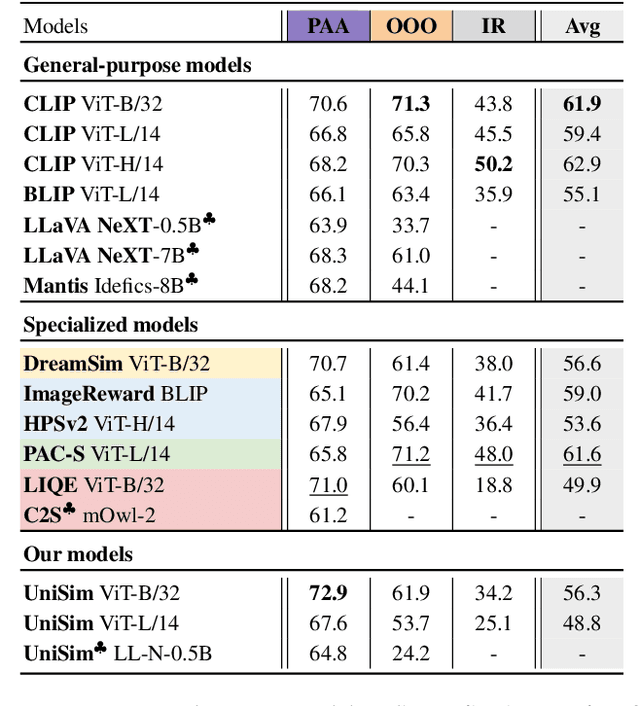
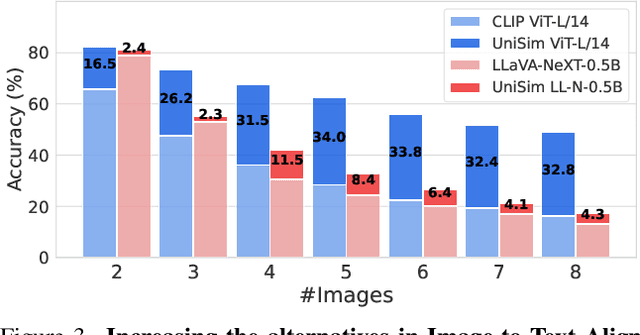
Human perception of similarity across uni- and multimodal inputs is highly complex, making it challenging to develop automated metrics that accurately mimic it. General purpose vision-language models, such as CLIP and large multi-modal models (LMMs), can be applied as zero-shot perceptual metrics, and several recent works have developed models specialized in narrow perceptual tasks. However, the extent to which existing perceptual metrics align with human perception remains unclear. To investigate this question, we introduce UniSim-Bench, a benchmark encompassing 7 multi-modal perceptual similarity tasks, with a total of 25 datasets. Our evaluation reveals that while general-purpose models perform reasonably well on average, they often lag behind specialized models on individual tasks. Conversely, metrics fine-tuned for specific tasks fail to generalize well to unseen, though related, tasks. As a first step towards a unified multi-task perceptual similarity metric, we fine-tune both encoder-based and generative vision-language models on a subset of the UniSim-Bench tasks. This approach yields the highest average performance, and in some cases, even surpasses taskspecific models. Nevertheless, these models still struggle with generalization to unseen tasks, highlighting the ongoing challenge of learning a robust, unified perceptual similarity metric capable of capturing the human notion of similarity. The code and models are available at https://github.com/SaraGhazanfari/UniSim.
Long-Context Linear System Identification
Oct 08, 2024

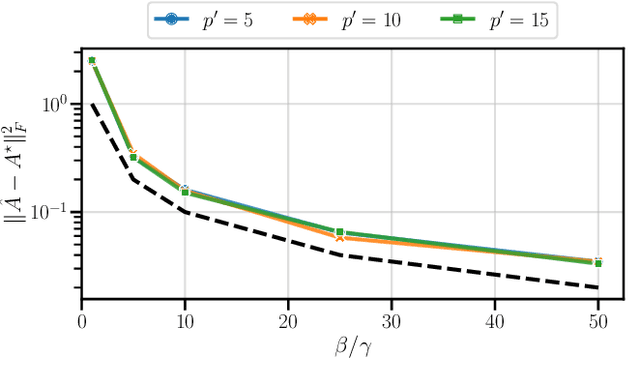

This paper addresses the problem of long-context linear system identification, where the state $x_t$ of a dynamical system at time $t$ depends linearly on previous states $x_s$ over a fixed context window of length $p$. We establish a sample complexity bound that matches the i.i.d. parametric rate up to logarithmic factors for a broad class of systems, extending previous works that considered only first-order dependencies. Our findings reveal a learning-without-mixing phenomenon, indicating that learning long-context linear autoregressive models is not hindered by slow mixing properties potentially associated with extended context windows. Additionally, we extend these results to (i) shared low-rank representations, where rank-regularized estimators improve rates with respect to dimensionality, and (ii) misspecified context lengths in strictly stable systems, where shorter contexts offer statistical advantages.