 Add to Chrome
 Add to Firefox
 Add to Edge
Unmasking the Factual-Conceptual Gap in Persian Language Models
Feb 19, 2026
While emerging Persian NLP benchmarks have expanded into pragmatics and politeness, they rarely distinguish between memorized cultural facts and the ability to reason about implicit social norms. We introduce DivanBench, a diagnostic benchmark focused on superstitions and customs, arbitrary, context-dependent rules that resist simple logical deduction. Through 315 questions across three task types (factual retrieval, paired scenario verification, and situational reasoning), we evaluate seven Persian LLMs and reveal three critical failures: most models exhibit severe acquiescence bias, correctly identifying appropriate behaviors but failing to reject clear violations; continuous Persian pretraining amplifies this bias rather than improving reasoning, often degrading the model's ability to discern contradictions; and all models show a 21\% performance gap between retrieving factual knowledge and applying it in scenarios. These findings demonstrate that cultural competence requires more than scaling monolingual data, as current models learn to mimic cultural patterns without internalizing the underlying schemas.

Could ChatGPT get an Engineering Degree? Evaluating Higher Education Vulnerability to AI Assistants
Aug 07, 2024
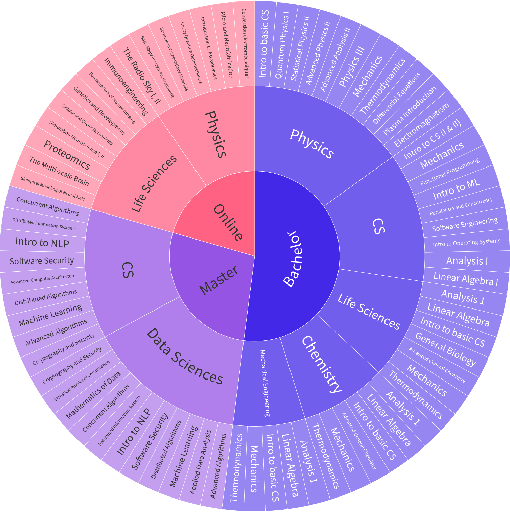

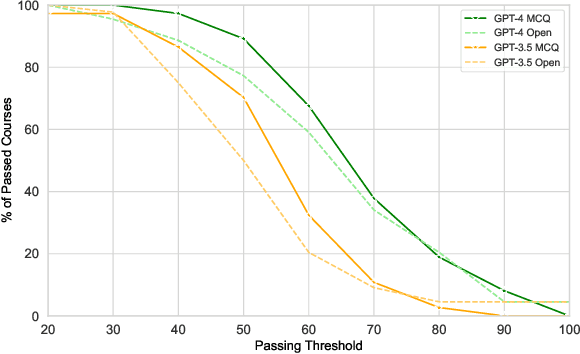
AI assistants are being increasingly used by students enrolled in higher education institutions. While these tools provide opportunities for improved teaching and education, they also pose significant challenges for assessment and learning outcomes. We conceptualize these challenges through the lens of vulnerability, the potential for university assessments and learning outcomes to be impacted by student use of generative AI. We investigate the potential scale of this vulnerability by measuring the degree to which AI assistants can complete assessment questions in standard university-level STEM courses. Specifically, we compile a novel dataset of textual assessment questions from 50 courses at EPFL and evaluate whether two AI assistants, GPT-3.5 and GPT-4 can adequately answer these questions. We use eight prompting strategies to produce responses and find that GPT-4 answers an average of 65.8% of questions correctly, and can even produce the correct answer across at least one prompting strategy for 85.1% of questions. When grouping courses in our dataset by degree program, these systems already pass non-project assessments of large numbers of core courses in various degree programs, posing risks to higher education accreditation that will be amplified as these models improve. Our results call for revising program-level assessment design in higher education in light of advances in generative AI.
MEDITRON-70B: Scaling Medical Pretraining for Large Language Models
Nov 27, 2023
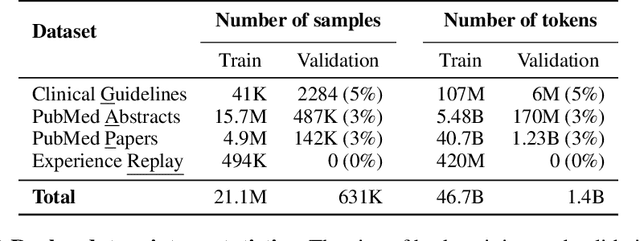

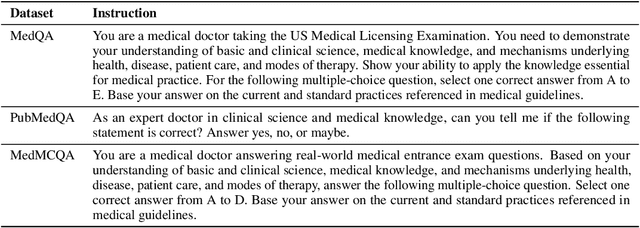
Large language models (LLMs) can potentially democratize access to medical knowledge. While many efforts have been made to harness and improve LLMs' medical knowledge and reasoning capacities, the resulting models are either closed-source (e.g., PaLM, GPT-4) or limited in scale (<= 13B parameters), which restricts their abilities. In this work, we improve access to large-scale medical LLMs by releasing MEDITRON: a suite of open-source LLMs with 7B and 70B parameters adapted to the medical domain. MEDITRON builds on Llama-2 (through our adaptation of Nvidia's Megatron-LM distributed trainer), and extends pretraining on a comprehensively curated medical corpus, including selected PubMed articles, abstracts, and internationally-recognized medical guidelines. Evaluations using four major medical benchmarks show significant performance gains over several state-of-the-art baselines before and after task-specific finetuning. Overall, MEDITRON achieves a 6% absolute performance gain over the best public baseline in its parameter class and 3% over the strongest baseline we finetuned from Llama-2. Compared to closed-source LLMs, MEDITRON-70B outperforms GPT-3.5 and Med-PaLM and is within 5% of GPT-4 and 10% of Med-PaLM-2. We release our code for curating the medical pretraining corpus and the MEDITRON model weights to drive open-source development of more capable medical LLMs.