 Add to Chrome
 Add to Firefox
 Add to Edge
Diffusion Forcing Planner: History-Annealed Planning with Time-Dependent Guidance for Autonomous Driving
Jun 09, 2026
Learning-based motion planners, despite recent progress, often suffer from temporal inconsistency. Small perturbations across frames can accumulate into unstable trajectories, degrading comfort and safety in closed-loop driving. Several methods attempt to inject history as a static conditioning signal to stabilize outputs, only to induce the planner to copy historical patterns instead of adapting to environment contexts. To address this limitation, we propose Diffusion Forcing Planner (DFP), a diffusion-based planning framework driven by history-guided control. Specifically, DFP decomposes the full trajectory into history, current and future segments, and assign independent noise levels to each segment. The model jointly denoises the historical and the future segments, enforcing a heterogeneous joint diffusion process. At inference, classifier-free guidance (CFG) is applied to steer future sampling using annealed history in a controllable manner. Closed-loop evaluation and comprehensive ablations on nuPlan show that DFP achieves competitive performance while producing continuous, stable, and controllable motion plans in complex driving scenarios.

Root Cause Localization for Microservice Systems in Cloud-edge Collaborative Environments
Jun 19, 2024With the development of cloud-native technologies, microservice-based software systems face challenges in accurately localizing root causes when failures occur. Additionally, the cloud-edge collaborative environment introduces more difficulties, such as unstable networks and high latency across network segments. Accurately identifying the root cause of microservices in a cloud-edge collaborative environment has thus become an urgent problem. In this paper, we propose MicroCERCL, a novel approach that pinpoints root causes at the kernel and application level in the cloud-edge collaborative environment. Our key insight is that failures propagate through direct invocations and indirect resource-competition dependencies in a cloud-edge collaborative environment characterized by instability and high latency. This will become more complex in the hybrid deployment that simultaneously involves multiple microservice systems. Leveraging this insight, we extract valid contents from kernel-level logs to prioritize localizing the kernel-level root cause. Moreover, we construct a heterogeneous dynamic topology stack and train a graph neural network model to accurately localize the application-level root cause without relying on historical data. Notably, we released the first benchmark hybrid deployment microservice system in a cloud-edge collaborative environment (the largest and most complex within our knowledge). Experiments conducted on the dataset collected from the benchmark show that MicroCERCL can accurately localize the root cause of microservice systems in such environments, significantly outperforming state-of-the-art approaches with an increase of at least 24.1% in top-1 accuracy.
Data privacy protection in microscopic image analysis for material data mining
Nov 09, 2021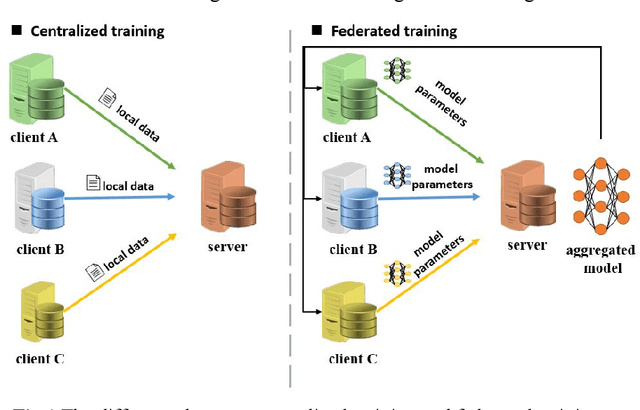
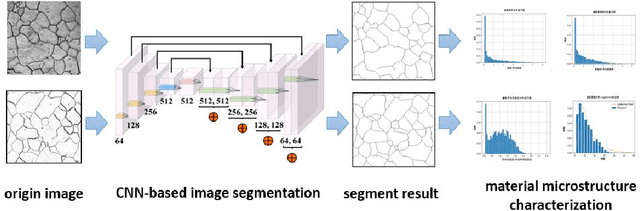
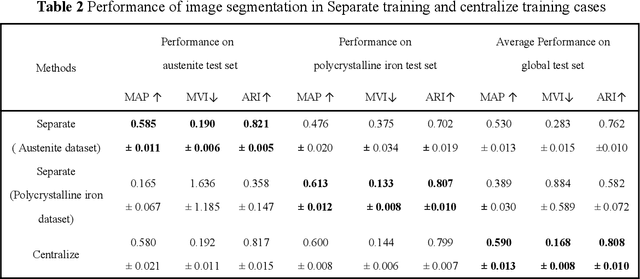
Recent progress in material data mining has been driven by high-capacity models trained on large datasets. However, collecting experimental data has been extremely costly owing to the amount of human effort and expertise required. Therefore, material researchers are often reluctant to easily disclose their private data, which leads to the problem of data island, and it is difficult to collect a large amount of data to train high-quality models. In this study, a material microstructure image feature extraction algorithm FedTransfer based on data privacy protection is proposed. The core contributions are as follows: 1) the federated learning algorithm is introduced into the polycrystalline microstructure image segmentation task to make full use of different user data to carry out machine learning, break the data island and improve the model generalization ability under the condition of ensuring the privacy and security of user data; 2) A data sharing strategy based on style transfer is proposed. By sharing style information of images that is not urgent for user confidentiality, it can reduce the performance penalty caused by the distribution difference of data among different users.