 Add to Chrome
 Add to Firefox
 Add to Edge
Rydberg Atomic Quantum Radio: A Comprehensive Survey From Wireless Communication Perspective
Jul 09, 2026
Next-generation space-air-ground-sea integrated networks (SAGSIN) impose unprecedented demands on advanced radio frequency (RF) receivers for full-spectrum agility, ultra-high sensitivity, and anti-jamming resilience, pushing conventional electronic receivers to their physical limits. To address these challenges, the Rydberg atomic quantum (RAQ) radio has emerged as a promising quantum-enabled receiver paradigm that directly maps electromagnetic fields onto atomic quantum states, offering an alternative to alleviate bottlenecks of conventional RF front ends. To provide a clear research roadmap, this survey presents a comprehensive review of RAQ radios by bridging atomic physics and wireless communications. Specifically, we first introduce the underlying quantum mechanisms, representative architectures, and atomic response models of RAQ radio. On this basis, state-of-the-art techniques for enhancing sensitivity, instantaneous bandwidth, and operating frequency are systematically reviewed, with particular emphasis on the inherent trade-offs among these key metrics. To connect quantum response with communication theory, we further analyze equivalent channel modeling frameworks for characterizing systematic performance limits. From the wireless communication perspective, some RAQ-enabled advanced technologies including cognitive, interference-resilient, low-frequency and multiple-input multiple-output (MIMO) communications are reviewed, alongside emerging deployment scenarios such as satellite networks, integrated sensing and communications, and reconfigurable intelligent surface-assisted systems. Finally, we identify open challenges and provide potential future directions of RAQ radio to inspire the further exploration.

Unified Analytical Model for Atomic Receivers Under Typical Quantum Interference Paths
Jul 09, 2026Atomic receivers, which leverage the quantum interference termed electromagnetically induced transparency (EIT) for radio-frequency (RF) to optical signal transduction, offer a revolutionary paradigm for next-generation wireless communications. However, current information-theoretic characterizations are predominantly restricted to the Ξ-type of EIT path and rely heavily on the weak-probe approximation, which fails to predict the behavior of the atomic receivers under high signal-to-noise ratio regimes. In this paper, we establish a unified analytical model for atomic receivers, and apply this model to three typical quantum interference paths, i.e., V -type, Λ-type, and Ξ-type configurations. To provide a universal characterization, we propose the quantum coherence transfer coefficient (QCTC) to model the equivalent channel response induced by atomic receivers, using a steady-state perturbation framework built on the three-level EIT solution. The closed-form expressions of equivalent channel gains are then derived for three paths. Our results provide an analytical foundation for future capacity analysis and waveform optimization in atomic radio communication.
Doppler-Resilient Rydberg Atomic Receiver for High-Dynamic Communication Networks via Adaptive Local Oscillator Tracking
Jul 09, 2026Rydberg atomic receiver has emerged as promising candidate for next-generation wireless communication, due to the exceptional sensitivity and ability to overcome the physical limitations of traditional radio frequency antennas. Utilizing the resonant response of atomic energy levels for signal detection, Rydberg atomic receiver is inherently confined to a narrow instantaneous bandwidth. However, in high-mobility scenarios such as satellite communications, the severe Doppler effect induces carrier frequency offsets, which drive the signal beyond the instantaneous bandwidth and result in severe distortion. In this paper, we propose an adaptive local oscillator (LO) tracking Rydberg atomic receiver architecture designed to lock high-dynamic signals within the effective atomic response bandwidth. By employing a cross-product automatic frequency control (CPAFC) algorithm, the system dynamically estimates the instantaneous frequency offset, generates a corresponding error control signal, and adjusts the LO frequency through a feedback loop. Consequently, the intermediate frequency signal can always be locked close to the center of the atomic response bandwidth regardless of dynamics. Simulation results show that the proposed architecture significantly outperforms existing Rydberg atomic receiver, effectively alleviating performance degradation in high-dynamic environments.
Signal-Dependent Shot Noise Modeling of Rydberg Atomic Quantum Receivers: A Design Perspective
May 11, 2026In this paper, we develop a communication-oriented complex baseband equivalent model for superheterodyne Rydberg atomic quantum receivers (RAQRs). The model explicitly captures photodetection-induced signal-dependent shot noise and its coupling with the optical operating point. By leveraging an atomic superheterodyne architecture and a strong local oscillator, we construct a complex baseband representation for both the received signal and the signal-dependent shot noise under both direct incoherent optical detection and balanced coherent optical detection. The derived model reveals that the optical operating point jointly determines the normalized effective receive gain and the equivalent noise background, thereby establishing a traceable gain-noise tradeoff governed by system design. More importantly, the proposed model shows that neglecting signal-dependent shot noise may lead to inaccurate operating-point design. Finally, by extending to the multiple-input-multiple-output (MIMO) case, we derive a lower bound on the achievable rate while considering the signal-dependent shot noise. Our analysis \textcolor{black}{reveals} that the non-zero asymptotic rate of RAQ-MIMO and its superiority over conventional RF-MIMO hinge on the normalized noise floor of the RAQ receive chain falling below that of RF MIMO. Simulation results validate our analysis and yield practical, closed-form design guidelines for RAQR front ends, revealing parameter regimes in which RAQ-MIMO outperforms conventional MIMO systems.
Processing Load Allocation of On-Board Multi-User Detection for Payload-Constrained Satellite Networks
Mar 06, 2024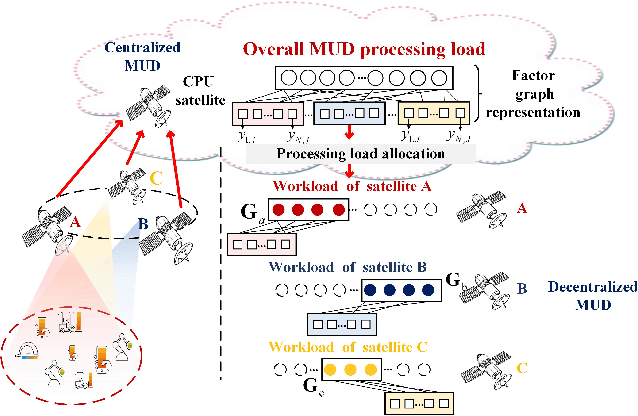
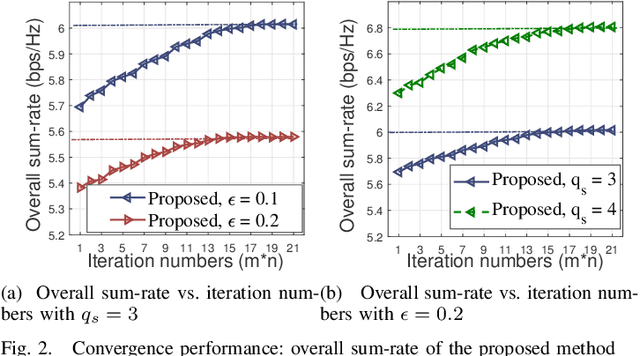
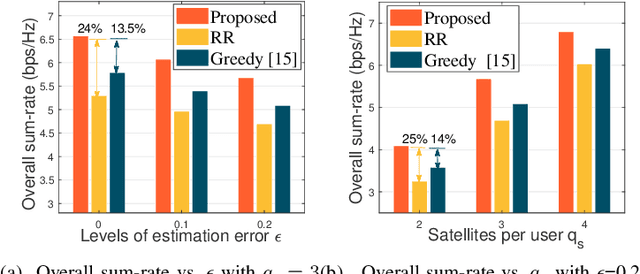
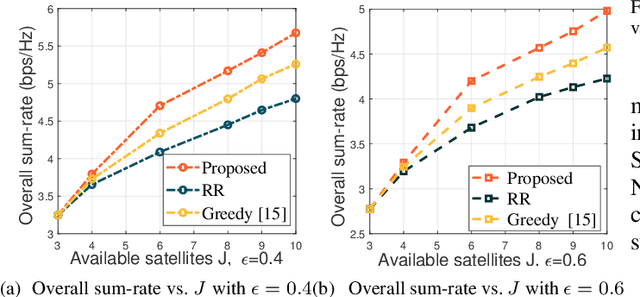
The rapid advance of mega-constellation facilitates the booming of direct-to-satellite massive access, where multi-user detection is critical to alleviate the induced inter-user interference. While centralized implementation of on-board detection induces unaffordable complexity for a single satellite, this paper proposes to allocate the processing load among cooperative satellites for finest exploitation of distributed processing power. Observing the inherent disparities among users, we first excavate the closed-form trade-offs between achievable sum-rate and the processing load corresponding to the satellite-user matchings, which leads to a system sum-rate maximization problem under stringent payload constraints. To address the non-trivial integer matching, we develop a quadratic transformation to the original problem, and prove it an equivalent conversion. The problem is further simplified into a series of subproblems employing successive lower bound approximation which obtains polynomial-time complexity and converges within a few iterations. Numerical results show remarkably complexity reduction compared with centralized processing, as well as around 20\% sum-rate gain compared with other allocation methods.
Few-Shot Recognition and Classification of Jamming Signal via CGAN-Based Fusion CNN Algorithm
Nov 09, 2023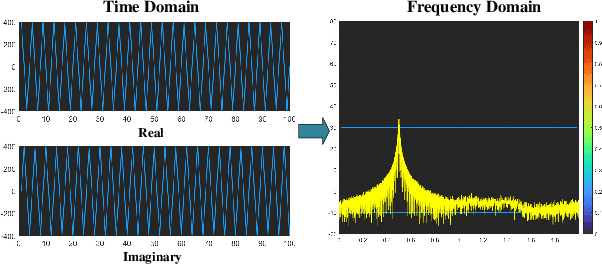
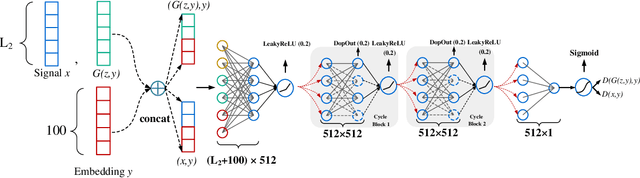
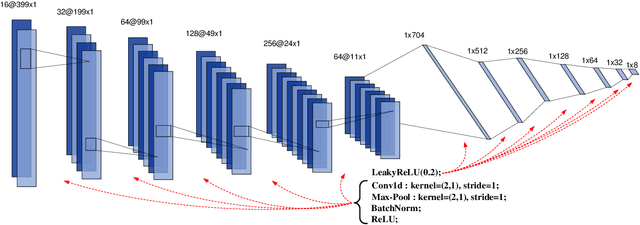
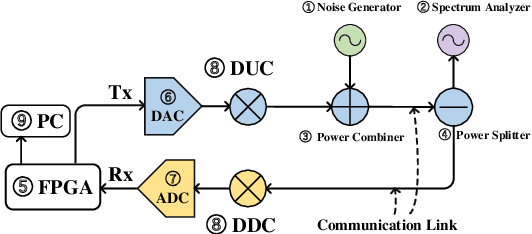
The precise classification of jamming signals holds paramount significance in the effective implementation of anti-jamming strategies within communication systems subject to intricate environmental variables. In light of this imperative, we propose an innovative fusion algorithm based on conditional generative adversarial network (CGAN) and convolutional neural network (CNN) to solve the problem of difficulty in applying deep learning (DL) algorithms due to the instantaneous nature of jamming signals in practical communication systems. Compared with previous methods, our algorithm achieved an 8% improvement in accuracy even when working with a limited dataset. Unlike previous research, we have simulated real-world satellite communication scenarios using a hardware platform and validated our algorithm using the resulting time-domain waveform data. The experimental results indicate that our algorithm still performs extremely well, which demonstrates significant potential for practical application in real-world communication scenarios.