 Add to Chrome
 Add to Firefox
 Add to Edge
Doppler-Resilient Rydberg Atomic Receiver for High-Dynamic Communication Networks via Adaptive Local Oscillator Tracking
Jul 09, 2026
Rydberg atomic receiver has emerged as promising candidate for next-generation wireless communication, due to the exceptional sensitivity and ability to overcome the physical limitations of traditional radio frequency antennas. Utilizing the resonant response of atomic energy levels for signal detection, Rydberg atomic receiver is inherently confined to a narrow instantaneous bandwidth. However, in high-mobility scenarios such as satellite communications, the severe Doppler effect induces carrier frequency offsets, which drive the signal beyond the instantaneous bandwidth and result in severe distortion. In this paper, we propose an adaptive local oscillator (LO) tracking Rydberg atomic receiver architecture designed to lock high-dynamic signals within the effective atomic response bandwidth. By employing a cross-product automatic frequency control (CPAFC) algorithm, the system dynamically estimates the instantaneous frequency offset, generates a corresponding error control signal, and adjusts the LO frequency through a feedback loop. Consequently, the intermediate frequency signal can always be locked close to the center of the atomic response bandwidth regardless of dynamics. Simulation results show that the proposed architecture significantly outperforms existing Rydberg atomic receiver, effectively alleviating performance degradation in high-dynamic environments.

Processing Load Allocation of On-Board Multi-User Detection for Payload-Constrained Satellite Networks
Mar 06, 2024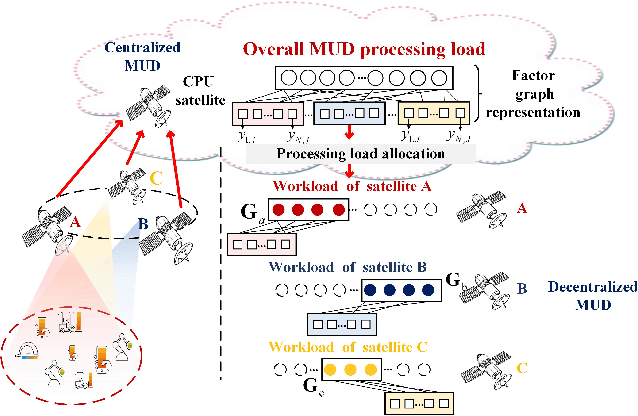
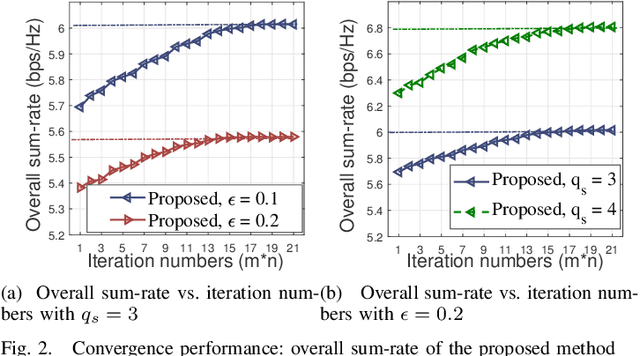
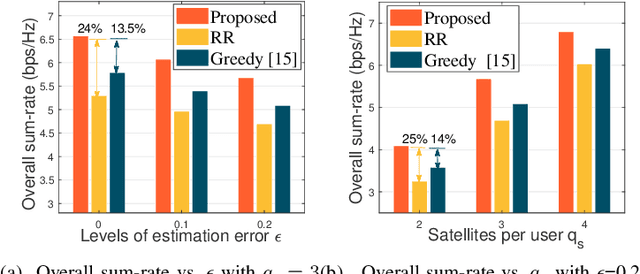
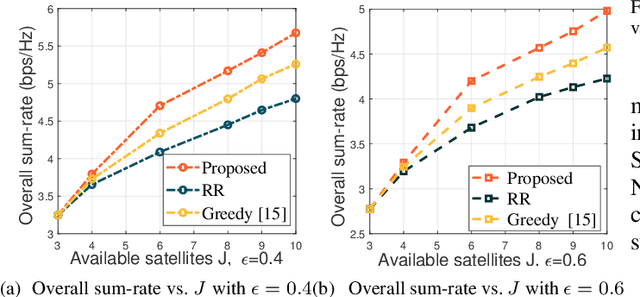
The rapid advance of mega-constellation facilitates the booming of direct-to-satellite massive access, where multi-user detection is critical to alleviate the induced inter-user interference. While centralized implementation of on-board detection induces unaffordable complexity for a single satellite, this paper proposes to allocate the processing load among cooperative satellites for finest exploitation of distributed processing power. Observing the inherent disparities among users, we first excavate the closed-form trade-offs between achievable sum-rate and the processing load corresponding to the satellite-user matchings, which leads to a system sum-rate maximization problem under stringent payload constraints. To address the non-trivial integer matching, we develop a quadratic transformation to the original problem, and prove it an equivalent conversion. The problem is further simplified into a series of subproblems employing successive lower bound approximation which obtains polynomial-time complexity and converges within a few iterations. Numerical results show remarkably complexity reduction compared with centralized processing, as well as around 20\% sum-rate gain compared with other allocation methods.