 Add to Chrome
 Add to Firefox
 Add to Edge
The Illusion of Cross-Lingual Safety in Low-Resource Languages
Aug 11, 2026
Safety alignment in large language models (LLMs) is largely developed in English, assuming these safeguards generalize across multilingual settings. However, this assumption remains underexplored and exposes a vulnerability in low-resource languages. We investigate cross-lingual safety transfer in four African languages, Twi, Hausa, Amharic, and Swahili, using LoDNA, a new safety dataset that pairs literal translations with culturally localized prompts. To move beyond generation-based evaluation, we propose a latent geometric framework that probes hidden-state refusal representations in LLMs. Our experimental results show that cross-lingual safety transfer is severely limited; harmful prompts retain less than 10% of the English refusal signal across most language-model pairs. Literal and localized prompts are semantically aligned (cosine 0.95-0.996) but drift across layers, suggesting models encode the concepts without routing them to safety mechanisms. These findings demonstrate that current multilingual safety alignment is superficial, providing strong evidence against the assumption of a universal, language-agnostic harm manifold within the specific low-resource languages studied. Warning: This paper contains example data that may be offensive or harmful.

SemEval-2026 Task 9: Detecting Multilingual, Multicultural and Multievent Online Polarization
Apr 08, 2026We present SemEval-2026 Task 9, a shared task on online polarization detection, covering 22 languages and comprising over 110K annotated instances. Each data instance is multi-labeled with the presence of polarization, polarization type, and polarization manifestation. Participants were asked to predict labels in three sub-tasks: (1) detecting the presence of polarization, (2) identifying the type of polarization, and (3) recognizing the polarization manifestation. The three tasks attracted over 1,000 participants worldwide and more than 10k submission on Codabench. We received final submissions from 67 teams and 73 system description papers. We report the baseline results and analyze the performance of the best-performing systems, highlighting the most common approaches and the most effective methods across different subtasks and languages. The dataset of this task is publicly available.
Agents of Chaos
Feb 23, 2026We report an exploratory red-teaming study of autonomous language-model-powered agents deployed in a live laboratory environment with persistent memory, email accounts, Discord access, file systems, and shell execution. Over a two-week period, twenty AI researchers interacted with the agents under benign and adversarial conditions. Focusing on failures emerging from the integration of language models with autonomy, tool use, and multi-party communication, we document eleven representative case studies. Observed behaviors include unauthorized compliance with non-owners, disclosure of sensitive information, execution of destructive system-level actions, denial-of-service conditions, uncontrolled resource consumption, identity spoofing vulnerabilities, cross-agent propagation of unsafe practices, and partial system takeover. In several cases, agents reported task completion while the underlying system state contradicted those reports. We also report on some of the failed attempts. Our findings establish the existence of security-, privacy-, and governance-relevant vulnerabilities in realistic deployment settings. These behaviors raise unresolved questions regarding accountability, delegated authority, and responsibility for downstream harms, and warrant urgent attention from legal scholars, policymakers, and researchers across disciplines. This report serves as an initial empirical contribution to that broader conversation.
Team A at SemEval-2025 Task 11: Breaking Language Barriers in Emotion Detection with Multilingual Models
Feb 27, 2025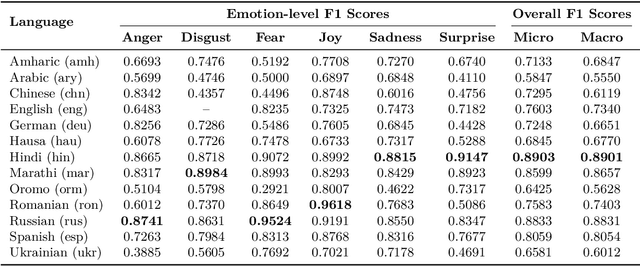
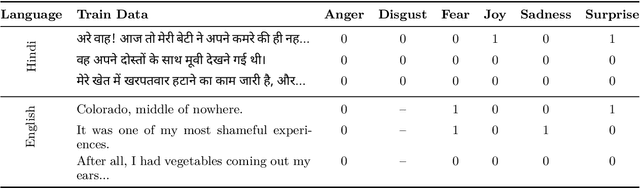
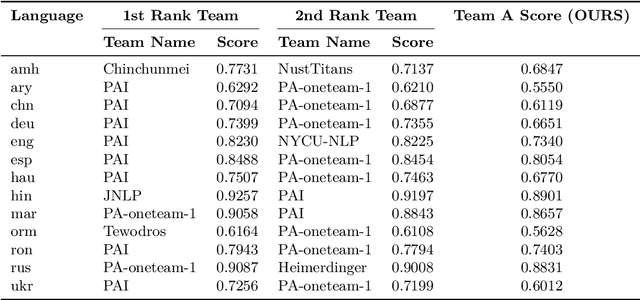
This paper describes the system submitted by Team A to SemEval 2025 Task 11, ``Bridging the Gap in Text-Based Emotion Detection.'' The task involved identifying the perceived emotion of a speaker from text snippets, with each instance annotated with one of six emotions: joy, sadness, fear, anger, surprise, or disgust. A dataset provided by the task organizers served as the foundation for training and evaluating our models. Among the various approaches explored, the best performance was achieved using multilingual embeddings combined with a fully connected layer. This paper details the system architecture, discusses experimental results, and highlights the advantages of leveraging multilingual representations for robust emotion detection in text.