 Add to Chrome
 Add to Firefox
 Add to Edge
Foundation Models for Epileptogenic Zone Identification in Drug-Resistant Epilepsy
Jun 21, 2026
Accurate identification of the epileptogenic zone (EZ) is essential for seizure freedom after resective surgery in drug-resistant epilepsy, yet seizure freedom rates remain below 50%. We developed EpiiSLM, a dual foundation model system for EZ identification with stereo-electroencephalography (sEEG), by training a signal foundation model on 104,990 minutes of sEEG recordings from the Montreal Neurological Institute & Hospital, while leveraging all recordings regardless of surgical outcome and anchoring EZ biomarker extraction on non-epileptic signals. A language foundation model then integrates sEEG-derived outputs with multimodal clinical information to produce interpretable predictions. Under leave-one-patient-out evaluation, EpiiSLM achieved 0.978 contact-level positive predictive value (PPV), outperforming the seizure onset zone(SOZ)-as-EZ baseline by 15.1% (p < 0.05), and 100% region-level accuracy; on an external dataset, EpiiSLM achieved 0.857 contact-level PPV. EpiiSLM requires only one night of interictal sleep data, suggesting potential to reduce invasive sEEG monitoring duration and improve surgical outcomes.

Video-Based Prediction of In-Flight Particle Characteristics in Atmospheric Plasma Spraying
Jun 05, 2026Atmospheric plasma spraying (APS) is a widely used coating process in which in-flight particle temperature and velocity strongly influence coating quality. However, these particle characteristics are difficult to monitor continuously during operation, motivating the development of non-invasive data-driven diagnostic methods. In this work, we investigate the predictive potential of high-speed video observations of the plasma plume for estimating in-flight particle characteristics in APS. We introduce three different video-derived feature representations and evaluate them using Tabular Prior-Data Fitted Networks (TabPFN), convolutional neural networks (CNN), and classical regression baselines including Random Forest, Gradient Boosting, Support Vector Regression, and XGBoost. Experiments are conducted using grouped leave-one-out cross-validation on 126 labeled pre- and post-spray video recordings from 63 APS spray runs. Across the engineered feature experiments, TabPFN achieves the most consistent performance for temperature prediction, reaching R2 = 0.86 using the combined feature representation. CNN models particularly perform stronger for velocity prediction, achieving R2 of 0.81. In addition, we evaluate models operating directly on raw video frames using pretrained CNNs and find that the highest performance is achieved by a pretrained CNN with a regression head with R2 of 0.90 and 0.82 for temperature and velocity, respectively. The results demonstrate that video-derived plume information provides a promising and scalable foundation for non-invasive APS diagnostics and real-time process monitoring.
Unsupervised Continual Clustering via Forward-Backward Knowledge Distillation
Jun 05, 2026Unsupervised Continual Learning (UCL) aims to enable neural networks to learn sequential tasks without labels or access to past data. A major challenge in this setting is Catastrophic Forgetting, where models forget previously learned tasks upon learning new ones. This challenge is amplified in UCL due to the absence of labels to guide learning and memory retention. Existing mitigation strategies, such as knowledge distillation and replay buffers, often raise memory and privacy concerns. Moreover, current UCL methods largely overlook clustering-specific objectives. To fill this gap, we introduce Unsupervised Continual Clustering (UCC) and propose Forward-Backward Knowledge Distillation for Continual Clustering (FBCC). FBCC employs a continual teacher network with a clustering projector and lightweight task-specific students. Through a dual-phase forward-backward distillation process, the teacher learns new clusters while preserving previously discovered cluster structure without storing past data. FBCC represents a pioneering approach to UCC, demonstrating improved clustering performance across sequential tasks. Experiments on four benchmark datasets demonstrate that FBCC consistently outperforms existing continual learning baselines in clustering accuracy while significantly reducing catastrophic forgetting.
Adversarial-Robust Multivariate Time-Series Anomaly Detection via Joint Information Retention
Mar 26, 2026Time-series anomaly detection (TSAD) is a critical component in monitoring complex systems, yet modern deep learning-based detectors are often highly sensitive to localized input corruptions and structured noise. We propose ARTA (Adversarially Robust multivariate Time-series Anomaly detection via joint information retention), a joint training framework that improves detector robustness through a principled min-max optimization objective. ARTA comprises an anomaly detector and a sparsity-constrained mask generator that are trained simultaneously. The generator identifies minimal, task-relevant temporal perturbations that maximally increase the detector's anomaly score, while the detector is optimized to remain stable under these structured perturbations. The resulting masks characterize the detector's sensitivity to adversarial temporal corruptions and can serve as explanatory signals for the detector's decisions. This adversarial training strategy exposes brittle decision pathways and encourages the detector to rely on distributed and stable temporal patterns rather than spurious localized artifacts. We conduct extensive experiments on the TSB-AD benchmark, demonstrating that ARTA consistently improves anomaly detection performance across diverse datasets and exhibits significantly more graceful degradation under increasing noise levels compared to state-of-the-art baselines.
Collision-Aware Vision-Language Learning for End-to-End Driving with Multimodal Infraction Datasets
Mar 26, 2026High infraction rates remain the primary bottleneck for end-to-end (E2E) autonomous driving, as evidenced by the low driving scores on the CARLA Leaderboard. Despite collision-related infractions being the dominant failure mode in closed-loop evaluations, collision-aware representation learning has received limited attention. To address this gap, we first develop a Video-Language-Augmented Anomaly Detector (VLAAD), leveraging a Multiple Instance Learning (MIL) formulation to obtain stable, temporally localized collision signals for proactive prediction. To transition these capabilities into closed-loop simulations, we must overcome the limitations of existing simulator datasets, which lack multimodality and are frequently restricted to simple intersection scenarios. Therefore, we introduce CARLA-Collide, a large-scale multimodal dataset capturing realistic collision events across highly diverse road networks. Trained on this diverse simulator data, VLAAD serves as a collision-aware plug-in module that can be seamlessly integrated into existing E2E driving models. By integrating our module into a pretrained TransFuser++ agent, we demonstrate a 14.12% relative increase in driving score with minimal fine-tuning. Beyond closed-loop evaluation, we further assess the generalization capability of VLAAD in an open-loop setting using real-world driving data. To support this analysis, we introduce Real-Collide, a multimodal dataset of diverse dashcam videos paired with semantically rich annotations for collision detection and prediction. On this benchmark, despite containing only 0.6B parameters, VLAAD outperforms a multi-billion-parameter vision-language model, achieving a 23.3% improvement in AUC.
EngineAD: A Real-World Vehicle Engine Anomaly Detection Dataset
Mar 26, 2026The progress of Anomaly Detection (AD) in safety-critical domains, such as transportation, is severely constrained by the lack of large-scale, real-world benchmarks. To address this, we introduce EngineAD, a novel, multivariate dataset comprising high-resolution sensor telemetry collected from a fleet of 25 commercial vehicles over a six-month period. Unlike synthetic datasets, EngineAD features authentic operational data labeled with expert annotations, distinguishing normal states from subtle indicators of incipient engine faults. We preprocess the data into $300$-timestep segments of $8$ principal components and establish an initial benchmark using nine diverse one-class anomaly detection models. Our experiments reveal significant performance variability across the vehicle fleet, underscoring the challenge of cross-vehicle generalization. Furthermore, our findings corroborate recent literature, showing that simple classical methods (e.g., K-Means and One-Class SVM) are often highly competitive with, or superior to, deep learning approaches in this segment-based evaluation. By publicly releasing EngineAD, we aim to provide a realistic, challenging resource for developing robust and field-deployable anomaly detection and anomaly prediction solutions for the automotive industry.
Multitask-Informed Prior for In-Context Learning on Tabular Data: Application to Steel Property Prediction
Mar 24, 2026Accurate prediction of mechanical properties of steel during hot rolling processes, such as Thin Slab Direct Rolling (TSDR), remains challenging due to complex interactions among chemical compositions, processing parameters, and resultant microstructures. Traditional empirical and experimental methodologies, while effective, are often resource-intensive and lack adaptability to varied production conditions. Moreover, most existing approaches do not explicitly leverage the strong correlations among key mechanical properties, missing an opportunity to improve predictive accuracy through multitask learning. To address this, we present a multitask learning framework that injects multitask awareness into the prior of TabPFN--a transformer-based foundation model for in-context learning on tabular data--through novel fine-tuning strategies. Originally designed for single-target regression or classification, we augment TabPFN's prior with two complementary approaches: (i) target averaging, which provides a unified scalar signal compatible with TabPFN's single-target architecture, and (ii) task-specific adapters, which introduce task-specific supervision during fine-tuning. These strategies jointly guide the model toward a multitask-informed prior that captures cross-property relationships among key mechanical metrics. Extensive experiments on an industrial TSDR dataset demonstrate that our multitask adaptations outperform classical machine learning methods and recent state-of-the-art tabular learning models across multiple evaluation metrics. Notably, our approach enhances both predictive accuracy and computational efficiency compared to task-specific fine-tuning, demonstrating that multitask-aware prior adaptation enables foundation models for tabular data to deliver scalable, rapid, and reliable deployment for automated industrial quality control and process optimization in TSDR.
ICLAD: In-Context Learning for Unified Tabular Anomaly Detection Across Supervision Regimes
Mar 19, 2026Anomaly detection on tabular data is commonly studied under three supervision regimes, including one-class settings that assume access to anomaly-free training samples, fully unsupervised settings with unlabeled and potentially contaminated training data, and semi-supervised settings with limited anomaly labels. Existing deep learning approaches typically train dataset-specific models under the assumption of a single supervision regime, which limits their ability to leverage shared structures across anomaly detection tasks and to adapt to different supervision levels. We propose ICLAD, an in-context learning foundation model for tabular anomaly detection that generalizes across both datasets and supervision regimes. ICLAD is trained via meta-learning on synthetic tabular anomaly detection tasks, and at inference time, the model assigns anomaly scores by conditioning on the training set without updating model weights. Comprehensive experiments on 57 tabular datasets from ADBench show that our method achieves state-of-the-art performance across three supervision regimes, establishing a unified framework for tabular anomaly detection.
MultiTab: A Scalable Foundation for Multitask Learning on Tabular Data
Nov 13, 2025Tabular data is the most abundant data type in the world, powering systems in finance, healthcare, e-commerce, and beyond. As tabular datasets grow and span multiple related targets, there is an increasing need to exploit shared task information for improved multitask generalization. Multitask learning (MTL) has emerged as a powerful way to improve generalization and efficiency, yet most existing work focuses narrowly on large-scale recommendation systems, leaving its potential in broader tabular domains largely underexplored. Also, existing MTL approaches for tabular data predominantly rely on multi-layer perceptron-based backbones, which struggle to capture complex feature interactions and often fail to scale when data is abundant, a limitation that transformer architectures have overcome in other domains. Motivated by this, we introduce MultiTab-Net, the first multitask transformer architecture specifically designed for large tabular data. MultiTab-Net employs a novel multitask masked-attention mechanism that dynamically models feature-feature dependencies while mitigating task competition. Through extensive experiments, we show that MultiTab-Net consistently achieves higher multitask gain than existing MTL architectures and single-task transformers across diverse domains including large-scale recommendation data, census-like socioeconomic data, and physics datasets, spanning a wide range of task counts, task types, and feature modalities. In addition, we contribute MultiTab-Bench, a generalized multitask synthetic dataset generator that enables systematic evaluation of multitask dynamics by tuning task count, task correlations, and relative task complexity. Our code is publicly available at https://github.com/Armanfard-Lab/MultiTab.
Zero-Shot Anomaly Detection with Dual-Branch Prompt Learning
Aug 01, 2025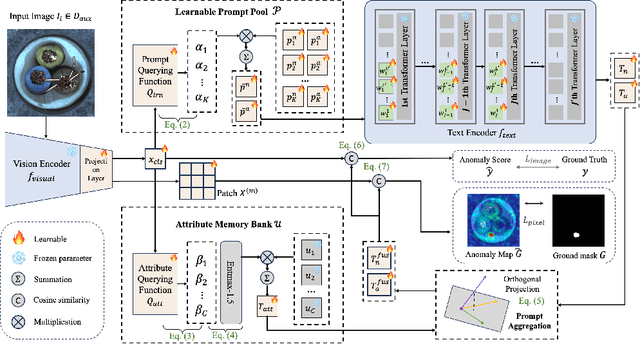
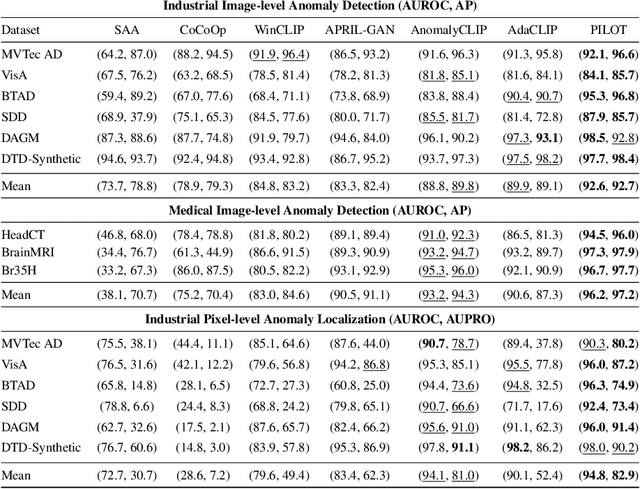
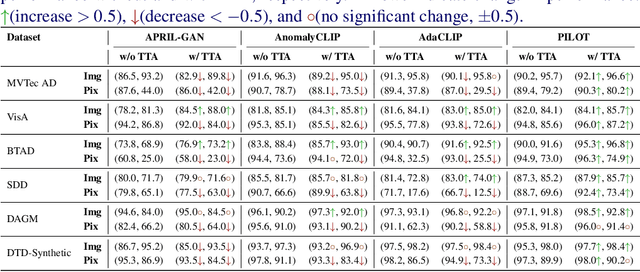
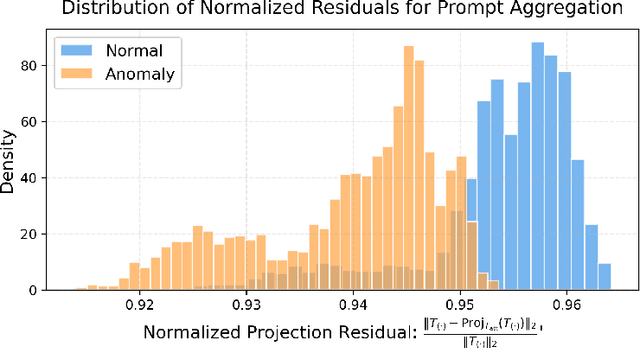
Zero-shot anomaly detection (ZSAD) enables identifying and localizing defects in unseen categories by relying solely on generalizable features rather than requiring any labeled examples of anomalies. However, existing ZSAD methods, whether using fixed or learned prompts, struggle under domain shifts because their training data are derived from limited training domains and fail to generalize to new distributions. In this paper, we introduce PILOT, a framework designed to overcome these challenges through two key innovations: (1) a novel dual-branch prompt learning mechanism that dynamically integrates a pool of learnable prompts with structured semantic attributes, enabling the model to adaptively weight the most relevant anomaly cues for each input image; and (2) a label-free test-time adaptation strategy that updates the learnable prompt parameters using high-confidence pseudo-labels from unlabeled test data. Extensive experiments on 13 industrial and medical benchmarks demonstrate that PILOT achieves state-of-the-art performance in both anomaly detection and localization under domain shift.