 Add to Chrome
 Add to Firefox
 Add to Edge
Multitask-Informed Prior for In-Context Learning on Tabular Data: Application to Steel Property Prediction
Mar 24, 2026
Accurate prediction of mechanical properties of steel during hot rolling processes, such as Thin Slab Direct Rolling (TSDR), remains challenging due to complex interactions among chemical compositions, processing parameters, and resultant microstructures. Traditional empirical and experimental methodologies, while effective, are often resource-intensive and lack adaptability to varied production conditions. Moreover, most existing approaches do not explicitly leverage the strong correlations among key mechanical properties, missing an opportunity to improve predictive accuracy through multitask learning. To address this, we present a multitask learning framework that injects multitask awareness into the prior of TabPFN--a transformer-based foundation model for in-context learning on tabular data--through novel fine-tuning strategies. Originally designed for single-target regression or classification, we augment TabPFN's prior with two complementary approaches: (i) target averaging, which provides a unified scalar signal compatible with TabPFN's single-target architecture, and (ii) task-specific adapters, which introduce task-specific supervision during fine-tuning. These strategies jointly guide the model toward a multitask-informed prior that captures cross-property relationships among key mechanical metrics. Extensive experiments on an industrial TSDR dataset demonstrate that our multitask adaptations outperform classical machine learning methods and recent state-of-the-art tabular learning models across multiple evaluation metrics. Notably, our approach enhances both predictive accuracy and computational efficiency compared to task-specific fine-tuning, demonstrating that multitask-aware prior adaptation enables foundation models for tabular data to deliver scalable, rapid, and reliable deployment for automated industrial quality control and process optimization in TSDR.

Optimizing Ghost Imaging via Analysis and Design of Speckle Patterns
Mar 10, 2022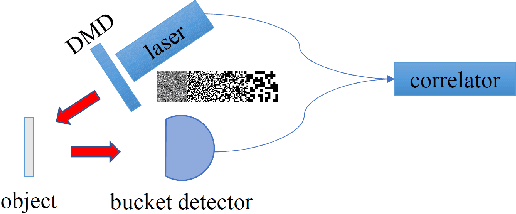

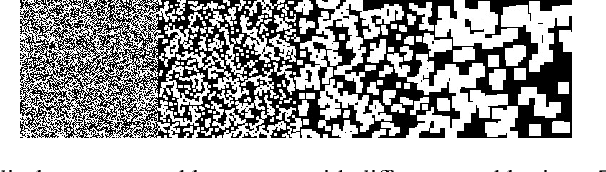
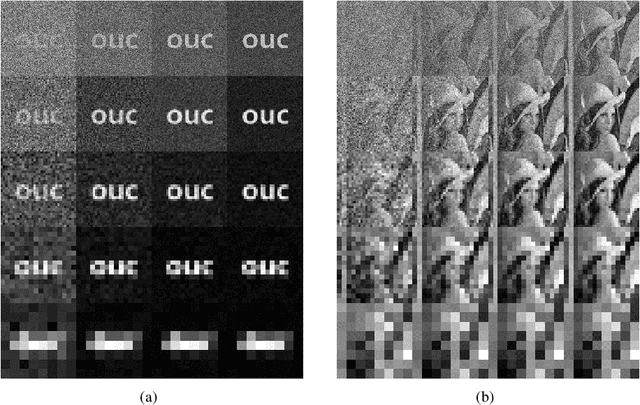
We study the influence rules of the speckle size of light source on ghost imaging, and propose a new type of speckle patterns to improve the quality of ghost imaging. The results show that the image quality will first increase and then decrease with the increase of the speckle size, and there is an optimal speckle size for a specific object. Moreover, by using the random distribution of speckle positions, a new type of displacement speckle patterns is designed, and the imaging quality is better than that of the random speckle patterns. These results are of great significances for finding the best speckle patterns suitable for detecting targets, which further promotes the practical applications of ghost imaging.
Deep Single Image Deraining Via Estimating Transmission and Atmospheric Light in rainy Scenes
Jun 22, 2019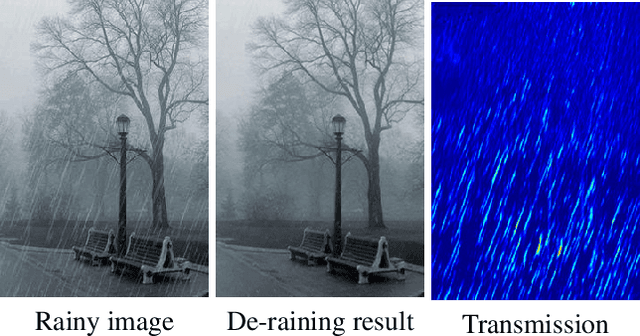
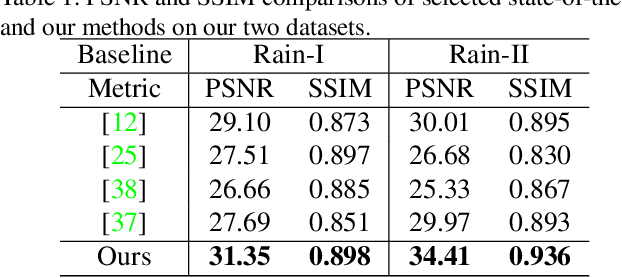
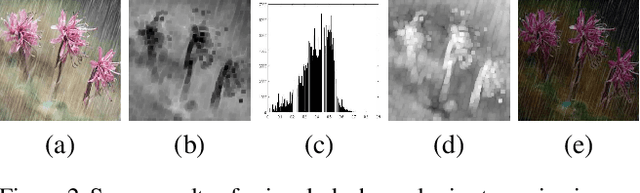
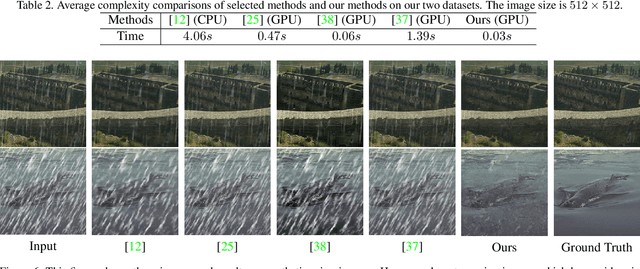
Rain removal in images/videos is still an important task in computer vision field and attracting attentions of more and more people. Traditional methods always utilize some incomplete priors or filters (e.g. guided filter) to remove rain effect. Deep learning gives more probabilities to better solve this task. However, they remove rain either by evaluating background from rainy image directly or learning a rain residual first then subtracting the residual to obtain a clear background. No other models are used in deep learning based de-raining methods to remove rain and obtain other information about rainy scenes. In this paper, we utilize an extensively-used image degradation model which is derived from atmospheric scattering principles to model the formation of rainy images and try to learn the transmission, atmospheric light in rainy scenes and remove rain further. To reach this goal, we propose a robust evaluation method of global atmospheric light in a rainy scene. Instead of using the estimated atmospheric light directly to learn a network to calculate transmission, we utilize it as ground truth and design a simple but novel triangle-shaped network structure to learn atmospheric light for every rainy image, then fine-tune the network to obtain a better estimation of atmospheric light during the training of transmission network. Furthermore, more efficient ShuffleNet Units are utilized in transmission network to learn transmission map and the de-raining image is then obtained by the image degradation model. By subjective and objective comparisons, our method outperforms the selected state-of-the-art works.