 Add to Chrome
 Add to Firefox
 Add to Edge
Suiren-1.0 Technical Report: A Family of Molecular Foundation Models
Mar 23, 2026
We introduce Suiren-1.0, a family of molecular foundation models for the accurate modeling of diverse organic systems. Suiren-1.0 comprising three specialized variants (Suiren-Base, Suiren-Dimer, and Suiren-ConfAvg) is integrated within an algorithmic framework that bridges the gap between 3D conformational geometry and 2D statistical ensemble spaces. We first pre-train Suiren-Base (1.8B parameters) on a 70M-sample Density Functional Theory dataset using spatial self-supervision and SE(3)-equivariant architectures, achieving robust performance in quantum property prediction. Suiren-Dimer extends this capability through continued pre-training on 13.5M intermolecular interaction samples. To enable efficient downstream application, we propose Conformation Compression Distillation (CCD), a diffusion-based framework that distills complex 3D structural representations into 2D conformation-averaged representations. This yields the lightweight Suiren-ConfAvg, which generates high-fidelity representations from SMILES or molecular graphs. Our extensive evaluations demonstrate that Suiren-1.0 establishes state-of-the-art results across a range of tasks. All models and benchmarks are open-sourced.

Queue-Aware STAR-RIS Assisted NOMA Communication Systems
Feb 24, 2022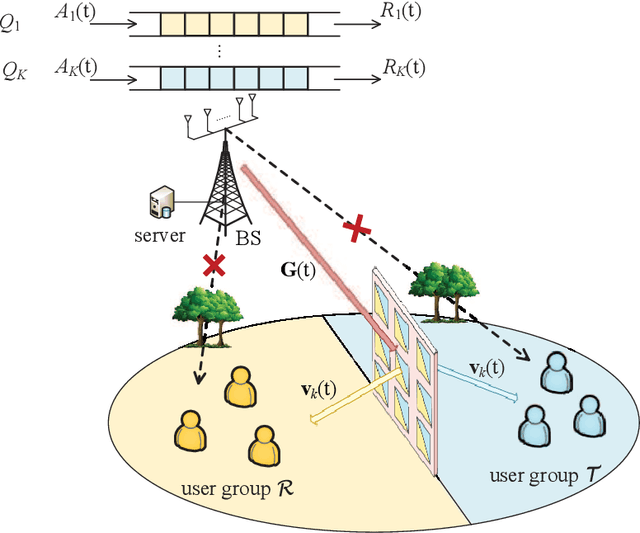
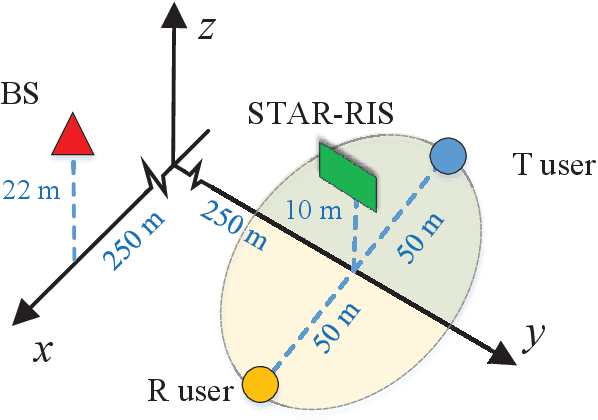
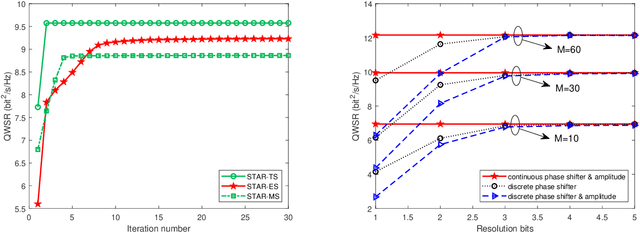
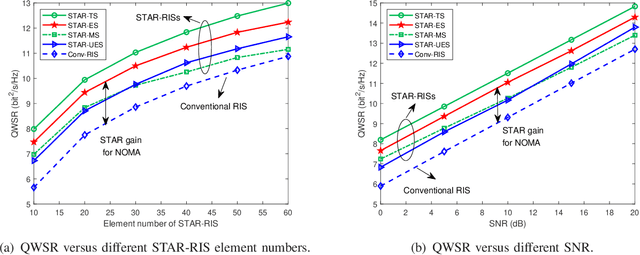
In this paper, the queue-aware simultaneously transmitting and reflecting reconfigurable intelligent surfaces (STAR-RIS) assisted non-orthogonal multiple access (NOMA) communication system is investigated to ensure the system stability, where the long-term stability-oriented problem is reformulated to maximize the per-slot queue-weighted sum rate (QWSR) of users based on the Lyapunov drift theory. By jointly optimizing the NOMA decoding order, the active beamforming coefficients at the BS, and the passive transmission and reflection coefficients at the STAR-RIS, three STAR-RIS operating protocols are considered, namely energy splitting (ES), mode switching (MS), and time switching (TS). For ES, the blocked coordinate descent and the successive convex approximation methods are invoked to handle the highly-coupled and non-convex problem. For MS, the proposed algorithm is further extended to a penalty-based two-loop algorithm to solve the binary amplitude constrained problem. For TS, the formulated problem is decomposed into two subproblems, each of which can be solved in a similar manner to ES. Simulation results show that: i) our proposed STAR-RIS assisted NOMA communication achieves better performance than the conventional schemes; ii) the reformulated QWSR maximization problem confirms the system stability; and iii) TS achieves superior performance with respect to both the QWSR and the average queue length.