 Add to Chrome
 Add to Firefox
 Add to Edge
Suiren-1.0 Technical Report: A Family of Molecular Foundation Models
Mar 23, 2026
We introduce Suiren-1.0, a family of molecular foundation models for the accurate modeling of diverse organic systems. Suiren-1.0 comprising three specialized variants (Suiren-Base, Suiren-Dimer, and Suiren-ConfAvg) is integrated within an algorithmic framework that bridges the gap between 3D conformational geometry and 2D statistical ensemble spaces. We first pre-train Suiren-Base (1.8B parameters) on a 70M-sample Density Functional Theory dataset using spatial self-supervision and SE(3)-equivariant architectures, achieving robust performance in quantum property prediction. Suiren-Dimer extends this capability through continued pre-training on 13.5M intermolecular interaction samples. To enable efficient downstream application, we propose Conformation Compression Distillation (CCD), a diffusion-based framework that distills complex 3D structural representations into 2D conformation-averaged representations. This yields the lightweight Suiren-ConfAvg, which generates high-fidelity representations from SMILES or molecular graphs. Our extensive evaluations demonstrate that Suiren-1.0 establishes state-of-the-art results across a range of tasks. All models and benchmarks are open-sourced.

Equivariant Asynchronous Diffusion: An Adaptive Denoising Schedule for Accelerated Molecular Conformation Generation
Mar 10, 2026Recent 3D molecular generation methods primarily use asynchronous auto-regressive or synchronous diffusion models. While auto-regressive models build molecules sequentially, they're limited by a short horizon and a discrepancy between training and inference. Conversely, synchronous diffusion models denoise all atoms at once, offering a molecule-level horizon but failing to capture the causal relationships inherent in hierarchical molecular structures. We introduce Equivariant Asynchronous Diffusion (EAD) to overcome these limitations. EAD is a novel diffusion model that combines the strengths of both approaches: it uses an asynchronous denoising schedule to better capture molecular hierarchy while maintaining a molecule-level horizon. Since these relationships are often complex, we propose a dynamic scheduling mechanism to adaptively determine the denoising timestep. Experimental results show that EAD achieves state-of-the-art performance in 3D molecular generation.
Equivariant Masked Position Prediction for Efficient Molecular Representation
Feb 12, 2025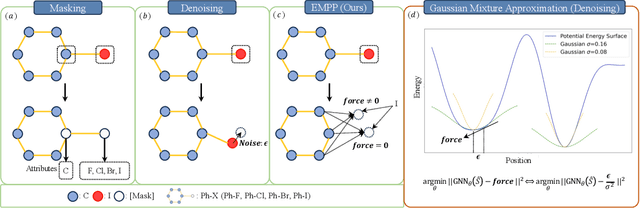
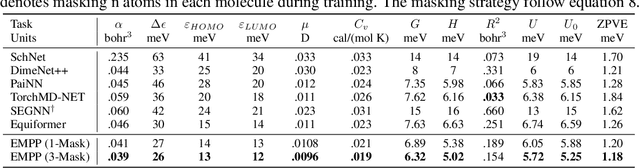

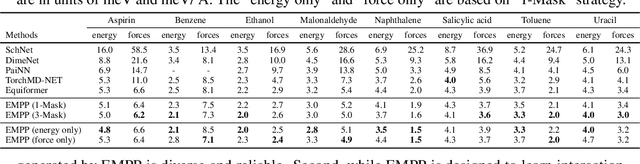
Graph neural networks (GNNs) have shown considerable promise in computational chemistry. However, the limited availability of molecular data raises concerns regarding GNNs' ability to effectively capture the fundamental principles of physics and chemistry, which constrains their generalization capabilities. To address this challenge, we introduce a novel self-supervised approach termed Equivariant Masked Position Prediction (EMPP), grounded in intramolecular potential and force theory. Unlike conventional attribute masking techniques, EMPP formulates a nuanced position prediction task that is more well-defined and enhances the learning of quantum mechanical features. EMPP also bypasses the approximation of the Gaussian mixture distribution commonly used in denoising methods, allowing for more accurate acquisition of physical properties. Experimental results indicate that EMPP significantly enhances performance of advanced molecular architectures, surpassing state-of-the-art self-supervised approaches. Our code is released in https://github.com/ajy112/EMPP.
* 24 pages, 6 figures