 Add to Chrome
 Add to Firefox
 Add to Edge
Visual Credit Audit for Multimodal Spatial Reasoning
Jul 29, 2026
Closed yes/no spatial benchmarks can reward a correct answer even when the image adds little support beyond no-image contexts. Under a fixed forced-choice interface, Visual Credit Audit (VCA) separates two estimands: whether the benchmark image gives the model's declared decision more support than text-only and blank controls, and whether the model responds to relation-specific visual evidence. The first audit is training- and label-free and does not require an answer flip. Applying labels yields dependence-credited correctness (D-CC); on correct items, it equals same-control gold-aligned positive gain, while prediction alignment extends the audit to errors. Across four open MLLMs and two spatial benchmarks, 12.73-26.25% of decisions are correct yet uncredited. Matched same-split image permutation reduces D-CC by 21.25-47.80 points, with every paired 95% interval above zero. Fixed-pixel relation contrasts and a 3x3 evidence-source factorial show why null controls cannot identify relation response. Among controlled correct-but-uncredited agreement decisions, response to relation reversal spans 81.57-100.00%, while 32.11% pooled change answer. Independently audited outcomes on 108 geometry-compatible edits provide a bounded natural-image correspondence check. VCA thereby decomposes benchmark success into correctness, additional image support, and relation-consistent response.

Gemini 1.5: Unlocking multimodal understanding across millions of tokens of context
Mar 08, 2024In this report, we present the latest model of the Gemini family, Gemini 1.5 Pro, a highly compute-efficient multimodal mixture-of-experts model capable of recalling and reasoning over fine-grained information from millions of tokens of context, including multiple long documents and hours of video and audio. Gemini 1.5 Pro achieves near-perfect recall on long-context retrieval tasks across modalities, improves the state-of-the-art in long-document QA, long-video QA and long-context ASR, and matches or surpasses Gemini 1.0 Ultra's state-of-the-art performance across a broad set of benchmarks. Studying the limits of Gemini 1.5 Pro's long-context ability, we find continued improvement in next-token prediction and near-perfect retrieval (>99%) up to at least 10M tokens, a generational leap over existing models such as Claude 2.1 (200k) and GPT-4 Turbo (128k). Finally, we highlight surprising new capabilities of large language models at the frontier; when given a grammar manual for Kalamang, a language with fewer than 200 speakers worldwide, the model learns to translate English to Kalamang at a similar level to a person who learned from the same content.
Gemini: A Family of Highly Capable Multimodal Models
Dec 19, 2023This report introduces a new family of multimodal models, Gemini, that exhibit remarkable capabilities across image, audio, video, and text understanding. The Gemini family consists of Ultra, Pro, and Nano sizes, suitable for applications ranging from complex reasoning tasks to on-device memory-constrained use-cases. Evaluation on a broad range of benchmarks shows that our most-capable Gemini Ultra model advances the state of the art in 30 of 32 of these benchmarks - notably being the first model to achieve human-expert performance on the well-studied exam benchmark MMLU, and improving the state of the art in every one of the 20 multimodal benchmarks we examined. We believe that the new capabilities of Gemini models in cross-modal reasoning and language understanding will enable a wide variety of use cases and we discuss our approach toward deploying them responsibly to users.
Water Preservation in Soan River Basin using Deep Learning Techniques
Jun 26, 2019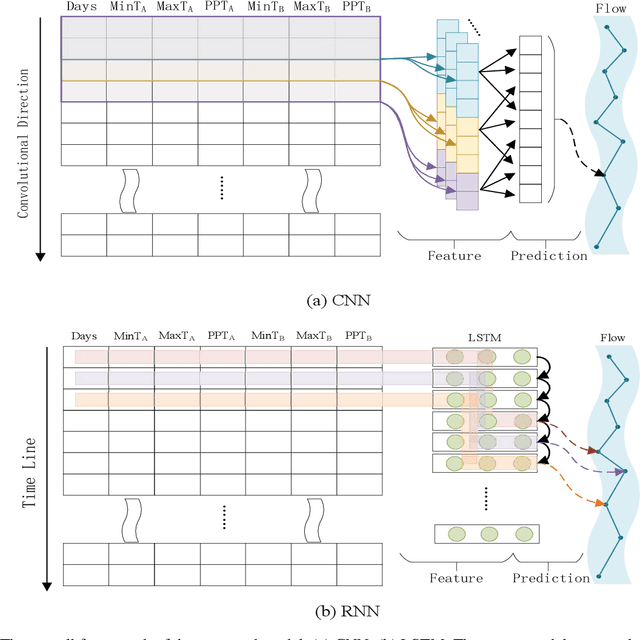

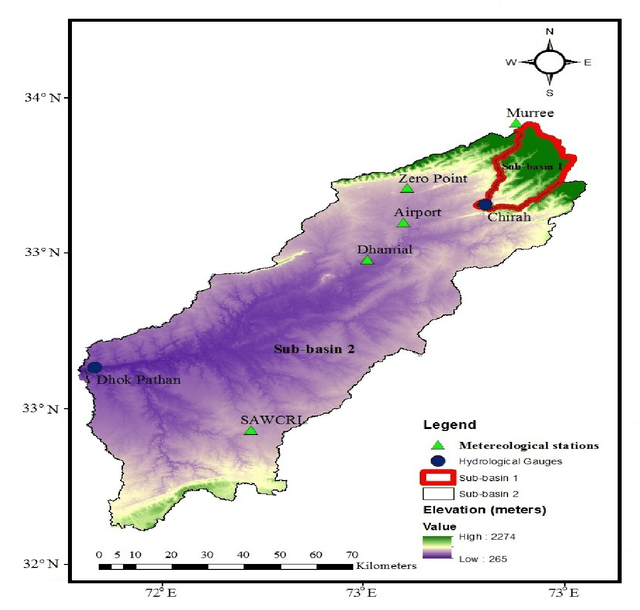
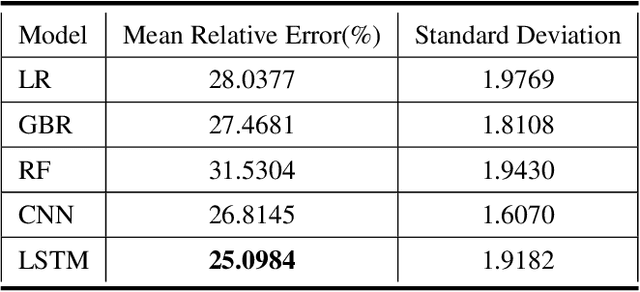
Water supplies are crucial for the development of living beings. However, change in the hydrological process i.e. climate and land usage are the key issues. Sustaining water level and accurate estimating for dynamic conditions is a critical job for hydrologists, but predicting hydrological extremes is an open issue. In this paper, we proposed two deep learning techniques and three machine learning algorithms to predict stream flow, given the present climate conditions. The results showed that the Recurrent Neural Network (RNN) or Long Short-term Memory (LSTM), an artificial neural network based method, outperform other conventional and machine-learning algorithms for predicting stream flow. Furthermore, we analyzed that stream flow is directly affected by precipitation, land usage, and temperature. These indexes are critical, which can be used by hydrologists to identify the potential for stream flow. We make the dataset publicly available (https://github.com/sadaqat007/Dataset) so that others should be able to replicate and build upon the results published.