 Add to Chrome
 Add to Firefox
 Add to Edge
Improving Few-Shot Change Detection Visual Question Answering via Decision-Ambiguity-guided Reinforcement Fine-Tuning
Dec 31, 2025
Change detection visual question answering (CDVQA) requires answering text queries by reasoning about semantic changes in bi-temporal remote sensing images. A straightforward approach is to boost CDVQA performance with generic vision-language models via supervised fine-tuning (SFT). Despite recent progress, we observe that a significant portion of failures do not stem from clearly incorrect predictions, but from decision ambiguity, where the model assigns similar confidence to the correct answer and strong distractors. To formalize this challenge, we define Decision-Ambiguous Samples (DAS) as instances with a small probability margin between the ground-truth answer and the most competitive alternative. We argue that explicitly optimizing DAS is crucial for improving the discriminability and robustness of CDVQA models. To this end, we propose DARFT, a Decision-Ambiguity-guided Reinforcement Fine-Tuning framework that first mines DAS using an SFT-trained reference policy and then applies group-relative policy optimization on the mined subset. By leveraging multi-sample decoding and intra-group relative advantages, DARFT suppresses strong distractors and sharpens decision boundaries without additional supervision. Extensive experiments demonstrate consistent gains over SFT baselines, particularly under few-shot settings.

Enhancing Clean Label Backdoor Attack with Two-phase Specific Triggers
Jun 10, 2022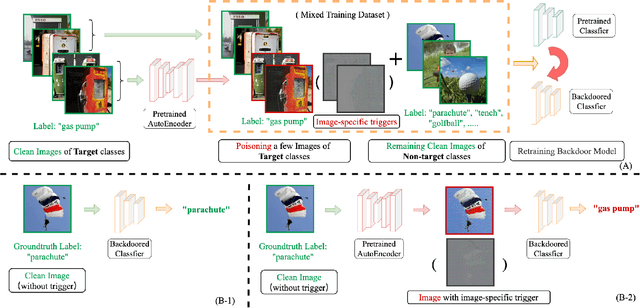
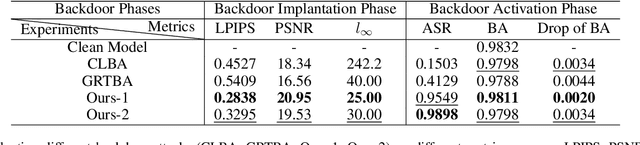
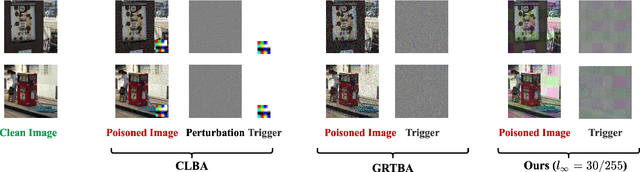
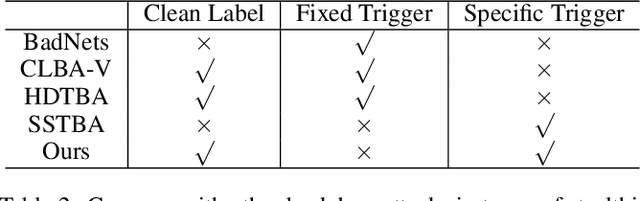
Backdoor attacks threaten Deep Neural Networks (DNNs). Towards stealthiness, researchers propose clean-label backdoor attacks, which require the adversaries not to alter the labels of the poisoned training datasets. Clean-label settings make the attack more stealthy due to the correct image-label pairs, but some problems still exist: first, traditional methods for poisoning training data are ineffective; second, traditional triggers are not stealthy which are still perceptible. To solve these problems, we propose a two-phase and image-specific triggers generation method to enhance clean-label backdoor attacks. Our methods are (1) powerful: our triggers can both promote the two phases (i.e., the backdoor implantation and activation phase) in backdoor attacks simultaneously; (2) stealthy: our triggers are generated from each image. They are image-specific instead of fixed triggers. Extensive experiments demonstrate that our approach can achieve a fantastic attack success rate~(98.98%) with low poisoning rate~(5%), high stealthiness under many evaluation metrics and is resistant to backdoor defense methods.
Enhanced CNN for image denoising
Nov 05, 2018
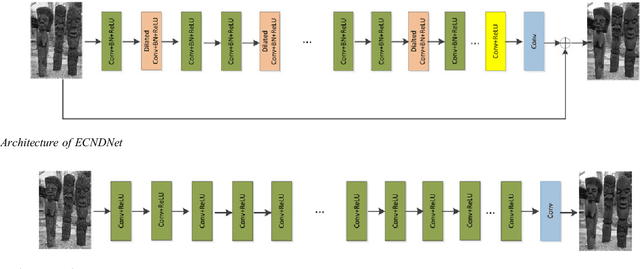
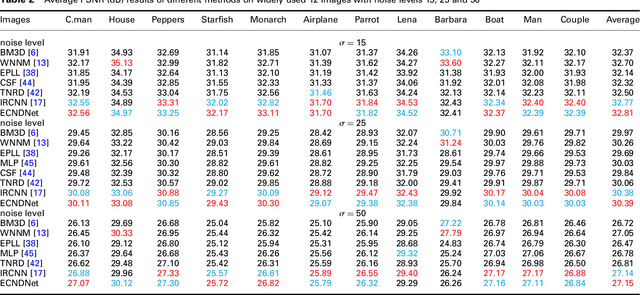
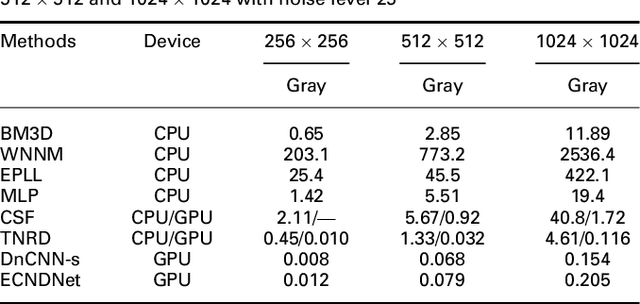
Due to the flexible architectures of deep convolutional neural networks (CNNs), which are successfully used for image denoising. However, they suffer from the following drawbacks: (1) deep network architecture is very difficult to be train. (2) Very deep networks face the challenge of performance saturation. In this paper, we propose a novel method called enhanced convolutional neural denoising network (ECNDNet). Specifically, we use residual learning and batch normalization (BN) techniques to address the problem of training difficulties and accelerate the convergence of the network. In addition, dilated convolutions are used in our network to enlarge the context information and reduce the computational cost. Extensive experiments demonstrate that our ECNDNet outperforms the state-of-the-art methods such as IRCNN for image denoising.